It's not very nice. I am starting to see a trend out there. Trad Catholics, at least many of them, had this Pope's number from the moment he was announced after the white smoke went up. For the most part your more mainstream conservative, small 'o' orthodox Catholics snorted and rolled their eyes at the dire warnings coming from the traddies.
Not anymore.
More and more of them are coming round to the "there is something seriously wrong with this one" line of thinking. And if most of them have not yet reached the point where they are willing to use the "H" word in connection with the Supreme Pontiff, increasingly they are openly calling into question his temperament, judgement and prudence.
Anyways that's a start.
Thursday, January 12, 2017


Wednesday, January 11, 2017
Question
Does anyone know what the story is with the Midwest Conservative Journal? It went silent back in mid December and I noticed yesterday that the site is now down. It was one of my favorite blogs.
Britain: On the death of the Labour Party
LONDON — The British Labour Party is in meltdown. After reviving the center-left in the 1990s, and then dominating British politics until 2010, Labour now faces the gravest challenge in its 116-year history. One of the oldest social-democratic parties in the world is fighting to survive; there is no guarantee it will.
Labour’s crisis is a microcosm of the test that confronts social democracy at large. In polling, Labour has fallen to its lowest level in generations. Shortly before Christmas, the party’s support dropped to 24 percent, which if repeated in a national election would mark its lowest share of the vote since 1918. Forecasts suggest that the number of Labour seats in Parliament could slip from the 232 the party won in 2015 to 190 in 2020, its poorest showing since 1935.
The bad news does not end there. In a recent election to fill a vacant parliamentary seat, Labour suffered the humiliation of failing to reach even 5 percent of the vote. In Scotland, where Labour lost all but one of its seats in 2015, leaked internal polling not only put the party a distant third behind the Scottish nationalists and the Conservatives, but also offered this ominous warning: “There is no such thing as a core Labour vote anymore.”
This week, a report from the center-left Fabian Society suggested that the Labour vote could fall in the 2020 general election to as low as 20 percent because in previous elections it has underperformed its midterm polling by an average of 8 points. This would leave the main opposition party with only 140 to 150 seats in Parliament. The report spoke “of insignificance, even of looming death.”
Many blame Labour’s radical left-wing leader, Jeremy Corbyn, for this decline. Since being elected in 2015, and then re-elected last summer after nearly 200 of the party’s members of Parliament staged an unsuccessful coup, Mr. Corbyn seems destined to lead Labour into oblivion. While his supporters point to an influx of new members, mainly middle-class, college-educated people in Southeast England, they ignore an exodus of support in “Middle England” and Labour’s industrial heartlands.
Read the rest here.
Tuesday, January 10, 2017
Scottish Episcopal Church Reads from the Quran at Epiphany
Christians are familiar with the Bible texts that detail the conception and birth of Jesus to His mother, the Virgin Mary.
But they are not so used to hearing the Muslim version of the story read out in church. And especially not on Epiphany, which celebrates the incarnation of God as His son Jesus - a doctrine denied by Muslims.
Michael Nazir-Ali, a leading evangelical Christian in Britain, has now condemned the reading on a service at the Scottish Episcopal Church's Glasgow Cathedral last Friday.
The congregation at St Mary's cathedral heard the Muslim version of the Virgin Mary's conception of Jesus, from the Koran's Sura 19, sung by Madinah Javed. The passage explains how Mary gave birth after an angel told her God would give her a child.
Muslims believe Jesus was a prophet, and that He was a precursor to Mohammed rather than the Son of God.
Sura 19 states that Mary was "ashamed" after she gave birth, and that the infant Jesus miraculously spoke to her from his crib and claimed he was "a servant of God".
It denies Jesus was the Son of God.
A post on the cathedral's Facebook page describes the service as a "wonderful event".
Read the rest here.
HT: A Blog reader.
Saturday, January 07, 2017
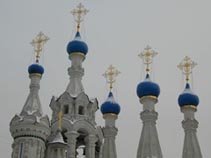
Patriarch Kirill's Christmas Message
On this holy night I extend my heartfelt greetings to you all and from the depths of my soul I congratulate you on the great feast of the Nativity of Christ: the feast of the fulfillment of the promises of old for the salvation of the human race, the feast of the ineffable love of the Maker towards his creation, the feast of the coming into the world of the Son of God who is the Messiah.
The Fathers have spoken much over the centuries on the mystery of the Incarnation of God. And now we, as the Fathers before us, hearken to the words of the Church’s prayers and hymns, with reverence listen to Scripture which tells us of this glorious event, and cease not to be amazed at this wondrous miracle.
In his reflections on Christ’s Nativity, St. Symeon the New Theologian writes the following: “God, as he came into the world … united the divine nature with human nature, so that the human person could become god, and that the Most Holy Trinity may mysteriously abide in this person who has become god by grace” (10th Homily). And St. Ephraim the Syrian speaks of the Incarnation of God thus: “Today the Godhead sealed itself upon humanity, that so with the Godhead’s seal humanity might be adorned” (Hymns for the Nativity of Christ).
In attending to these wise words, we ask ourselves: in what manner may we be adorned with this divine seal? How can we attain the likeness of God, to which all people have been called since the creation of the world? How are we to live so that “Christ be formed in us” (Gal 4:19)? The answer is simple: let us observe the commandments of the Saviour. Together with the apostle Paul I address you all, my beloved: “Bear ye one another’s burdens, and so fulfil the law of Christ” (Gal 6:2). Cover all things with love and you will find peace and tranquility of soul. Be of generous spirit when forgiving all – and in your hearts there will reign the joy which “no man taketh from you” (Jn 16:22). “In your patience possess ye your souls” (Lk 21:19) – and you will inherit life everlasting.
How important it is that we Christians not only call upon others to follow lofty moral ideals, but endeavour to embody these very same ideals in our everyday lives and in the first instance in ministering to our neighbours. And then by God’s grace we may obtain within ourselves the true fruits of the spirit: “love, joy, peace, longsuffering, gentleness, goodness, faith, meekness, temperance” (Gal 5:22-23).
“And let us consider one another to provoke unto love and to good works” (Heb 10:24). When we overcome conflict and division, we speak convincingly to the world of the Saviour who is born and in our deeds we testify to the unusual beauty and spiritual power of the Orthodox faith.
We have embarked upon the year 2017. Exactly one hundred years separates us from events which radically transformed the life of Russia – a great multinational country, and plunged her into the madness of civil war, when children rose up against their parents and brother against brother. The subsequent losses and afflictions which our people endured were in many ways determined by the destruction of our thousand year-old statehood and the struggle against the peoples’ religious faith, generating a profound division within society.
With awe and reverence we recall the great endeavours of the New Martyrs and Confessors of the Church of Russia, through whose prayers, we believe, the Lord never abandoned our people and granted to it the strength to accomplish many great feats of labour and military feats leading us to victory in the most terrible of all wars, to restoring the country, to achievements which evoke admiration.
We give thanks to God for the miracle he has revealed to the world – the resurrection of faith and piety within our people, for the restoration of holy sites once destroyed, for new churches and monasteries, the construction of which is a visible sign of the profound changes that have taken place in peoples’ hearts.
Over recent decades there have been and there remain today many difficulties and hardships. But they are all transient, and that is why we are not afraid of them. The experience of the past century has taught us many things and is to serve as a warning against many things.
Let us fearlessly tread the paths of salvation, “for God is with us.” Let us be stronger in our faith, “for God is with us.” Let hope assert itself within us, “for God is with us.” Let us grow in love and accomplish good, “for God is with us.”
Let us place all our hope in the Lord, for he is “everlasting strength” (Is 26:4) and, as the apostle Peter testifies, “there is no salvation in any other” (Acts 4:12). May the light of Christ illumine all our earthly path, and may this path lead us to the kingdom of heaven, which the Lord has prepared for those who love him.
As I spiritually rejoice today together with all of you who live in various countries, cities and villages, yet making up the one Church of Christ, my prayerful wish is that each of you shall enjoy health of soul and body, peace in your families and success in your labours. And may the Lord and Saviour who was born in Bethlehem grant to each of us the opportunity with renewed strength and with all our heart to feel his presence in our lives.
Amen.
Tuesday, January 03, 2017


Saturday, December 31, 2016

Concerns for the Queen's Health
The Queen may miss the annual New Year's Day church service at Sandringham, with a decision expected to be taken on Sunday morning on whether she is well enough to attend.
The 90-year-old monarch has not been seen in public for 11 days since she and Prince Philip fell ill with what was officially described as "heavy colds".
The illness forced the Queen to miss the Christmas Day service at St Mary Magdalene church in Sandringham for the first time in 28 years.
Philip, 95, who is known for his robust health, was well enough to attend and walked briskly to the church as usual on Christmas morning with Prince Charles, Prince Harry and other family members.
But a Buckingham Palace spokeswoman said she was unable to confirm or deny if the Queen would be going to the 16th century church today on New Year's Day, adding: "The Queen is continuing to recover from her heavy cold and is still in residence at Sandringham."
"We probably will not know what is happening until the morning."
Read the rest here.
Thursday, December 29, 2016
Saturday, December 24, 2016

Friday, December 16, 2016
Tuesday, December 13, 2016
Sunday, December 11, 2016
Constantinople to the Greek Church: Defrock and Excommunicate Critics of the Council
Unbelievable. The hubris of this man knows no bounds. Clearly he sees
himself as an Orthodox Francis. I wonder if he intends to break
communion with the churches of Antioch, Bulgaria Georgia and Russia.
Anaxios!
Anaxios!
Friday, December 09, 2016
Quote of the day...
"There is a crackpot quality to this pontificate. Nothing is gained by
tripping over our own tongues trying to disguise, excuse, or justify
it. The Church was healthier under Alexander VI. A sinner, for sure. Yet
the Borgia pope was still an impressive man in many ways. The Church
would be better served by a pope who had all his wits plus a mistress on
the side than an erratic, mercy-mongering pretender to virtue."
From here.
HT: Bill Tighe
From here.
HT: Bill Tighe
Rome in Eye of A Storm- An interview with Edward Pentin on the crisis in the Catholic Church
He is a veteran Vatican-watcher, the Rome reporter for the USA’s National Catholic Register. He’s also that rarity among journalists – a practicing Catholic.
He’s a real pro, too. In 2014 Edward Pentin’s journalistic integrity came under fire from a Pope Francis favorite, German Cardinal Emeritus Walter Kasper. The liberal Cardinal’s disparaging comments about African prelates attending the Synod had been captured on Pentin’s Iphone recorder. Kasper publicly denied ever making such remarks – and then had to retract his denial when Pentin quietly published the audio. The resulting furore quickly derailed attempts to hijack the Synod by Kasper and his cronies.
Now it seems that once again, all eyes are on Rome. A group of high-ranking prelates have made public a ‘dubia’ they had sent to Pope Francis with questions on Amoris Laetitia. This, because the Pope ignored the same dubia, sent privately two months before.
All quite proper under Canon Law. But the move has set off a firestorm of controversy, even involving the Pope himself, who this week made the astounding comparison of journalists covering Vatican scandals to people with a sexual interest in feces. Now, rumours are swirling that the Pope is unwell, and one British journalist has even called for his retirement. Most recently, 23 scholars have signed a public letter supporting the Cardinals, warning of a ‘metastasizing crisis’ in the Church.
What is going on in the Vatican? In an attempt to get some clarity amidst a storm of spin, REGINA asked Edward Pentin to report on what he’s seeing, from his vantage point in Rome.
Read the rest here.
Thursday, December 08, 2016
Semper Fidelis
From a speech delivered by General John Kelley USMC...
Two years ago when I was the Commander of all U.S. and Iraqi forces, in fact, the 22nd of April 2008, two Marine infantry battalions, 1/9 “The Walking Dead,” and 2/8 were switching out in Ramadi. One battalion in the closing days of their deployment going home very soon, the other just starting its seven-month combat tour.
Two Marines, Corporal Jonathan Yale and Lance Corporal Jordan Haerter, 22 and 20 years old respectively, one from each battalion, were assuming the watch together at the entrance gate of an outpost that contained a makeshift barracks housing 50 Marines.
The same broken down ramshackle building was also home to 100 Iraqi police, also my men and our allies in the fight against the terrorists in Ramadi, a city until recently the most dangerous city on earth and owned by Al Qaeda. Yale was a dirt poor mixed-race kid from Virginia with a wife and daughter, and a mother and sister who lived with him and he supported as well. He did this on a yearly salary of less than $23,000. Haerter, on the other hand, was a middle class white kid from Long Island.
They were from two completely different worlds. Had they not joined the Marines they would never have met each other, or understood that multiple America’s exist simultaneously depending on one’s race, education level, economic status, and where you might have been born. But they were Marines, combat Marines, forged in the same crucible of Marine training, and because of this bond they were brothers as close, or closer, than if they were born of the same woman.
The mission orders they received from the sergeant squad leader I am sure went something like: “Okay you two clowns, stand this post and let no unauthorized personnel or vehicles pass.” “You clear?” I am also sure Yale and Haerter then rolled their eyes and said in unison something like: “Yes Sergeant,” with just enough attitude that made the point without saying the words, “No kidding sweetheart, we know what we’re doing.” They then relieved two other Marines on watch and took up their post at the entry control point of Joint Security Station Nasser, in the Sophia section of Ramadi, al Anbar, Iraq.
A few minutes later a large blue truck turned down the alley way—perhaps 60-70 yards in length—and sped its way through the serpentine of concrete jersey walls. The truck stopped just short of where the two were posted and detonated, killing them both catastrophically. Twenty-four brick masonry houses were damaged or destroyed. A mosque 100 yards away collapsed. The truck’s engine came to rest two hundred yards away knocking most of a house down before it stopped.
Our explosive experts reckoned the blast was made of 2,000 pounds of explosives. Two died, and because these two young infantrymen didn’t have it in their DNA to run from danger, they saved 150 of their Iraqi and American brothers-in-arms.
When I read the situation report about the incident a few hours after it happened I called the regimental commander for details as something about this struck me as different. Marines dying or being seriously wounded is commonplace in combat. We expect Marines regardless of rank or MOS to stand their ground and do their duty, and even die in the process, if that is what the mission takes. But this just seemed different.
The regimental commander had just returned from the site and he agreed, but reported that there were no American witnesses to the event—just Iraqi police. I figured if there was any chance of finding out what actually happened and then to decorate the two Marines to acknowledge their bravery, I’d have to do it as a combat award that requires two eye-witnesses and we figured the bureaucrats back in Washington would never buy Iraqi statements. If it had any chance at all, it had to come under the signature of a general officer.
I traveled to Ramadi the next day and spoke individually to a half-dozen Iraqi police all of whom told the same story. The blue truck turned down into the alley and immediately sped up as it made its way through the serpentine. They all said, “We knew immediately what was going on as soon as the two Marines began firing.” The Iraqi police then related that some of them also fired, and then to a man, ran for safety just prior to the explosion.
All survived. Many were injured … some seriously. One of the Iraqis elaborated and with tears welling up said, “They’d run like any normal man would to save his life.”
What he didn’t know until then, he said, and what he learned that very instant, was that Marines are not normal. Choking past the emotion he said, “Sir, in the name of God no sane man would have stood there and done what they did.”
“No sane man.”
“They saved us all.”
What we didn’t know at the time, and only learned a couple of days later after I wrote a summary and submitted both Yale and Haerter for posthumous Navy Crosses, was that one of our security cameras, damaged initially in the blast, recorded some of the suicide attack. It happened exactly as the Iraqis had described it. It took exactly six seconds from when the truck entered the alley until it detonated.
You can watch the last six seconds of their young lives. Putting myself in their heads I supposed it took about a second for the two Marines to separately come to the same conclusion about what was going on once the truck came into their view at the far end of the alley. Exactly no time to talk it over, or call the sergeant to ask what they should do. Only enough time to take half an instant and think about what the sergeant told them to do only a few minutes before: “ … let no unauthorized personnel or vehicles pass.”
The two Marines had about five seconds left to live. It took maybe another two seconds for them to present their weapons, take aim, and open up. By this time the truck was half-way through the barriers and gaining speed the whole time. Here, the recording shows a number of Iraqi police, some of whom had fired their AKs, now scattering like the normal and rational men they were—some running right past the Marines. They had three seconds left to live.
For about two seconds more, the recording shows the Marines’ weapons firing non-stop…the truck’s windshield exploding into shards of glass as their rounds take it apart and tore in to the body of the son-of-a-bitch who is trying to get past them to kill their brothers—American and Iraqi—bedded down in the barracks totally unaware of the fact that their lives at that moment depended entirely on two Marines standing their ground. If they had been aware, they would have know they were safe … because two Marines stood between them and a crazed suicide bomber.
The recording shows the truck careening to a stop immediately in front of the two Marines. In all of the instantaneous violence Yale and Haerter never hesitated. By all reports and by the recording, they never stepped back. They never even started to step aside. They never even shifted their weight. With their feet spread shoulder width apart, they leaned into the danger, firing as fast as they could work their weapons. They had only one second left to live.
The truck explodes. The camera goes blank. Two young men go to their God.
Six seconds.
Not enough time to think about their families, their country, their flag, or about their lives or their deaths, but more than enough time for two very brave young men to do their duty … into eternity. That is the kind of people who are on watch all over the world tonight—for you.
Four days before delivering these remarks General Kelly's own son was killed in Afghanistan.
Wednesday, December 07, 2016

Monarchy done right

Monday, December 05, 2016
Dutch bishops update wording of the Lord's prayer
November 30, 2016 (LifeSiteNews) – Dutch Catholics are raising alarm bells after the bishops of the Netherlands and Belgium changed the words to the Our Father in a way that they believe amounts to an "ideological reinterpretation of the text."
Dutch Catholics who still attend weekly Mass heard a newly-worded Our Father last Sunday that no longer asked God the Father, as Jesus taught, “to lead us not into temptation” but, instead, “not into trial.”
Vox Populi, an orthodox Catholic lay group, is organizing a petition advocating the traditional translation. “Why would this ‘reform’ be necessary now? There is not a single pastoral need to come up with a ‘new common Dutch-Flemish translation’ of the ‘Our Father.’”
Recent Dutch Catholic history is so marked by destructive innovation that in 1996 one faithful scholar declared the situation had long passed the “crisis” phase and achieved “ruin.”
The former translation of the Latin “temptationem” was “bekoring,” or “temptation.” The new version replaces that with “beproeving,” which means in English, “test,” “ordeal,” or “tribulation.”
Read the rest here.
And the hits just keep on coming...
Sunday, December 04, 2016
France outlaws pro-life websites
PARIS, December 2, 2016 (LifeSiteNews) --The socialist government of France passed a bill after one day's debate that criminalizes websites that might dissuade women from abortion.
The “digital interference” bill is aimed at cracking down on French websites that would, in the words of the bill, "deliberately mislead, intimidate and/or exert psychological or moral pressure to discourage recourse to abortion."
Convicted website owners could face two years in prison and fines up to 30,000 euros ($31,799 USD).
The majority left voted in a block for the bill while the minority right formed a block against it.
Bruno Retailleau, who heads the Republicans party group in the Senate, told French radio Thursday that the bill "is totally against freedom of expression,” adding that it contradicts the 1975 law that legalized abortion and which called for women to be informed of alternatives.
Christian Democratic Party member Jean-Frederic Poisson also blasted the bill on Twitter for what he saw as the government's double standard in banning sites that propose “alternatives” to abortion but not “jihadist websites.”
Read the rest here.
Subscribe to:
Posts (Atom)