Showing posts with label Catholic. Show all posts

Thursday, July 31, 2008

Is the Episcopal Church a Truly Catholic Church?

Fr Kimel (aka the Pontificator) asks and answers the question.

In the early 70s the large majority of catholic Episcopalians firmly opposed the ordination of women to the presbyterate and episcopate, believing that it was contrary to the will of Christ and the ecumenical tradition of the Church. When the 1976 General Convention decided to permit the ordination of women to the priesthood, most Anglo-Catholics decided to remain within the Episcopal Church and to fight for a reversal of church policy. What happened? The older generation retired or died. The younger generation, including the present writer, eventually got with the national church program. Seminaries and bishops carefully weeded out the opponents of women’s ordination from the prospective ordinand pool. Thirty-five years later we find that a new orthodoxy has been successfully imposed and the opponents of women’s ordination marginalized. Twenty years ago one might have been forgiven for thinking that it was still possible to reverse this situation, but surely no one can persuasively argue this any longer. Something very similar is now happening on the question of the moral legitimacy of same-sex unions. The goodness of same-sex unions is now widely affirmed in the Episcopal Church. New ordinands are expected to support this policy and the doctrine underlying it. Perhaps freedom to oppose this policy is still allowed in some dioceses (presumably Texas); but the number of such dioceses declines each year. Within a decade or two Episcopal priests will no longer be permitted to teach the catholic understanding of Holy Matrimony nor to declare the immorality of same-sex unions. In the inclusive Church, even tolerance has its limits. The recent history of the Episcopal Church demonstrates the harsh truth of Neuhaus’s Law: “Wherever orthodoxy is optional, it sooner or later will be proscribed.”

This essay is must reading. I strongly recommend it in its entirety.

Hat tip to T-19

Wednesday, May 28, 2008

Orthodox Bishop Communes with Catholics

Apparently Metropolitan Nicolae of the Romanian Orthodox Church has been communed by Catholics. Needless to say this is creating some waves. I personally am concerned about this and hope that some sort of explanation is requested from the Holy Synod. However, I also think people should be cautious in reading too much into this. As far as I can tell this was a violation of church discipline from both an Orthodox perspective and the Catholic as well. I am content to wait and see what his explanation is.

Hat tip to Eirenikon.

Friday, August 24, 2007

What's in a name?

From the I am really not making this up file...
Referring to God as Allah will bring Christians and Muslims closer together, the Roman Catholic Bishop of Breda in the Netherlands said last week. Speaking on Dutch television on Aug 13, the Rt Rev Tiny Muskens urged Christians to call God Allah and predicted that within 100 years the name would be used in Dutch churches.
Read the rest here.

On whining about church

Rod Dreher (aka the Crunchy Con) has posted a rather thoughtful article on people who spend all or a good deal of their time whining about their church and looking for its faults. I highly recommend it.

Hat tip to the Young Fogey.

Friday, August 17, 2007

Sharing the cup: Orthodoxy and inter-communion

There is an interesting thread going on over at the Byzantine Forum. The topic began with someone posting to the effect that he is Orthodox but lives in an area where there are no Orthodox parishes within a reasonable radius to him. He has thus been attending an Eastern Rite Catholic parish. Quickly thereafter someone posted a note basically welcoming him to the catholic Church ands stated that going back and forth between the Orthodox and Catholic Church aught not to present an issue. My reply to this and the subsequent discussion it has provoked can be found here (page 6 of the thread). However I think my most recent post sums up the point I have been attempting to make in response to the claims that inter communion has been tolerated in some instances.
Originally Posted By: Matt
Ad Orientum,

The Orthodox churches are self-governing. It is up to the Antiochian Orthodox Church to decide how, or whether, to apply church cannons. There is not some universal agreed upon way of applying them. Some "Super Orthodox" still follow the prohibition of praying with schismatics and heretics. Wanna know how closely that is followed by the Orthodox churches and believers? Even at St. Tikon's (the "conservative" Orthodox seminary) I believe it is usually the "spirit" of the cannon that is appealed to rather then the "letter". Moreover, it is quite possible that some Antiochians do not believe the Melkites are heretics and schismatics as you seem to suggest. If such is the case then Antiochian actions seem even more justified.

Also, if the Melkites are not Orthodox because they are not in communion with your bishop then what of the old-calendarists? Are they also out of your Orthodox circle? What about seemingly random folks like "Patriarch Photios" (aka Joseph Farrel)? Heck, some Eastern Orthodox now believe the Copts are Orthodox and you haven't been in communion with them for 1500 years. I just don't think your system works.

In any event, I hope I am not coming off to harshly.

All the best
My Reply:

Matt,

Again I do not dispute your point that there have been instances of inter communion. The question is whether or not it is proper and correct. You correctly point out that each (canonical) Orthodox Church is self governing. And yes that means the Antiochians have very broad rights in determining whom they are in communion with. So let me ask the question. Is the Antiochian Patriarchate in communion with Rome? Have they formally repudiated the Council of Constantinople of 1484? If they have then I missed the memo.

You ask if certain groups are "Orthodox" or not. My answer in most cases is that I leave that up to God and the legitimate hierarchs of The Church to determine. The question I would ask is; are they in communion with me via my bishop? If the answer is yes then there is no problem. If the answer is no than we have a problem which may or may not (there are many reasons for not being in communion) touch on matters intrinsic to The Faith.

You say that each Orthodox Church can decide how or when to apply Church Canons. Thats a very broad statement that I am not able to fully agree with. Yes, there is such a thing as oikonomia which is far better understood and more widely practiced in Orthodoxy than in the Latin Church. But economy is not carte blanche to disregard the immemorial disciplines of The Church. If some in the Antichian Church are communing in the Melkite/Latin Church then the question which needs to be asked is; is this with the blessing of their bishop?

If the answer is yes than I am constrained to express my respectful disagreement with that policy. But beyond that it is indeed up to their Synod to determine if anything improper is going on. If they are doing so without the blessing of their bishop than it is a serious sin which by default places the offending party outside communion with his/her own bishop. While Orthodoxy is not quite as legalistic as some might think neither are we a do it yourself church either.

Finally another question looms. Even if there have been some instances of inter-communion sanctioned (or at least tolerated) by one or two bishops mostly in Lebanon, what are the broader implications? My answer is very few. Even after 1484 there were isolated cases of inter-communion between Orthodox and Latins. But they were "isolated." They were, and I would argue, are today extremely rare.

You refer to the Church Canons prohibiting praying with schismatics and heretics. And you correctly note that few outside of the Old Calendarist sects practice akria (a strict application of the letter of the law as opposed to oikonomia). But as far as I know all of the canonical Orthodox prohibit communion with non-Orthodox. That for us is the litmus test of your relationship to The Church. Are we in communion with one another? Is it possible that there have been aberrations and tolerances or abuses of this canon? It is more than possible. It is certain. But thats not to be seen as restoration of communion. If any Orthodox jurisdiction wishes to restore communion with Rome they are free to do so. But actions can have consequences.

This is where I note my objection to your assertion that each jurisdiction has absolute authority to determine if, when, or in what manner they will obey Church Canons. If a jurisdiction strays too far from what the rest of the Orthodox world is prepared to accept they may find themselves isolated to one degree or another. Orthodoxy (despite some superficial similarities in ecclesiology) is not the Anglican Communion where one jurisdiction can do whatever it wants and the rest just have to lump it. Orthodox jurisdictions have severed communion with one another for far less significant things than permitting open communion. While I will not make concrete predictions I think that any Orthodox jurisdiction that chose to restore communion with Rome before there was a consensus within The Church as a whole that the time was right, would find itself quickly isolated. That isolation would likely (IMO) also extend to communion with the other Orthodox Churches.

This brings us back to my litmus test. Is the church / parish you wish to commune in itself "in communion" with your bishop? If the answer is "no" then do not do it, unless it is your intention to sever communion with him.

ICXC
John

Friday, August 03, 2007

What's wrong with these pictures?


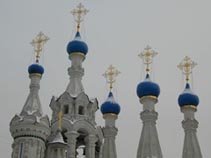
These pictures (originally posted at Rorate Caeli) are from the Ukrainian Greek Catholic Church in Poland.

Wednesday, May 16, 2007

Ratzinger on the Lefebvrist Schism

Fr. Kimel has posted some remarks by then Card +Ratzinger on the Roman Catholic Traditionalists who revolted under the leadership of Archbishop +Lefebvre. I had not seen this particular quote before and I think it is well worth a read. I think they are all the more interesting given the current efforts by +B16 to heal this particular schism.

Monday, April 24, 2006

Latest on the SSPX & the Tridentine Indult...

(Click on image for larger view)

The New Liturgical Movement posted a clip from CWNews on the latest rumors emanating from Rome. As I stated a while back, the indult is almost certainly coming since it is a non-negotiable condition for normalizing relations with the SSPX which +Benedict XVI urgently desires. To those who expected this to be done the day after +Benedict's election I can only say you do not know +Benedict. This is a man who does not act rashly. Even so, the pace of events in the Vatican has been at something near light speed compared to the usual glacial pace of that corner of the world. I append the news clip below.

Apr. 21 (CWNews.com) - During a closed-door meeting on March 23 with the College of Cardinals, Pope Benedict XVI indicated that he plans a move to allow broader use of the old Latin Mass. The exact nature of the Pope's move, and its timing, remain matters of intense speculation.

As the French bishops concluded their annual assembly on April 7, Cardinal Jean-Pierre Ricard revealed that the Pope is expected to issue directives "in the coming weeks or months" that would appeal to traditionalist Catholics. The French cardinal confirmed that Pope Benedict is particularly anxious to find ways of restoring normal relations with the Society of St. Pius X (SSPX).

As prefect of the Congregation for the Doctrine of the Faith, then-Cardinal Ratzinger was closely involved in the efforts-- ultimately fruitless-- to avoid a breach between the late Archbishop Marcel Lefebvre's traditionalist group and the Vatican. In June 1988 the archbishop consecrated four bishops, against explicit orders from the Holy See, and the Vatican responded with a decree of excommunication.

Since that time the Vatican has maintained contact with the breakaway traditionalist group, looking toward a restoration of normal ecclesiastical ties. Talks between SSPX leaders and Vatican officials became more intense in the Jubilee Year 2000, at the explicit request of Pope John Paul II; the efforts have been stepped up again under Pope Benedict XVI. The new Pope has always been perceived by traditionalist Catholics as a sympathetic friend, and his private meeting last August with Bishop Bernard Fellay, the SSPX superior, was seen as an important step toward reconciliation.

For several weeks, at the Pope's request, Vatican officials have been discussing proposals for the reintegration of the SSPX into the normal structure of the Church. After the March 23 meeting of the world's cardinals, Cardinal Dario Castrillon Hoyos-- who as president of the Ecclesia Dei commission has been the Vatican's leading figure in talks with traditionalists-- said that the Church would welcome back the Lefebvrists "with open arms." The day's discussions, the Colombian cardinal said, had involved a search for "the best formula" for a canonical resolution of the split.

For the past month, a recurrent rumor at the Vatican has been that Pope Benedict will issue a motu proprio allowing the universal use of the 1962 Roman Missal. (The use of the old rite is currently allowed only with the approval of the diocesan bishop, under the terms of the 1988 papal directive Ecclesia Dei, from which the Vatican commission draws its name.) Reports have also suggested that the Vatican is prepared to lift the decrees of excommunication against the SSPX leaders. And there have been reports that the Holy See could create a new ecclesiastical unit, an apostolic administration of personal prelature, for the pastoral care of traditionalist Catholics.

However both the Vatican and the Lefebvrist group have listed conditions that must be met before reconciliation is possible. The Vatican insists that the SSPX leaders manifest their repentance for the break with Rome, and accept the validity of Vatican II documents. The SSPX demands a Vatican move allowing free worldwide use of the old Latin Mass, and the freedom to question the content of some Vatican II documents.

A motu proprio allowing unrestricted use of the Tridentine rite would fulfill the first SSPX request. Last December, in a pre-Christmas address to the Roman Curia, Pope Benedict emphasized that the documents of Vatican II must be interpreted in the light of Church tradition-- a statement that went a long way toward satisfying the other traditionalist demand.

While Pope Benedict is clearly hoping to restore full communion, it remains unclear how many members of the SSPX are equally anxious to repair ties with Rome. Some Lefebvrists have indicated a strong desire to resolve their disagreements with the Holy See; others, such as Bishop Richard Williamson, have suggested that there is no realistic prospect for agreement with a Vatican leadership they regard as thoroughly corrupt. Bishop Fellay-- probably hoping to hold the different factions together, as the SSPX moves toward a July leadership vote-- has allowed that the Vatican seems anxious to move toward reconciliation faster than his own followers are ready to go.

Thursday, April 13, 2006

OK. It didn't show up today...

But it's coming. Really. The Rorate Caeli editor seems to have succumbed to despair. But all of the signs still point to some form of Universal Indult for the Traditional Roman Rite. It's a nonnegotiable condition for the SSPX whom we know that +Benedict XVI urgently desires to see reconciled with Rome. Beyond that we also know that +Benedict has long had a pronounced sympathy for the rite himself. So just relax, take a deep breath and wait. All the signs point to this coming about. Even more interesting (from my point of view) will be the response from the Orthodox. Orthodoxy has always been very reluctant to comment on the internal affairs of the Roman Church (and properly so). But it is certainly true that the chaos (heavily manifested in the liturgy) of the Western Church post-Vatican II has been a source of grave concern to many Orthodox theologians and liturgists. Some have even been openly critical of the reformed Roman Rite of Paul VI. How the revival of a liturgical rite that is at it's core pre-schism will be recieved should be interesting to watch.

Wednesday, April 12, 2006

The Tridentine Indult

The latest news on the Universal indult is that there is no news. Whatever +Benedict XVI is up to, he is playing his cards close to the vest. However it needs to be noted that the rumors that something significant is imminent have been widespread now for nigh on two weeks. No one, not even the most minor Vatican functionary has offered any kind of denial either on the record or anonymously. This leads me to conclude that after so many false alarms this is the real deal. It may or may not come tomorrow (my guess is it will). But something is clearly coming. At this writing, Maundy Thursday in Rome is now only hours away. Rarely has any day been awaited with such anticipation in the world of Roman Catholics (and perhaps some dread on the part of the liberal wing of that church). As a final note I saw a post that reminded me Holy Thursday is also the day +Paul VI issued his Apostolic Constitution Missale Romanum Novus Ordo in 1969. Does +Benedict have a sense of irony?

Monday, April 10, 2006

The Tridentine Signs of the Times

Some thoughts are posted by by the well known conservative Catholic Priest Fr. John T. Zuhlsdorf on the much rumored Tridentine indult. I think they are worth a look for those interested in this subject.

Sunday, April 09, 2006

The Universal Indult

Rorate Caeli reports that the Italian Press seems to be confirming the much anticipated Universal Indult for the use of the pre-Vatican II Roman Liturgy is now only days away. Exactly what this will portend for relations between Rome and some of her wayward children is not entirely clear. It certainly can only help in repairing relations with the Society of St. Pius X (SSPX). My guess is that a lot will depend on how this indult is worded. Will it be a still conditional but much broader permission for the use of the older liturgy? Or will it be a truly blanket permission? Another possibility is that it might simply be a declaration that the Bull Quo Primum Tempore (1570) remains in effect. Another question is what if any other gestures will accompany this. There has been some speculation that +Benedict might publicly offer Mass using this rite, perhaps on Maundy Thursday. Of course this will have little impact on relations with the more extremist groups such as the various sede vecantist sects. They are so far over the edge that there is no real hope. But clearly this will be a significant move to bring back into the fold those Catholics alienated by the liturgical chaos of the last 40 years in the Latin Church.