Click on the image for full sized version.


Greed is Sin
14 hours ago
 Bishop Hilarion (Alfeeyev) of Vienna
 They are by all accounts a magnificent corner of Northern Russia, still in a near wilderness state. Indeed until recently you would be hard pressed to find a lot of evidence of human habitation in the Solovetsky Islands. There is the ancient monastery and of course the remnants of one of the Soviet Union's first concentration camps, complete with mass graves.
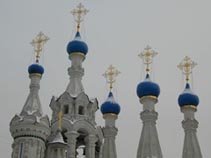
...The islands, also known as Solovki, are one of the holiest sites in Russian Orthodox Christianity, and the 40 or so monks who reside here consider the land their own. Their predecessors settled here in the 15th century, creating a monastic dynasty that lasted nearly 500 years. They built the white-walled Transfiguration Cathedral, capped with silver cupolas, and enclosed it in fortress-thick walls of granite. An intricate canal system linking dozens of lakes still supplies fresh water to the islands’ 1,000 inhabitants.Sounds like my idea of an awesome vacation get away. While we are at it, does anyone know if there are any good roller coasters near Auschwitz? [/sarcasm]
Fiercely opposed to religion, the Soviets imprisoned or killed most of the clergy members and lopped off the cupolas. Having only recently returned after a banishment of nearly 70 years, many of the monks are now alarmed by the efforts of entrepreneurs like Ms. Smirnova to open the islands to tourists.
...Buried beneath the wild blueberry fields and gangly forests of knotted dancing birches are the bones of thousands of inmates who perished at one of the first and most notorious Soviet prison camps: the Solovetsky Camp of Special Purpose, described by Aleksandr Solzhenitsyn as the harbinger of the gulag.
Through the camp’s 20-year history, hundreds of thousands of prisoners — aristocrats, clergymen, intelligentsia, common criminals — toiled through brutal winters and mosquito-plagued summers, succumbing to disease, starvation and execution. Prison officials experimented with methods of torture that were later refined at prison camps throughout the Soviet Union. The horrors that occurred here remained an official secret even after the camp closed in 1939.