Thursday, March 18, 2021
Tech stocks fall as the bond rout continues
Thursday, February 04, 2021
How to Win at the Stock Market by Being Lazy
Read it here.
Executive Summary: Low cost broad based index funds or near equivalent ETFs are very hard to beat. Even the so called professional money managers, who often charge scandalous fees, rarely beat the dirt cheap fund that just tracks the S&P 500.
Saturday, January 30, 2021
Robinhood attempts to explain trading limits
Online broker Robinhood said that it put temporary buying restrictions on a small number of securities because central Wall Street clearinghouse-mandated deposit requirements for equities increased tenfold.
The decision by Robinhood, a free-trading pioneer and app that’s popular among small investors, drew scrutiny from its customers over the past week.
“It was not because we wanted to stop people from buying these stocks,” Robinhood said in a blog post published late Friday.
“We did this because the required amount we had to deposit with the clearinghouse was so large — with individual volatile securities accounting for hundreds of millions of dollars in deposit requirements — that we had to take steps to limit buying in those volatile securities to ensure we could comfortably meet our requirements,” it continued.
Amateur investors using Robinhood and other apps bid up heavily shorted stocks and caused GameStop shares to skyrocket 400% in the past week, resulting in major losses for hedge funds who shorted the shares.
Robinhood initially told investors they could only sell and not buy new shares in certain companies that were attracting attention from retail traders on Reddit. The brokerage is now allowing clients to buy only a single share of GameStop. A total of 50 securities are now restricted on the stock trading app.
Wednesday, January 27, 2021
GameStop: Wall Street's bloody battle of the shorts
Friday, September 25, 2020
Luke Gromen discusses macroeconomic trends
Thursday, April 09, 2020
Get ready for the recovery of the 1%
Which one moved the market? The Fed move, driving the Dow Jones Industrial Average up 500 points by midday.
The market jump, unemployment surge and Fed rescue efforts all converged to form a new split in the economy, between the asset-rich and the rest of America.
Much like the early days of the financial crisis recovery, the wealthy (or the top 10% who own more than 85% of the stocks and financial assets) were quickly saved by the Federal Reserve and Congress.
In 2009, the stock market jumped more than 50% from its low, thanks to the TARP program and other Fed and government support. It took the rest of American almost a decade to recover lost wages and their home values.
The diverging fortunes of the haves and have-nots led to a massive, post-crisis backlash against the wealthy. It gave rise to the Occupy Wall Street Movement, the Tea Party, anti-establishment politicians and a roaring debate over inequality.
Now, while the root cause of the crisis is vastly different, and no one is talking about greedy sub-prime bankers who brought the trouble on themselves, the coronavirus and response is likely to lead the country down a similar anti-elite path...
Read the rest here.
Thursday, March 26, 2020
The Stock Market Bounces (and a personal note)
Thursday, July 18, 2019
Ray Dalio: Paradigm Shifts
Read it here.
Monday, December 08, 2014
China's stock mania decouples from economic reality
The Shanghai Composite Index has risen 32pc in the past six weeks, blowing through 3,000 to a three-and-a-half-year high even though corporate earnings are declining steeply.
Read the rest here.
Wednesday, May 23, 2012
Facebook's Timely Lesson
It is a seldom heard and even more seldom heeded maxim: In general, people should not buy individual stocks.Source.
Well, three days into its first week of being a publicly traded stock and the much fawned over Facebook (ticker symbol FB) has lost 18% of its value. Now I don't want to rub salt into any open wounds for those who may have bought the stock but as an important object lesson this is too good to pass up. The point being that buying individual securities is ALWAYS a form of speculating. You are trying to outsmart the financial markets and very very few people can do this with success over the long term. There is a mountain of statistical evidence and studies showing that in any given year around 2/3 of your high priced Wall Street money men will underperform their respective index. Over any given ten year period it's about 90% that fall short of the index. When you further factor in the generally steep fees and expenses they charge, or that you pay your broker in trading fees and then add on the tax implications of trading stocks, the number of those who beat the market becomes statistically insignificant.
You are not going to beat the Street especially over the long term. Wall Street is the world's biggest casino and they have the house advantage from all those fees and expenses. Even worse this casino is as crooked as your dog's hind legs. Insider trading and price fixing are rampant. Remember when you buy a share of Facebook or whatever stock you think is about to get hot you are probably buying it from some big investment bank, which means they think it is going down. These people have every tool in the world at their fingertips (legal and otherwise) and they still come up short of the index most years. What makes you think you are going to be in the 1% that actually beats the house by a wide enough margin to make up for all the fees and added taxes? Here is the bottom line... Speculating is a suckers game.
Folks if you are going to be invested in stocks (and most people should be) stick to one or two broadly diversified low cost index funds or near equivalent ETFs. This is the only way you are likely to get your fair share of returns on the stock market. As far as asset allocation goes, being deeply conservative, I am a fan of the late Harry Browne's Permanent Portfolio (see here and here). But even a very simple 50/50 portfolio suggested by the legendary Jack Bogle consisting of half in a total US Bond Market Index Fund and the other half in a Total US Stock Market Index Fund will give you good returns over time with limited risks. Look for the cheapest funds you can find, reinvest the dividends and then leave it alone other than for rebalancing once a year or as needed.
Monday, May 21, 2012
Facebook IPO is a flop
Facebook stock's slide continued Monday, leaving some investors wondering about the outlook for the newly-public social network.Read the rest here.
Facebook's stock tumbled below its $38 IPO price on its second day of trading. By Monday afternoon the company’s share price was down 10 percent from Friday’s closing price of $38.23. (You can track the performance of Facebook’s stock price here.)
When a stock falls below its offer price so soon after an IPO it is considered a disappointment for the company, particularly when the IPO is the most heavily traded ever and concerns such a high profile company.
Tuesday, February 14, 2012
Warren Buffet's advice on stocks and bonds
There’s been a bunch of press lately about how Warren Buffet dislikes bonds (and gold) and loves stocks. In particular, he warns on bonds and inflation being a bad combination. Yes, they are. That’s why you shouldn’t own just bonds (or any single asset). He also advises (according to this article which may be wrong) that investors be 100% in stocks. Yikes!Read the rest here.
Well I thought it would be interesting to crank up www.stockcharts.com and see how he’s done with his company Berkshire Hathaway (BRK.A). Going back as far as stockcharts.com allows for these funds (1999), we can see how he compares against the maligned US Treasury Long Term Bonds (Vanguard’s version), Vanguard Total Bond Market, and Short Term Treasury Fund also from Vanguard (interest and dividends included):
Berkshire Hathaway vs. Long Term Treasuries vs. Vanguard Total Bond vs. Short Term Treasuries
Ooops... That tarnishes someone's star.
Wednesday, January 18, 2012
Some Sober Observations and Advice For Investing
Doing some research recently I’ve found that almost 9 out of 10 of the trades on any given day on Wall Street are between professionals, not individuals. Think about that for a second. When you go to make a trade, 9 out of 10 times you are doing it against someone that does it for a living. And not just a living, but paid really big bucks to do it and has a tremendous amount of resources behind them. This includes mutual funds, pension funds, hedge funds, professional speculators, investment banks, etc.Read the rest here.
But it gets even better. If 9 out of 10 trades are between professionals that means that most of the trades pros do are between each other. Now that’s interesting to consider. That means the average you see in the investing products on Wall Street represents the best that the pros on Wall Street can do in any single year.
Often I read about an investing strategy or trading method that claims to beat the broad market indices. That’s a pretty bold claim. I have to wonder if the sellers of these ideas are aware of the reality of trading on Wall Street. To think that you’re going to teach an individual investor to go up against a highly skilled pro and win. It’s kind of like telling an amateur golfer they are going to turn into Tiger Woods if they just buy the right golf club. It’s a fun thing to think about, but just not very realistic.
Even much vaunted hedge funds, the supposed masters of secret Wall Street strategies, often bomb. If they can’t do it, what chance does an individual have?
This is good advice. I particularly recommend the article linked in the source post.
Wednesday, April 13, 2011
Most Mutual Funds Are Ripping You Off, Says IFA’s Mark Hebner
I am generally very cautious when it comes to offering any specific advice on investments and have almost never done so on here. That said, I will give a thumbs up to Hebner's comments. Anyone interested in the subject is encouraged to do a little research or just read any of the works by Jack Bogle. Yes, there are a VERY few exceptions, but in general I don't like managed mutual funds, especially when it comes to stocks. Low cost index funds are almost always your best long term investment for stocks.
They give you instant diversification (a broad based index), added security (individual companies could go belly up, whereas an index might take a hit but you will never lose all your money in one), and the costs are much lower than managed funds. Fees and expenses matter. They cut into your long term profits big time because they detract from your compound returns. And then again you come back to a mountain of data and studies going back decades that show index funds outperforming actively managed mutual funds or privately managed portfolios.
Tuesday, November 16, 2010
Financial markets tumble over spreading debt crisis
Worries about Europe’s debt crisis and possible moves by authorities in Asia to slow fast-paced growth there swept the world’s markets on Tuesday and pushed stocks in the United States sharply lower.Read the rest here.
As finance ministers from the 16 countries that use the euro met in Brussels to discuss the problems in Ireland, investors worried that the debt crisis could spread across the Continent to Portugal, and even to Spain.
“There is a worry about the state of things overseas. It is the European debt crisis that is causing this,” said Zach Pandl, economist at Nomura in New York.
Stocks, which have been grinding lower since the Federal Reserve announced its asset purchase program to stimulate the economy, fell for the seventh consecutive day.
The Dow Jones industrial average briefly fell below 11,000 for the first time since early October. At the close it was at 11,023.50 down 178.47 points, or 1.59 percent on the day.
The Standard & Poor’s 500-stock index fell 1.62 percent, and the Nasdaq composite dropped 1.75 percent.
Thursday, May 06, 2010
Today in numbers and what they mean...
Some quick numbers for consideration...
The DOW ended down 347.8 or 3.4%
The S&P 500 down 37.2 or 3.24%
The NASDAQ down 82.65 or 3.44%
Oil down 2.81 to 77.21 per barrel (It was over $86 just last week)
The Euro was slammed, dropping to 1.2529 to the dollar
The only things that rose were the dollar which made new highs for the year against the Euro and and the Pound, US high grade bonds which rallied across the curve and gold which rose 33.20 to $1209.80 oz an advance of some 2.8%.
Conclusions... there is a growing alarm at the vast amount of sovereign debt in the world and the possibility of a cascading debt crisis. As per normal in times of alarm there was a flight to the dollar and the most conservative of dollar denominated securities. However this time, unlike in 2008, we are also seeing a large move into gold which has been rising steadily for well over a month. Of particular noteworthiness is that gold has been rallying IN TANDEM with the dollar. This has been going on for weeks and does not appear to be an aberration. If in fact gold, which has historically done the opposite of the dollar, is in the process of decoupling from the USD it could signal investors increasing concern over US sovereign debt levels and the anticipation of large scale intervention by the FED and other central banks around the world. In effect gold may be in the process of becoming once again the world's defacto reserve currency.
Wall Street: It's not over
Thursday, March 12, 2009
More on Roubini and Shiller's Dour Outlook
Well, you guessed it. I'm here to post up even more bullish news! And, by bullish news, I obviously mean bearish news. After all, its Nouriel Roubini and Robert Shiller.
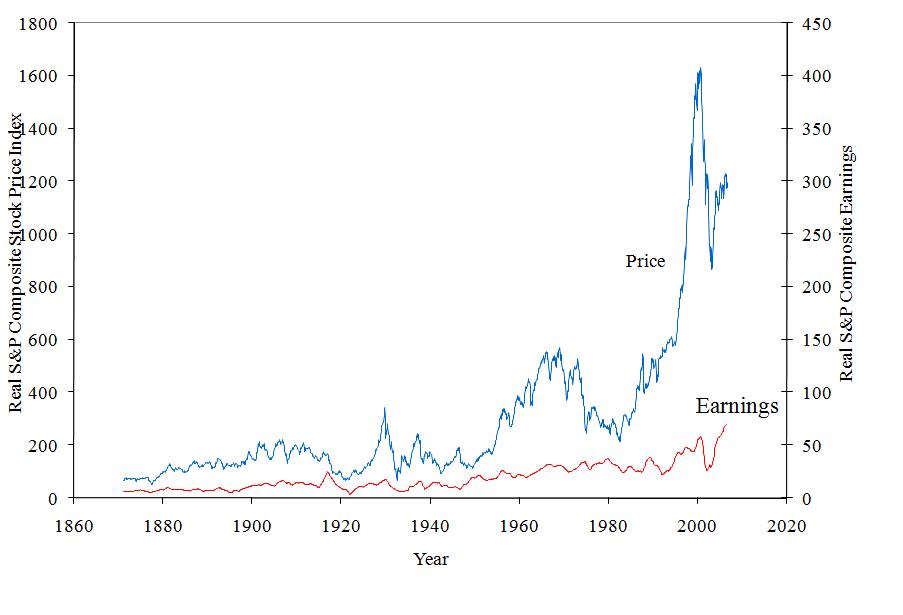
Here's the deal, Shiller has a set of S&P earnings and P/E ratios available in spreadsheet format here. Big hat tip to Cliff Küle for flagging this Shiller data and graphs to our attention. Cliff posts up some historical info, illustrated below. First, real S&P composite earnings:
Click to enlarge:
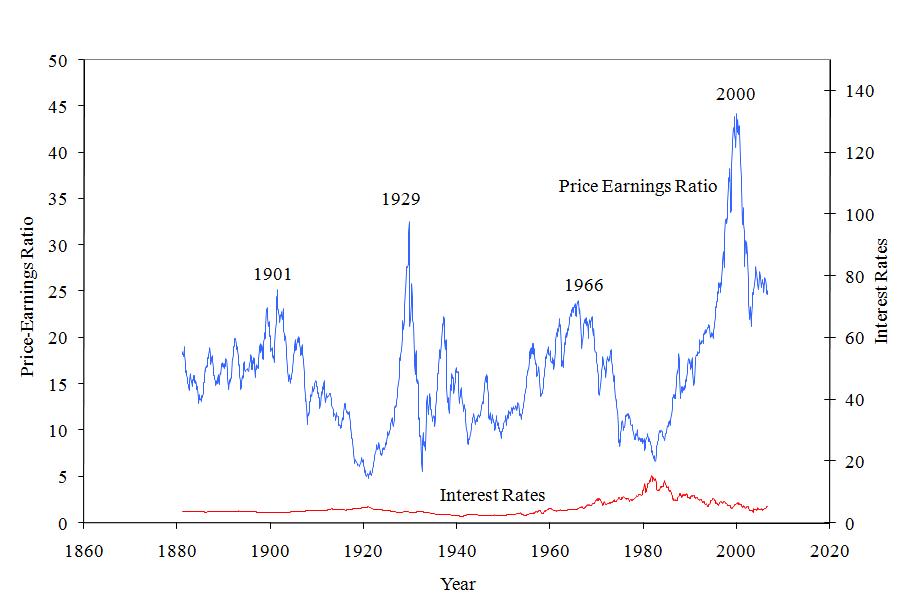
And secondly, historical P/E ratios and interest rates.
Click to enlarge:
By that historical data, you'd think that a 5 P/E could be achieved given the severity of everything that's happened. But, if you're not that apocalyptic, then maybe somewhere around 10x would be more appropriate. And, 'Dr. Doom' himself, Nouriel Roubini thinks that the S&P500 will see 600, which could be somewhat close to 10x by his measurement. Taken from Bloomberg,
The benchmark index for U.S. stocks would have to slump 12 percent from last week’s closing level to meet his forecast. Roubini is assuming that companies in the S&P 500 will report profit of $50 a share this year and investors will pay 12 times that for equities.
My main scenario is that it’s highly likely it goes to 600 or below,' Roubini said Thursday in an interview at the Chicago Board Options Exchange Risk Management Conference in Dana Point, California. A level of '500 is less likely, but there is some possibility you get there.'
Source