Showing posts with label Russain Orthodox. Show all posts

Monday, July 07, 2008

A Decree of the Russian Orthodox Church

MOSCOW: July 2, 2008
Decision of the Holy Sobor of the Russian Orthodox Church On the Report of the Chairman of the Synodal Commission on Canonization, Metropolitan Yuvenaly of Krutitsa and Kolomensk

[Decreed:] To approve the work of the Synodal Commission on the Canonization of Saints during the inter-Sobor period.

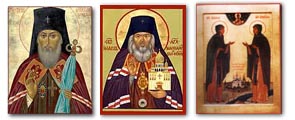
To glorify as Church-wide saints and include into the Church Calendar of the Russian Orthodox Church the following names:

    Hierarch Anthony (Smirnitsky, 1773-1846) of Voronezh, establishing December 20 (January 2) as his feast day;

    Hierarch John (Maximovich, 1896-1966) of Shanghai and San Francisco, establishing June 19 (July 2) as his feast day;*

    Abbess Juliania (1300-1393) and Nun Eupraxia (1302-1394) of Moscow, establishing May 3 (16) as their feast day;

To inform the Primates of the brethren Local Orthodox Churches of these names for inclusion in the lists of their saints.

To authorize the Holy Synod to examine and make decisions on the matter of the glorification of saints by the Russian Orthodox Church Outside of Russia during the period of division.

The Scholarly Committee is to include into the curricula of theological schools the lives and theological legacies of the New Martyrs and Confessors of Russia of the 20th Century.


ALEXY, PATRIARCH OF MOSCOW AND ALL RUSSIA

Members of the Presidium of the Council of Bishops:

Vladimir, Metropolitan of Kiev and All Ukraine

Daniel, Metropolitan of Tokyo and All Japan

Vladimir, Metropolitan of St Petersburg and Ladoga

Philaret, Patriarchal Exarch of All Belarus, Metropolitan of Minsk and Slutsk

Yuvenaly, Metropolitan of Krutitsa and Kolomensk

Kirill, President of the Department of External Church Relations, Metropolitan of

Smolensk and Kaliningrad

Kliment, Administrator of the Moscow Patriarchate, Metropolitan of Kaluga and Borovsk

Vladimir, Metropolitan of Kishinev and All Moldova

Hilarion, First Hierarch of the Russian Orthodox Church Outside of Russia,

Metropolitan of Eastern America and New York

Vladimir, Metropolitan of Tashkent and Mid-Asia

Alexander, Metropolitan of Riga and All Latvia

Kornily, Metropolitan of Tallin and All Estonia

Ioann, Archbishop of Belgorod and Starooskolsk

Kirill, Archbishop of Yaroslavl and Rostov


Source

* My namesake has been approved by the Russian Church.

Monday, October 08, 2007

A Hierarchical Liturgy


Scenes and music from a hierarchical liturgy of the Russian Orthodox Church.

Monday, October 01, 2007

Alexei II: Meeting with Pope likely in a year or two

This via the traditionalist Roman Catholic website Rorate Caeli; Patriarch Alexei II of Moscow indicated in an interview with the French paper Le Figaro that he expects to meet with Pope Bendict XVI in the next year or two. Assuming the accuracy of the story, this is a significant development. It would be the first explicit declaration by Moscow that there will be a meeting with the Pope of Rome. The Russian Church has been very cool towards Rome for years and has resisted attempts by the Vatican to arrange a meeting with the Pope. This was especially true under the previous pontificate. However since the election of B-16 there has been a noticeable warming in relations between the world's largest Orthodox church and the Holy See. Read the details here.

Wednesday, May 30, 2007

Moscow takes aim at (new?) Rome

Despite all the ink spilled over the subject of my preceding post, many Orthodox (including yours truly) will tell you that the Filioque is something that can probably be overcome. In fact most of the differences between Orthodoxy and Rome are in my opinion not insurmountable. This doesn't mean it would be a cake walk. But with a lot of charity and patience and a healthy dose of creativity most of the separating issues probably can be overcome to a degree sufficient to permit some sort of restoration of communion. The key word there is "most."

To me and I think again most (I only avoid the term "all" out of an abundance of caution) Orthodox the deal breaker is papal primacy and Vatican I. The language in the decrees of the First Vatican Council regarding the universal jurisdiction of the Pope and his infallibility are regarded as heresy by almost all Orthodox. And unfortunately the language used in those decrees is so crystal clear and unambiguous that there is not really any wiggle room for creative reinterpretation or "doctrinal development."
Wherefore we teach and declare that,
  • by divine ordinance,
  • the Roman church possesses a pre-eminence of ordinary power over every other church, and that
  • this jurisdictional power of the Roman pontiff is both
    • episcopal and
    • immediate.
  • Both clergy and faithful,
    • of whatever rite and dignity,
    • both singly and collectively,
  • are bound to submit to this power by the duty of hierarchical subordination and true obedience, and this
    • not only in matters concerning faith and morals,
    • but also in those which regard the discipline and government of the church throughout the world.
And...
So, then,
  • if anyone says that
    • the Roman pontiff has merely an office of supervision and guidance, and
      • not the full and supreme power of jurisdiction over the whole church, and this
      • not only in matters of
        • faith and morals, but also in those which concern the
        • discipline and government of the church dispersed throughout the whole world; or that
    • he has only the principal part, but not the absolute fullness, of this supreme power; or that
    • this power of his is not ordinary and immediate both over all and each of the churches and over all and each of the pastors and faithful:
    let him be anathema.
This is just not acceptable to the Orthodox Church.

In fairness we Orthodox, partly from historical circumstances, have been very clear in articulating what primacy is not, and not particularly clear about what it is. Indeed until recent times the subject has not really been much on anyone's agenda. There really was no need. However some years ago the late +John Paul Magnus of blessed memory issued a challenge to the Orthodox world to give our interpretation of the function of the Roman See. The silence was deafening. Now we are coming to the point where the silence will need to be broken. At the forthcoming session of the Catholic-Orthodox theological dialogue the topic is to be the primacy of the Bishop of Rome in the Church. I would give a lot of money that I don't have to be a fly on the wall of that meeting (with a universal translator).

As an interesting background to this, the chilly relations between Moscow and Constantinople seem to be growing cooler. Moscow has long accused the Patriarchate of New Rome of meddling in the affairs of the other churches (Russia's in particular) and of asserting a jurisdiction it does not have. Whereas +Bartholomew and the Synod of Bishops in Constantinople have been taking a more expansive view of things. Met. +John of Pergagmum, one of the foremost theologians in the Orthodox Church today, has strongly hinted at a broader interpretation of primacy than what has been normative within Orthodoxy. Of course nothing he has written even comes close to supporting the monarchical claims of the First Vatican Council. It is with this fascinating mix of church politics as a background that we see Moscow announcing that it is preparing an official position on the subject of primacy in the Church.

The Interfax News Service reports...
‘Our principal affirmation is this: primacy in the Church is necessary, also on the universal level, but on the level of the Universal Church it cannot be the primacy of jurisdiction but only the primacy of honour’, Bishop Hilarion of Vienna and Austria, Russian Church representative to European organizations, told Interfax on Monday.

‘There can be no compromises’ in this matter for the Moscow Patriarchate, he said. The aim of the theological dialogue is not to make a compromise but to identify the original understanding of the primacy of the Bishop of Rome in the early undivided Church, he noted.

‘Historically, the primacy of the Bishop of Rome in the Christian Church, from our point of view, was that of honour, not jurisdiction. That is to say, the jurisdiction of the Pope of Rome was never applied to all the Churches’, the bishop stressed.
No real surprises there. However, one might begin to wonder just who Moscow is taking aim at when reading a little farther down we note...
‘We consider it (the primacy of Constantinople - IF) exclusively as primacy of honour, while the See of Constantinople itself tends occasionally to give a broad interpretation to this primacy. These are the questions I believe around which principal problems will emerge’, Bishop Hilarion said.
We aint called "byzantine" for nothing.

All of the politics aside, the bottom line remains. Vatican I is the show stopper. I know of no Orthodox hierarch or credible theologian who would accept it. All of the other debates won't amount to a hill of beans because Vat. I is a nonnegotiable for the Roman Catholics and also for the Orthodox. In order to overcome it one or the other would have to cease to be what they are. And that is not gonna happen.

Sunday, May 27, 2007

The Music of the Russian Orthodox Church

There is a magnificent series of music videos on youtube featuring the music and chant of the Russian Orthodox Church. You can see a list here or just go to the youtube home page and type in "Russian Orthodox Music" for the complete list of videos. Even ignoring the music the scenery in the videos is breathtaking in itself. Below is a sample of one.

Thursday, May 17, 2007

In Communion!

Glory to God!

A great and bitter schism has ended and the two parts of the Russian Orthodox Church are again united.

Church bells pealed in Moscow as leaders of the Russian Orthodox faith signed a pact on Thursday healing a historic schism between the church in Russia, which for decades cooperated with Soviet authorities, and an offshoot set up abroad after the 1917 Bolshevik Revolution.

After a choir sang sonorous hymns, Moscow Patriarch Alexy II, leader of the main Russian Orthodox Church, led the ceremony with a sermon praising the healing of the split. Later, he formally signed the pact with Metropolitan Laurus, head of the Russian Orthodox Church Outside of Russia.

Russian President Vladimir Putin attended the somber celebrations, which were broadcast live on television.

Worshippers and white-robed clergy thronged the Christ the Savior Cathedral, symbolic of Russia's rejection of its communist past, when atheism was state doctrine and many believers were arrested and imprisoned.


Read the rest here...

Wednesday, May 16, 2007

More on the reunion

The International Herald Tribune has a nice article on the restoration of unity in the Russian Orthodox Church.

MOSCOW: The atmosphere was tense, laced with nearly a century of mistrust and bitter feelings, when President Vladimir Putin met in New York with leaders of an émigré church that had broken with the Russian Orthodox Church after the Bolshevik Revolution. The breakaway church had vowed never to return as long as the "godless regime" was in power.

"I want to assure all of you," Putin said at the 2003 meeting, "that this godless regime is no longer there." Then, recalled the Reverend Serafim Gan, a senior priest of the breakaway church, the Russian Orthodox Church Outside of Russia, Putin added: "You are sitting with a believing President."

That meeting set in motion years of difficult negotiations that on Thursday are expected to be capped by the signing of a canonical union at the Cathedral of Christ the Savior, which was dynamited by Stalin in 1931 and rebuilt in the 1990s. Church members are calling the signing - which coincides with the feast of Ascension - the symbolic end of Russia's civil war and confirmation of the Russian Orthodox Church's central role in post-Soviet society.

Joint services will also be held this weekend at Butovo, a Stalinist killing field outside Moscow that is now an Orthodox shrine to the Soviet dictator's victims, and at the Kremlin's Dormition Cathedral.

"This was a place of much sorrow, temptation, suffering, and the death of martyrs," said Father Gan about Butovo. "Now this place serves revival. I think that's what was deeply touching for all of us."

In an interview broadcast Monday on Vesti-24, a state-run news channel, Patriarch Aleksei II of the Russian Orthodox Church said "the Lord is helping us in this time, this time of spiritual revival, to gather up the stones that were so thoughtlessly scattered in the past."

The Russian Orthodox Church Outside of Russia, known informally as the Russian Church Abroad, will retain its name and administrative autonomy, said Father Gan. But Moscow will exercise ultimate authority in appointments and other church matters.

Read the rest here.

Friday, April 28, 2006

Will the Russian Church Be United?

From Fr. Huneycutt's excellent blog Orthodixie. Kindly direct comments to Fr. Huneycutts blog.

In the remote past of the 1960's and 1970's, we knew little of the Russian Church Abroad, but what we did know was all good. Jordanville's publications reached us—prayer books, the works of the Holy Fathers… The very appearance of these books bore witness that over there, pre-Revolutionary Russian traditions were preserved.

Soon, the voice of the contemporary bishops and priests abroad also began to reach us. I can state unequivocally that this voice was heard as the voice of our conscience, the voice of the whole "silent Church." Who else spoke out so clearly on the New Martyrs, on the Royal Family, on fatal modern trends, on ecumenism, etc? The glorification of the New Martyrs in 1981 was a great event for us, and before that, the canonization of Fr John of Kronstadt and of Ksenia the Blessed. We were well aware of the existing divisions from official publications, but we did not lend it too much significance. We knew that above and beyond all boundaries, the unity of our grace-filled live in Christ was preserved.

This was openly witnessed by the hierarchies of both parts of the Russian Church, who accepted clergymen in their existing rank who came from the other side. One First Hierarch of the Church Abroad, Metropolitan Philaret, in fact, had been a clergyman of the Moscow Patriarchate. The canonical existence of the Church Abroad had as its foundation the ukase of Patriarch Tikhon and his Synod of November 7/20, 1920, issued after General Vrangel's defeat, and having as one of its goals the ecclesiastical accommodation of millions of Russians who found themselves outside the borders of Soviet Russia.

Point number 2 states: "In the event a diocese, in consequence of the movement of the war front, changes of state borders, etc., finds itself completely out of contact with the Supreme Church Administration, or if the Supreme Church Administration itself, headed by His Holiness the Patriarch, for any reason whatsoever ceases its activity, the Diocesan Bishop immediately enters into relations with the bishops of neighboring dioceses for the purpose of organizing a higher instance of ecclesiastical authority for several dioceses in similar conditions (in the form either of a temporary Supreme Church administration or a Metropolitan district, or other)."

Of course, the ukase was issued under extreme circumstances, but these extreme circumstances, specifically the unprecedented persecution of the Church, describes the entire Soviet period of our history. We believed that as soon as this period ended, the unity of the Russian Church, split by the Revolution, would immediately be restored. The basis for these hopes was offered by the Church Abroad herself, which called herself, under the first two First Hierarchs at least, the part of the Russian Church that was abroad.

But as soon as the "iron curtain" was lifted, our hopes were replaced with disappointment. For Orthodox Russians who thought in traditional terms—and this is the overwhelming majority of our believers—the Russian Orthodox Church Outside of Russia had the highest authority, but this began to change when in 1990, she began to open parishes, then dioceses, in Russia. This was an erroneous decision in principle, but this activity on the territory of Russia was also littered with many mistakes. People who had just converted to the faith were drawn to the Church Abroad, having no roots in ecclesiastical or national traditions. They denounced the "Moscow Patriarchate" with such nauseating haughtiness, bundling under this name the hierarchy—which they did not, and could not, know—the many millions of people of the Church, and all our priests and monastics.

In addition to inexperienced neophytes, gathering under the Church Abroad were the corrupt and the careerists, who were reared under the Soviet system, such as Valentin of Suzdal. Unfortunately, the schism inflicted by the latter within the Church Abroad was inspired by the Church Abroad herself, in the person of her most renowned figure, the famous expert in canon law, Bishop Gregory (Grabbe), who proved himself to be a genuine ideologue of schism.

The canonical defects in the views of Bishop Gregory were, alas, not his alone. Many clergymen and laypersons abroad have a sense that the Russian Church Abroad is completely self-contained, even that she is unique in her dogmatic and canonical faithfulness to Orthodoxy. With such a world view, the catholic breadth of Orthodoxy is completely discarded.

How stark is the contrast between this and true Orthodoxy, from the pillars of the Church Abroad herself under Metropolitans Anthony and Anastassy! It is one thing when external, mostly political reasons led the Church Abroad to greater isolation in the Orthodox world. It is an entirely different matter when the Church Abroad herself provokes canonical battles with the Local Churches. Look at the wonderful words of Metropolitan Anthony on the matter of the church calendar in his correspondence with the monks of Mt Athos. Blessing them to struggle for the old calendar, he also very sternly warned them against ecclesiastical divisions and schisms on the calendar issue, considering that only dogmatic apostasy is grounds enough to cease church communion.

Canonical firmness of this sort was shared by Metropolitan Anastassy. Only in the last years of his life, without the knowledge of Metropolitan Anastassy, or the blessing of the Synod, individual bishops of the Church Abroad participated in the consecration of bishops for the schismatic Greek groups. When one asks clergymen of the Church Abroad about the canonical foundations for these consecrations, nothing revealing is heard, except phrases about the candidates having been good, pious men who suffered from the Greek authorities for the old calendar.

This is symptomatic of the serious atrophy of canonical awareness. The results of these consecrations lead one to tears. The Greek Churches, earlier maintaining a calm and even loyal attitude towards the Church Abroad, began to see her as a canonical opponent, and besides, the Church Abroad found herself drawn into the chaos of the Greek Old Calendar movement with its baker's dozen of "synods" and "jurisdictions," which declare as uncanonical not only the "new calendarists" but each other as well.

In recent years even the Serbian Church, which always preserved the closest bonds with the Church Abroad, became subject to rebuke for its alleged "ecumenism." When Western bombs containing depleted uranium fell on Serbia, our Patriarch hurried to Belgrade to pray together with Patriarch Pavle of Serbia for the salvation of the Serbian people. At the same time, voices emanated from the Church Abroad calling for the need to suspend relations with the Serbian Church.

Today, a crucial question is posed not to the Russian Church alone, but to the Universal Orthodox Church, a question of life or death. Where are we heading? Will we continue on the path of division, of fragmentation into newer and newer ecclesiastical institutions, which is inevitable down this road?

Not only recent events in the Church Abroad but matters in other Orthodox Churches speak of this real danger. But in order to abandon this road, we must recognize its faults, we must stop justifying divisions, as some ideologues of the Russian Orthodox Church Outside of Russia do. If we widen the ecclesiastical horizon, the system of foundations and precedents for today's zealots of divisions comes crashing down.

We remember Saint Cyprian of Carthage, but we forget that in the quarrel over the baptism of schismatics he was opposed by Stephan of Rome, also a martyr and also a saint. We also forget that the Church resolved this quarrel—but not in favor of Saint Cyprian (see rule 95 of the VI Ecumenical Council). We are taken with the logical acrivia of Saint Theodore the Studite, but we forget that he dared to condemn the great defenders of Orthodoxy Saints Tarasius and Nicipherous of Constantinople, and that the Church in the end anathematized "all written or spoken" against these bishops (the Synodic on the Triumph of Orthodoxy). Even the uncompromising acrivia of Saint Maxim the Confessor, who refused to receive communion with all five patriarchs and with "the whole Universal Church," was not without an alternative. Saint Maxim accused of the monothelitistic heresy even those who had rejected the monothelitic Ecthesis and did not follow it. The IV Ecumenical Council, condemning the heresy of monothelitism, remained silent about Saint Maxim. Even when the heretic Macarius, Patriarch of Antioch, spewed slander and lies against Saint Maxim, the Council did not utter one word in his defense.

If we allow ourselves to take church history out of context, picking and choosing what we like and ignoring all the rest, we fall into genuine Protestantism, the only difference being that we subject not only Holy Scripture to the whims of our personal judgment, but everything that we call Tradition. We must first answer of ourselves what we seek: to curl up into a small, isolated "jurisdiction," or to participate in the life of Universal Orthodoxy, supporting all that is good and healthy and struggling against all untruth.

Time is heading catastrophically fast. Tomorrow may be too late. "Tomorrow," in fact, may not even arrive.

We wait with baited breath that the forthcoming All-Diaspora Council will make a decision in principle on the reestablishment of communion with the Martyr-Church in the Homeland. All other questions will decide themselves. The current structure of the Russian Church allows all levels of autonomy, beginning with the Autonomous Japanese Church, which in fact is entirely independent, and the Ukrainian Orthodox Church, also completely independent and yet having influence over the life of the entire Russian Church through its First Hierarch, Metropolitan Vladimir, who is a permanent member of our Holy Synod.

It would be easier to achieve unity if we think carefully and with all seriousness ask of our conscience what the following individuals would do in our present circumstances: Metropolitan Anthony of blessed memory, Metropolitan Anastassy of blessed memory, St John of Shanghai ...

We should at least not forget that it was through the efforts of His Holiness Patriarch Varnava of Serbia, whose heart bled for the divisions in the Russian Church, that Metropolitan Anthony renewed communion with Metropolitan Eulogius, without even demanding that he withdraw from the jurisdiction of Constantinople, even while considering it uncanonical. Later, the American Metropoliate was accepted into communion by the Russian Orthodox Church Outside of Russia, while still retaining its autonomy. This triumph of the love of Christ must inspire the zealots of the memory of Vladyka Anthony.

Protopriest Valentin Asmus of the Moscow Patriarchate

Sunday, April 23, 2006

Alexy II sends letter of support to head of Russian Church abroad

The following article was posted by the Russian news service Interfax. As we approach the month of May, this could be one of the most important moments in recent history for Orthodoxy. The forthcoming All Diaspora Council to be held in San Francisco could effectively put the final stamp of approval on efforts to restore full communion between the Russian Orthodox Church Outside of Russia and the mother church. The broader implication is that it might also restore full communion between ROCOR and the rest of the canonical Orthodox world. Let us pray. Lord have mercy!

Moscow, April 23, Interfax - Patriarch Alexy II of Moscow and All Russia has sent a letter to First Hierarch of the Russian Orthodox Church Outside of Russia (ROCOR) Metropolitan Laurus, in which he supported his efforts toward the reunification of the two churches, Alexy said in an interview published in the Saturday issue of the Trud newspaper.

ROCOR's All-Diaspora Council is expected to make the final decision on whether to unify with the Moscow Patriarchate in May 2006. "However, there are forces to which this convergence is unacceptable," Alexy said.

He said pressure on the participants in the upcoming Council convention "is being applied from both the inside and outside."

"All evil forces are standing up against this," the patriarch said. "However, we still hope that reason will dominate. There are no factors dividing the Russian church abroad and the Moscow Patriarchate," he said.

The current period in relations between the Russian Orthodox Church and the ROCOR is most suitable for their reunification, he said.

"The more time passes, the less the Russian Church abroad will remain Russian. Therefore, this might perhaps be the last chance to unify two branches of the Russian people in one church," he said.

The Russian Orthodox Church is open to reunification and is praying "for those who will gather for the All-Diaspora Council on these paschal days to discuss this crucial issue," Alexy said.

"God willing they will have enough wisdom to hear Christ the Savior's prayer 'that they may all be one'," Alexy said.