(I can sort of be seen between the bishop's right shoulder and the protodeacon.)


 Source
(I can sort of be seen between the bishop's right shoulder and the protodeacon.)Source
Source
(I can sort of be seen between the bishop's right shoulder and the protodeacon.)Source


After the death of Saul, who had fallen on his sword during a battle with the Philistines, an Amalekite ran to inform David, who at that time was being persecuted by Saul.
Supposing that David would be very glad at the news he brought, the messenger decided to pose as Saul’s killer, in order to increase the anticipated reward.
However, when David had heard the story made up by the Amalekite about how he, at the request of the wounded Saul, had slain him, he took hold of his garments and rent them, as did also all the people who were with him. They mourned and wept and fasted till evening. And David said to the young man that told him, Whence art thou? And he answered, I am the son of a stranger, an Amalekite. And David said unto him, How wast thou not afraid to stretch forth thine hand to destroy the Lord’s anointed? And David called one of the young men, and said, Go near, and fall upon him. And he smote him that he died. And David said unto him, Thy blood be upon thy head; for thy mouth hath testified against thee, saying, I have slain the Lord’s anointed (II Kings [II Samuel in the Authorized Version] 1:1-16).
Thus the foreigner who posed as Saul’s killer was executed. He was subjected to a cruel punishment, even though Saul was the persecutor of the innocent David and had done much evil, for which the Lord had departed from him.
From David’s words it is evident that he doubted the veracity of the Amalekite’s story and was not convinced that the man was indeed Saul’s murderer; nevertheless, he gave him over to death, considering that even calling oneself a regicide and boasting of such a deed was worthy of death.
How many times more grave and sinful was the murder of the Orthodox monarch anointed by God; how many times greater must the punishment be for the murderers of Tsar Nicholas II and his family?!
In contrast to Saul, who had turned away from God and because of this had been abandoned by Him, Tsar Nicholas II was an exemplar of piety and complete devotion to God’s will.
Having received not the Old Testament pouring of oil on the head, but the grace-filled “Seal of the gift of the Holy Spirit” in the Mystery of Chrismation, Emperor Nicholas II was faithful to his high calling till the end of his life and was conscious of his responsibility before God.
In his every action, Emperor Nicholas II took his conscience into account; he always “walked before the Lord God.” He was “Most Pious” during the days of his earthly well-being, not only in name, but in actual fact. In his time of trial, he displayed patience like that of righteous Job.
Against such a Tsar did criminals raise their hands, and at a time when he had already been purified, like gold in the furnace, by the trials he had endured, so that he was an innocent sufferer in the full sense of the word.
The crime against Tsar Nicholas II is all the more terrible and sinful in that his whole family was killed together with him, including the children, who were not guilty of anything!
Such crimes do not remain unpunished. They cry out to Heaven and bring God’s wrath down upon the earth.
If the foreigner — the supposed murderer of Saul — underwent death, now the whole Russian nation is suffering for the murder of the defenseless Tsar-Sufferer and his family, because it allowed such a terrible misdeed to take place and remained silent when the Tsar was subjected to humiliation and deprived of his freedom.
God’s justice requires of us a profound realization of the sinfulness of what was done, together with repentance before the Tsar-Martyr and his memory.
The memory of the innocent holy princes Boris and Gleb aroused the conscience of the Russian people during the disturbances which upset the appanage principalities, and it shamed the princes who had initiated the strife. The blood of the holy Great Prince Igor brought about a spiritual change in the souls of the Kievans and united Kiev and Chernigov in venerating the slain holy prince. Saint Andrew Bogoliubsky sanctified with his blood the monarchy of Rus’, which was confirmed only considerably later, after his death as a martyr. The veneration of Saint Michael of Tver throughout Russia healed the wounds caused by the struggle between Moscow and Tver. The glorification of the holy Tsarevich Dimitri cleared the consciousness of the Russian people, inspired moral strength and led, after severe shocks, to the rebirth of Russia.
The Tsar-Martyr Nicholas II and his much-suffering family have now entered into the choir of these Passion-bearers.
This greatest of crimes, committed with respect to him, must be expiated by fervent veneration of him and by the glorification of his struggle.
Rus’ must bow down before its humiliated, slandered and martyred Tsar, just as the Kievans once bowed down before the venerable Prince Igor whom they martyred, and just as the people
of Vladimir and Suzdal bowed down before the slain Great Prince Andrew Bogoliubsky!
Then the Tsar-Passion-bearer will acquire boldness before God, and his prayer will deliver the Russian land from the calamities it is enduring.
Then the Tsar-Martyr and his fellow sufferers will become new heavenly defenders of Holy Rus’.
The innocent blood that was shed will regenerate Russia and make it radiant with new glory!
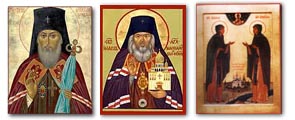
[Decreed:] To approve the work of the Synodal Commission on the Canonization of Saints during the inter-Sobor period.
To glorify as Church-wide saints and include into the Church Calendar of the Russian Orthodox Church the following names:
Hierarch Anthony (Smirnitsky, 1773-1846) of Voronezh, establishing December 20 (January 2) as his feast day;
Hierarch John (Maximovich, 1896-1966) of Shanghai and San Francisco, establishing June 19 (July 2) as his feast day;*
Abbess Juliania (1300-1393) and Nun Eupraxia (1302-1394) of Moscow, establishing May 3 (16) as their feast day;
To inform the Primates of the brethren Local Orthodox Churches of these names for inclusion in the lists of their saints.
To authorize the Holy Synod to examine and make decisions on the matter of the glorification of saints by the Russian Orthodox Church Outside of Russia during the period of division.
The Scholarly Committee is to include into the curricula of theological schools the lives and theological legacies of the New Martyrs and Confessors of Russia of the 20th Century.
ALEXY, PATRIARCH OF MOSCOW AND ALL RUSSIA
Members of the Presidium of the Council of Bishops:
Vladimir, Metropolitan of Kiev and All Ukraine
Daniel, Metropolitan of Tokyo and All Japan
Vladimir, Metropolitan of St Petersburg and Ladoga
Philaret, Patriarchal Exarch of All Belarus, Metropolitan of Minsk and Slutsk
Yuvenaly, Metropolitan of Krutitsa and Kolomensk
Kirill, President of the Department of External Church Relations, Metropolitan of
Smolensk and Kaliningrad
Kliment, Administrator of the Moscow Patriarchate, Metropolitan of Kaluga and Borovsk
Vladimir, Metropolitan of Kishinev and All Moldova
Hilarion, First Hierarch of the Russian Orthodox Church Outside of Russia,
Metropolitan of Eastern America and New York
Vladimir, Metropolitan of Tashkent and Mid-Asia
Alexander, Metropolitan of Riga and All Latvia
Kornily, Metropolitan of Tallin and All Estonia
Ioann, Archbishop of Belgorod and Starooskolsk
Kirill, Archbishop of Yaroslavl and Rostov
 Today is the Feast of St. John Maximovitch and also my name day.