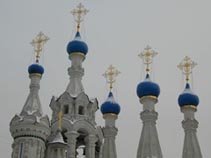
Leo Tolstoy’s excommunication from the Russian Orthodox Church in 1901 can’t be overturned because the writer never publicly renounced his “tragic spiritual aberrations” a church official said.Source
“The decision of the Most Holy Governing Synod merely stated an accomplished fact,” said Archimandrate Tikhon Shevkunov, executive secretary of Patriarch Kirill’s council on culture. “Count Tolstoy excommunicated himself from the church, he broke with it entirely. He not only didn’t deny this, but emphasized it vigorously at every opportunity.”
Shevkunov was responding to an open letter to the patriarch from Sergei Stepashin, a former prime minister, on the occasion of the centenary of Tolstoy’s death on Nov. 20. Stepashin, as head of the Russian Book Union, asked the patriarch to explain the church’s position on Tolstoy and to make a “public display of compassion in some form.”
Shevkunov’s and Stepashin’s letters were published today by Rossiiskaya Gazeta, the government’s newspaper of record.
Tolstoy was Russian literature’s most “tragic personality,” whose attacks on the church were “horrifying for the Orthodox consciousness.”
In the last decades of his life, Tolstoy’s activities were “truly destructive for Russia, which he loved,” Shevkunov said. “They brought misfortune upon the people whom he so wanted to serve.”
Thursday, November 18, 2010
Russian Orthodox Church "can not" lift excommunication of Tolstoy


Rowan Williams says women priests should not impede communion with Rome
VATICAN CITY (RNS) A week and a half after losing five Anglican bishops to the Catholic Church, the leader of the worldwide Anglican Communion reaffirmed his dedication to ecumenical relations between the two churches -- and his belief that female Anglican priests should not be an impediment to union.Source
Archbishop of Canterbury Rowan Williams spoke Wednesday (Nov. 17) at a ceremony marking the 50th anniversary of the Vatican's ecumenical office. Dozens of senior Catholic leaders attended, including the church's No. 2 official, Secretary of State Cardinal Tarcisio Bertone.
While reflecting on progress in Anglican-Catholic relations, Williams admitted to "intractable difficulties" in two areas: disputes over the authority of the pope, and a failure of the two churches "to recognize each other's ministries fully."
Catholics insist on an all-male priesthood, while several parts of the Anglican Communion -- including the Church of England, the Episcopal Church in the United States and the Anglican Church of Canada -- ordain women.
Williams echoed a statement from his Nov. 2009 address to a Vatican ecumenical conference, when he asked rhetorically "in what way" the ordination of women priests could "compromise the purposes of the church."
The issue has provoked tension not only between Rome and Canterbury, but within the Church of England itself.
Earlier this month, five Church of England bishops announced plans to join the Catholic church under a Vatican program that permits them to retain many traditional Anglican forms of worship and governance in special Catholic dioceses. The Vatican designed the program to facilitate the conversion of Anglicans upset by their churches' growing acceptance of homosexuality and women priests.
In his speech on Wednesday, Williams did not refer to the bishops' conversion or to the Vatican's overture to Anglican converts. Williams is scheduled to meet Pope Benedict XVI on Thursday.
H/T Dr. Tighe who writes in response to Dr. Williams' drivel...
Evidently he has run out of things to say on the subject, so now he contents himself with the mere repetition what he said in Rome in October 2009. But to what point, really? Rome made it clear already, in the correspondence between Paul VI and Coggan the AbC in 1975 and 76 that from the Catholic perspective WO would form an "insuperable obstacle" to Anglican/Catholic "reunion," and this was reenforced by Inter Insigniores in 1977, Ordinatio Sacerdotalis in 1994 and the CDF statement on OS in 1995. To put it bluntly, the Catholic teaching is that "the Church has no authority to ordain women," and that the status of this teaching is that it is "irreformable" (unchangeable). And when Williams goes on to argue that the question of who can preside at the Eucharist is not an essential or first-order issue, he sets himself at odds with the whole Catholic Tradition, East and West, as well as the position of the Catholics, the Orthodox, the Oriental Orthodox and the Assyrians, and so one can see that his "Catholic Anglicanism" has resolved itself into nothing more than ritualistic Liberal Protestantism. And so the "Church that Elizabeth Built" has returned back to its Protestant and Reformed origins of 1559, albeit bedizened with a medley of feathers filched from other fowl in its farings.
Tuesday, November 16, 2010
A quiet revolt against Rome is spreading in Belgium
BUIZINGEN, Belgium — Willy Delsaert is a retired railroad employee with dyslexia who practiced intensively before facing the suburban Don Bosco Catholic parish to perform the Sunday Mass rituals he grew up with.Read the rest here.
“Who takes this bread and eats,” he murmured, cracking a communion wafer with his wife at his side, “declares a desire for a new world.”
With those words, Mr. Delsaert, 60, and his fellow parishioners are discreetly pioneering a grass-roots movement that defies centuries of Roman Catholic Church doctrine by worshiping and sharing communion without a priest.
Don Bosco is one of about a dozen alternative Catholic churches that have sprouted and grown in the last two years in Dutch-speaking regions of Belgium and the Netherlands. They are an uneasy reaction to a combination of forces: a shortage of priests, the closing of churches, dissatisfaction with Vatican appointments of conservative bishops and, most recently, dismay over cover-ups of sexual abuse by priests.
The churches are called ecclesias, the word derived from the Greek verb for “calling together.” Five were started last year in the Netherlands by Catholics who broke away from their existing parishes, and more are being planned, said Franck Ploum, who helped start an ecclesia in January in Breda, the Netherlands, and is organizing a network conference for the groups in the two countries.
At this sturdy brick church southwest of Brussels, men and women are trained as “conductors.” They preside over Masses and the landmarks of life: weddings and baptisms, funerals and last rites. Church members took charge more than a year ago when their pastor retired without a successor. In Belgium, about two-thirds of clergymen are over 55, and one-third older then 65.
“We are resisting a little bit like Gandhi,” said Johan Veys, a married former priest who performs baptisms and recruits newcomers for other tasks at Don Bosco. “Our intention is not to criticize, but to live correctly. We press onward quietly without a lot of noise. It’s important to have a community where people feel at home and can find peace and inspiration.”
Despite objections Russian Orthodox Church to take possession of former Roman Catholic Church
Moscow, November 16, Interfax - The Moscow Patriarchate urges Catholics to give an unbiased opinion of transferring the former Catholic Church to the Russian Orthodox Church.Source
"First of all, I would like to assure everyone that the decision made by the regional Duma deputies (to transfer this and several other buildings to the Orthodox Church - IF) should not be in any way viewed as a hostile effort by the Kaliningrad Diocese," Dimitry Sizonenko, an acting secretary for inter-Christian relations of the Moscow Patriarchate Department for External Church Relations, told Interfax-Religion.
He denies the allegations of Archbishop Paolo Pezzi who earlier stated this draft law had been "insidiously lobbied".
According to Father Dimitry, some publications about the Russian Church laying claim on the building have been posted in Internet as far back as few months ago.
"It was no secret. Addressing the issue of the building transfer, the regional administration made it a condition that the philharmonic hall continued its work without charge. Thus, the final decision was made in favour of the bidder who met this quite reasonable requirement," Fr. Dimitry said.
He also denies any assumptions that the decision to transfer the former Catholic church to the Orthodox Church has shown disrespect for the lawful rights of the Catholic believers - the descendants of the postwar migrants who had arrived to Kaliningrad from across the Soviet Union.
"It should be remembered that the legal owners of Holy Family Church have left the city for good when it was included within the USSR. The postwar migrants, therefore, have no direct interest in this building," Fr. Dimitry stated.
He recalled that the building was neglected for many years, and "it is quite evident" that the Catholic descendants of those migrants were not the only ones who had done the renovation started in early 1970s by the head of the city council. The building was renovated to open the organ hall by a joint effort of all citizens and now it is their "common heritage".
According to Fr. Dimitry, "the way the Catholic Church treats this challenge today reveals many contradictions inherent to the Russian Catholic Church," and Catholics "unreasonably position themselves in this dispute as a religious minority." However, they make their statements on behalf of the Church which counts more than a billion believers globally.
Fr. Dimitry is convinced that it is possible to come up with a reasonable solution, because "the Russian Orthodox Church has always tried to decide such delicate matters in a way suitable for all."
This is not right. If the reverse were happening the Orthodox Church would (rightly) be raising cain over it.
Prince William is engaged to marry
LONDON — Years of fevered anticipation and premature speculation ended on Tuesday morning when Prince William, the heir to the heir to the British throne, said that, yes, he does plan to marry his girlfriend of many years, Kate Middleton.Read the rest here.
In a brief statement, William’s father, Prince Charles, said that he was “delighted” to announce the engagement of William and Miss Middleton, both 28, and that they would be married next spring or summer.
“Prince William has informed the queen and other close members of his family,” the statement said. “Prince William has also sought the permission of Miss Middleton’s father.”
Financial markets tumble over spreading debt crisis
Worries about Europe’s debt crisis and possible moves by authorities in Asia to slow fast-paced growth there swept the world’s markets on Tuesday and pushed stocks in the United States sharply lower.Read the rest here.
As finance ministers from the 16 countries that use the euro met in Brussels to discuss the problems in Ireland, investors worried that the debt crisis could spread across the Continent to Portugal, and even to Spain.
“There is a worry about the state of things overseas. It is the European debt crisis that is causing this,” said Zach Pandl, economist at Nomura in New York.
Stocks, which have been grinding lower since the Federal Reserve announced its asset purchase program to stimulate the economy, fell for the seventh consecutive day.
The Dow Jones industrial average briefly fell below 11,000 for the first time since early October. At the close it was at 11,023.50 down 178.47 points, or 1.59 percent on the day.
The Standard & Poor’s 500-stock index fell 1.62 percent, and the Nasdaq composite dropped 1.75 percent.
Lance Armstrong Inquiry Intensifies
Federal investigators and antidoping officials from the United States, including the federal agent Jeff Novitzky, have elevated their investigation of Lance Armstrong and are in France to meet with antidoping officials and members of Interpol, according to a person briefed on the investigation who spoke on condition of anonymity.Read the rest here.
United States officials have been scrutinizing Armstrong’s suspected links to doping for several months. Interpol is an international police organization that helps authorities from different countries work together on investigations.
The presence of United States investigators in France was first reported Tuesday by The Associated Press, which cited unnamed sources.
The investigation of Armstrong began earlier this year and has focused on whether he used performance-enhancing drugs to defraud sponsors while he was a member of the United States Postal Service cycling team.
Since the summer, a federal grand jury in Los Angeles has been hearing evidence about Armstrong, a seven-time winner of the Tour de France.
Monday, November 15, 2010
Calif. court upholds in-state tuition for illegal immigrants
 California
SAN FRANCISCO — The California Supreme Court weighed in Monday on the politically charged immigration fray when it ruled that illegal immigrants are entitled to the same tuition breaks offered to in-state high school students to attend public colleges and universities.Read the rest here.
While the ruling applies only to California, the case was closely watched nationally because nine other states, including New York and Texas, have similar laws.
Republican congressmen Lamar S. Smith of Texas and Steve King of Iowa filed a so-called friends of the court brief urging that illegal immigrants be denied the reduced rate.
The lawsuit considered by the court was part of a broader legal assault led by immigration legal scholar Kris Kobach, who has filed numerous cases across the country seeking to restrict the rights of illegal immigrants.
He represented a group of U.S. students who filed the lawsuit seeking to invalidate the California law.
Advent
For those of us on the New Calendar today marks the beginning of the Nativity Fast (Advent in the West). In terms of its strictness it is probably the easiest of the four Fasts. But it is the one I tend to struggle with the most. Please pray for me.
Sunday, November 14, 2010
Debating the Gold Standard
With gold having broken $1400 oz. it is once again in the news. A number of people outside of the usual suspects (so called gold bugs) are starting to whisper or even openly talk about something not seriously discussed since the 1970's, namely reverting to some system where money would be tied to gold, i.e. a gold standard. (See the preceding post.) It might surprise readers to learn this, but I am actually not wild about a rigid gold standard.
Although a sharp critic of the lax monetary policies of the Federal Reserve (which greatly contributed to the current mess we are in), I do actually believe that central banks need some flexibility to deal with emergencies that a rigid gold standard would deny. And of course it is worth noting that no country faced with a major crisis allowed itself to be wrecked (although we came close in the early 30's) by a strict adherence to gold as money. Nations confronted with an urgent need for money that they could not back with gold simply cheated. Or they abandoned the gold standard altogether until the emergency had passed. The United States is no exception. We (both sides) printed money during the Civil War, which gave us a decade of brutal inflation lasting well into the 1870's. And we did it again for a much shorter period during the First World War. The inflation there was short lived and less severe as we quickly returned to gold after the war was over. And of course we abandoned gold during the height of the Great Depression and stayed away from it until the early 1950's.
The combination of brutal depression era unemployment followed by the rationing of the war years kept inflation in check until the late 40's when we began to pay for all of the money printed and the massive debt accumulated. Post war inflation was eventually brought under control by the so called Bretton Woods Agreement which established a modified Gold Standard. Bretton Woods though proved unworkable in the cold war era as a consequence of the large defense budgets most nations had to maintain. There was widespread cheating and the United States kept backing away from gold as our true debts (masked as usual by Washington bookkeeping games) from cold war spending, the so called war on poverty, and the Vietnam War began to rise drastically.
By 1970 it was clear that the illusion could no longer be maintained. In 1971 President Nixon ended the last farcical ties to the old gold standard and the world shifted to a system of free floating paper (fiat) currencies. What followed was predictable. As the FED under then chairman Arthur Burns kept interest rates low (but not nearly as low as Greenspan and Bernanke have) the price of gold, now freely traded on the open market began to rise against paper money. By the mid-late 1970's we began to see the effects of more than a decade of loose money policies with a sharply rising CPI. The Great Inflation which had been building arguably since the Kennedy Administration finally exploded and by 1980 we had CPI at near 12%.
Throughout that period gold (and silver) rose faster than either the stock market or the bond market. Beginning in the early 80's following the appointment of Paul Volker the FED moved to crush the inflation with massive interest rate hikes. This temporarily plunged the United States into the worst post war recession until the current one. But it started to pass by 1983 (just in time for Reagan’s famous 1984 re-election campaign). The inflation was broken and for the next fifteen years the United States enjoyed a period of relative prosperity with only a minor recession in the early 90's. During most of this period inflation remained tame and gold after peaking in 1981 entered a twenty year bear market.
The lesson from all of this is that gold when adopted formally as currency is both unreliable (nations cheat at will) and undesirable (it denies any flexibility to central bankers to deal with legitimate emergencies). That doesn't mean I am against gold. I am not. Rather I believe gold is more or less where it should be today in terms of function.
Today gold is essentially an extra-national reserve currency. It is the one form of money not tied to any central bank and impervious to the depredations of the printing press. Investors can buy and hold it at will, or leave it alone if they think paper money is being managed wisely, and collect the interest on bonds. (Gold of course famously pays no dividends and has no yield.) By keeping government hands off gold private citizens in effect have their own safety net that they can add to or subtract from at will according to their confidence level in fiat currency.
Gold is the ordinary man's means of protecting himself from foolish actions on the part of governments and casting a "no confidence" vote when it looks like the FED is getting a little too hinky with the printing press. In this respect it also functions much as it did in the early 1970's when first opened up for public trading, in effect as a sort of early warning system. Gold today is pretty much where it was in the mid-70's (adjusting for inflation) and it is sending the same message. "We are in trouble."
In the final analysis gold is the canary in the coal mine. Gold does not trade at $1400 oz unless something is seriously wrong in Central Bank land and the halls of Congress.
A final observation for those who despise gold or or who are confirmed gold bugs. Gold has had a good run over the last decade thanks to Mr. Greenspan and Mr. Bernanke. But it won't last. At some point Washington will get its act together and we will swallow the bitter pills and stop printing money and racking up staggering deficits. This current policy is unsustainable, just as it was in the 1970's. When that happens gold will correct downward again as confidence in currency returns. I think we may be some years from that point though, and it is quite possible, even likely, that things will get much worse before hand.
Of the last four decades gold hugely outperformed the bond markets and stock markets for two of them. But gold also smelled like last week's trash left to ferment in 90+ degree temperatures during most of the 80's and 90's when stocks and bonds did extremely well. The lesson: Put not your faith in any one asset class. They all have their cyclical swings. Stay diversified and be prepared for whatever the future might bring. And be careful about predicting future events. If there is one consistent lesson that has been proven over and over again, it is that prognosticating on financial markets is a loosing game. If in doubt on that you are encouraged to read any of Jack Bogle's books.
Jim Grant (NY Times): It's time to go back on the Gold Standard

BY disclosing a plan to conjure $600 billion to support the sagging economy, the Federal Reserve affirmed the interesting fact that dollars can be conjured. In the digital age, you don’t even need a printing press.Read the rest here.
This was on Nov. 3. A general uproar ensued, with the dollar exchange rate weakening and the price of gold surging. And when, last Monday, the president of the World Bank suggested, almost diffidently, that there might be a place for gold in today’s international monetary arrangements, you could hear a pin drop.
Let the economists gasp: The classical gold standard, the one that was in place from 1880 to 1914, is what the world needs now. In its utility, economy and elegance, there has never been a monetary system like it.
It was simplicity itself. National currencies were backed by gold. If you didn’t like the currency you could exchange it for shiny coins (money was “sound” if it rang when dropped on a counter). Borders were open and money was footloose. It went where it was treated well. In gold-standard countries, government budgets were mainly balanced. Central banks had the single public function of exchanging gold for paper or paper for gold. The public decided which it wanted.
Congratulations: You have just become dictator for a day...
Now go fix the Federal Budget. I did it in about 5 minutes. Even managed to get a modest "surplus" to start paying down the actual debt. Isn't it wonderful when you don't have to deal with Congresses, and a thousand and one special interest groups? Hamilton was right. We should have been a monarchy.
Fraud alleged in recent Holy Synod decree regarding Antiochian Archdiocese of N. America
A bombshell may have just detonated in the Middle East. The fathers of Holy Trinity Monastery have posted a direct accusation that at least part of the recent decree of the Holy Synod of Antioch which purportedly gave autocratic authority to Metropolitan Philip was forged. Arab Orthodox blogger Samn! has the translation from the Arabic posted on his website. Met. Philip has been wielding this new found authority very aggressively recently, removing at least one troublesome bishop and two priests.
H/T Bill (the Godfather)
H/T Bill (the Godfather)
Saturday, November 13, 2010
Episcopal Diocese of Maryland sends gay priest to Anglo-Catholic parish converting to Rome
Last Sunday the Episcopal Diocese of Maryland sent in another priest to celebrate an unscheduled Service of Holy Communion at Calvary Episcopal Church. This decision on the part of the Diocese was made following the parish's overwhelming vote to disassociate with The Episcopal Church and begin the conversion process to Roman Catholicism.Read the rest here.
The Rev. Jesse Leon Anthony Parker, rector at St. John's-in-the-Village, celebrated a 9 am Eucharist at Mount Calvary, wedging his service in between Mount Calvary's scheduled 8 am Low Mass and 10 am Solemn High Mass. Only a handful of loyal Episcopalians attended the impromptu service.
Fr. Parker is the only priest at St. John's which is about two and a half miles away. He has been rector at that parish since 1991.
Mount Calvary's rector, the Rev. Jason Catania said that it was "no surprise" that Fr. Parker showed up. The Diocese of Maryland communicated its intension to Fr. Catania beforehand. The visiting Episcopal priest is an openly homosexual relationship.
Although Fr. Parker started his service late, which caused it to run overtime, Fr. Cantania said there were "no incidents and everyone was polite." However, the Mount Calvary rector is speaking with the Diocese of Maryland to insure that there is not another unscheduled Service of Holy Communion celebrated at his altar.
The Episcopal Diocese of Maryland officially refused to comment about the incident.
That's what I've always liked about the Episcopalians. They are so classy.
Poliics, football and the Democratic Party
ASHEVILLE, N.C. — After a junior year in which he almost won the Heisman Trophy, Heath Shuler was picked in the first round of the 1994 National Football League draft by the Washington Redskins. In less than two seasons — and after a few too many interceptions — he was replaced as the team’s starting quarterback. ESPN described him as one of the all-time draft busts.Read the rest here.
He might be expected to play down such a distinction. But Mr. Shuler, 38, who just won a third term as the congressman representing North Carolina’s 11th District, has turned it into metaphor.
“It’s no different than me as a quarterback,” he said in an interview here on Thursday. “I didn’t play very good. So what they’d do? They benched me.”
The Redskins in this instance are the Democrats in Congress. The dismal season is the trouncing they received at the polls two weeks ago. And the quarterback is Nancy Pelosi, the soon-to-be former speaker of the House.
Since surviving that election, Mr. Shuler has emerged as one of most prominent voices in the debate about the Democratic Party’s immediate future. He was among the first to call for Ms. Pelosi to step down from her leadership role in the new Congress and said he would run for minority leader himself if no alternative emerged (though he admitted that he would be an underdog).
The Democrats’ achievements in the last Congress, Mr. Shuler said, are unpopular with the public because the party’s leadership has been too reflexively partisan. He says a more moderate approach is needed.
“It’s my guys that worked probably harder than any group in Washington, did all the right things, voted the right way and still got beat for the simple fact that you’ve got the far edges running the Congress,” Mr. Shuler said.
His guys are the members of the Blue Dog coalition, a group of conservative Democrats who came together after the Republican sweep of 1994, and, boy, did they ever have a bad Election Day this year. Twenty-four of the bloc’s 58 members were defeated, including two of its four leaders (Mr. Shuler is the coalition’s whip). Four other Blue Dogs are retiring this year.
Mr. Shuler has some points. Nancy Pelosi was a great lightning rod for the GOP. But the real problem IMO is that Shuler is a conservative in a liberal party. Back in 1946 the Democrats got handed their south ends in the congressional elections and the Republicans took control of Congress for the first time since Hoover was president. After the dust settled the party leadership urged Harry Truman to tack to the right and abandon a lot of the New Deal and some of his own liberal agenda including civil rights. Truman declined noting "given a choice between a Republican and a Republican, the people will vote for the Republican every time."
And that ladies and gentlemen is what just happened to the Blue Dog Democrats.
On a side note Truman ran against seemingly hopeless odds in 1948 against the Republican 80th Congress (which Truman castigated as the "do-nothing" Congress) and he won re-election and returned the Congress to a Democratic majority. If the GOP has any clue about history they will keep the 80th Congress's fate in mind as they settle down in their new majority.
Alaska: Efforts to steal election waning
JUNEAU, Alaska – The lawyers have started leaving.Read the rest here.
That is perhaps the surest sign that Joe Miller’s chances of becoming the next senator from Alaska are evaporating. With each passing day that election workers here in the state capital manually count write-in votes cast for Senator Lisa Murkowski, it appears increasingly likely that Alaskans spell too well for Mr. Miller’s math to work.
Assisted by lawyers sent by the Republican National Senatorial Committee, the Miller campaign set out to challenge every smudge, stray mark and misspelling they could find (and, often, only they could find) on write-in votes that appeared to be for Ms. Murkowski.
The plan was to question enough votes to close the 11,000-vote margin by which he trails – and then to convince the courts that those challenged votes should be discounted.
Alaska law says write-in votes will be counted if the name or last name is written “as it appears” on the candidate’s declaration form. But state election officials, citing legal precedent in the state, said they would count all votes in which they could determine “voter intent,” misspellings aside.
Now the dispute could become irrelevant. After three days of counting, the state has determined that 98 percent of write-in ballots were cast for Ms. Murkowski – and 90 percent of those were cast so cleanly that they have survived even the sometimes bafflingly strict scrutiny applied by monitors working for Mr. Miller.
Municipal Bonds Take a Hit
That is the question investors are asking after munis — those old faithfuls of investing — took their biggest hit since the financial collapse of 2008.Read the rest here.
Concern over the increasingly strained finances of states and cities and a growing backlog of new bonds for sale overwhelmed the market last week. After performing so well for so long, munis and funds that invest in them fell hard. One big muni fund, the Pimco Municipal Income Fund II, for instance, lost 7.5 percent. The fund is still up 6.75 percent so far this year.
While the declines were relatively small given the remarkable gains in these bonds over the last two years, the slump was swift enough to leave investors wondering if this was a brief setback or the start of something worse. For months, some on Wall Street have warned that indebted states and cities might face a crisis akin to the one that brought Greece to its knees.
“I think it’s too early to say that it’s more than a correction,” said Richard A. Ciccarone, the chief research officer of McDonnell Investment Management.
“The facts just don’t support a serious conclusion that the whole market’s going downhill,” he said. “They could. We’ve got some serious liabilities out there.”
The causes of the week’s big decline are clouded by unusual factors like the looming end of the Build America Bonds program, which has prompted local governments to race new bonds to market before an attractive federal subsidy is reduced.
But the big question confronting this market is how state and local governments will manage their debts. Many are staggering under huge pension and health care obligations that seem unsustainable.
Certainties are impossible because governments do not have to disclose the pension payouts they will have to make in the coming years, as they do for bond payouts.
California, for example, will have to sell nearly $14 billion of debt into the falling market this month, because of its record delay in getting a budget signed this year. The warnings keep coming. On Friday, Fitch, the credit ratings agency, issued a report saying that ratings downgrades for municipal bonds outnumbered upgrades for the seventh consecutive quarter.
I.R.S. Sits on Data Pointing to Missing Children
For parents of missing children, any scrap of information that could lead to an abductor is precious.Read the rest here.
Three years into an excruciating search for her abducted son, Susan Lau got such a tip. Her estranged husband, who had absconded with their 9-year-old from Brooklyn, had apparently filed a tax return claiming the boy as an exemption.
Investigators moved quickly to seek the address where his tax refund had been mailed. But the Internal Revenue Service was not forthcoming.
“They just basically said forget about it,” said Julianne Sylva, a child abduction investigator who is now deputy district attorney in Santa Clara County, Calif.
The government, which by its own admission has data that could be helpful in tracking down the thousands of missing children in the United States, says that taxpayer privacy laws severely restrict the release of information from tax returns. “We will do whatever we can within the confines of the law to make it easier for law enforcement to find abducted children,” said Michelle Eldridge, an I.R.S. spokeswoman.
The privacy laws, enacted a generation ago to prevent Watergate-era abuses of confidential taxpayer information, have specific exceptions allowing the I.R.S. to turn over information in child support cases and to help federal agencies determine whether an applicant qualifies for income-based federal benefits.
But because of guidelines in the handling of criminal cases, there are several obstacles for parents and investigators pursuing a child abductor — even when the taxpayer in question is a fugitive and the subject of a felony warrant.
Despite setback opponents of prohibition remain hopeful
SAN FRANCISCO — Proposition 19, which would have legalized marijuana in California, received more votes than the Republican nominee for governor, Meg Whitman.Read the rest here.
It also received untold news coverage, bringing the debate a new level of legitimacy in the eyes of many supporters. And while it lost — with 46 percent of the vote — its showing at the polls was strong enough that those supporters are confidently planning to bring it back before voters in California, and perhaps other states, in 2012.
“We’re going to win,” said Aaron Houston, the executive director of Students for Sensible Drug Policy, a nonprofit group in Washington. “And we’re going to win a whole lot sooner than anybody thinks.”
But for all that heady talk, proponents of legalization still face a series of stiff challenges, including winning over older members of the electorate — who overwhelmingly rejected the measure — as well as wary elected officials from both political parties. And while most advocates say that Proposition 19 was a high-water mark for the movement, many admit that the road to legalization will also require new campaign ideas, more money and a tighter, more detailed message to overcome persistent cultural concerns about the drug.
Friday, November 12, 2010
ROCOR to receive 10 Western Rite parishes
His Eminence Metropolitan Hilarion of New York is in the process of receiving ten new parishes and eighteen new clergy into the Russian Orthodox Church Outside of Russia, blessed to belong to the Western Rite.Read the rest here.
They have existed for some years under the name of the Holy Orthodox Catholic and Apostolic Church of America (HOCACA), an independent group yet studying and seeking to live the Orthodox Faith under the headship of Mr Anthony Bondi, who has served as the group's archbishop. He and his assistant bishop will be received, ordained, and elevated to the rank of archimandrite. The ordinations of all of the clergy are hoped to be completed over the next few weeks, by the invocation of the Holy Spirit and at the hands of Metropolitan Hilarion of New York and Bishop Jerome of Manhattan. As is generally the case with these unions, the joy of union is the focus rather than the separation of the past and it seems that, as it right and proper, there will be no pressure for these new clergy and faithful to relinquish their previous understanding of their situation.
Olbermann, O'Reilly and the death of real news
To witness Keith Olbermann - the most opinionated among MSNBC's left-leaning, Fox-baiting, money-generating hosts - suspended even briefly last week for making financial contributions to Democratic political candidates seemed like a whimsical, arcane holdover from a long-gone era of television journalism when the networks considered the collection and dissemination of substantive and unbiased news to be a public trust.Read the rest here.
Back then, a policy against political contributions would have aimed to avoid even the appearance of partisanship. But today, when Olbermann draws more than 1 million like-minded viewers to his program every night precisely because he is avowedly, unabashedly and monotonously partisan, it is not clear what misdemeanor his donations constituted. Consistency?
We live now in a cable news universe that celebrates the opinions of Olbermann, Rachel Maddow, Chris Matthews, Glenn Beck, Sean Hannity and Bill O'Reilly - individuals who hold up the twin pillars of political partisanship and who are encouraged to do so by their parent organizations because their brand of analysis and commentary is highly profitable.
The commercial success of both MSNBC and Fox News is a source of nonpartisan sadness for me. While I can appreciate the financial logic of drowning television viewers in a flood of opinions designed to confirm their own biases, the trend is not good for the republic. It is, though, the natural outcome of a growing sense of national entitlement. Daniel Patrick Moynihan's oft-quoted observation that "everyone is entitled to his own opinion, but not his own facts," seems almost quaint in an environment that flaunts opinions as though they were facts.
DNA test casts doubt on executed man's guilt
DALLAS — A DNA test on a strand of hair has cast doubt on the guilt of a Texas man who was executed 10 years ago during George W. Bush's final months as governor for a liquor-store robbery and murder.Read the rest here.
The single hair had been the only piece of physical evidence linking Claude Jones to the crime scene. But the DNA analysis found it did not belong to Jones and instead may have come from the murder victim.
Barry Scheck, co-founder of the Innocence Project, a New York legal center that uses DNA to exonerate inmates and worked on Jones' case, acknowledged that the hair doesn't prove an innocent man was put to death. But he said the findings mean the evidence was insufficient under Texas law to convict Jones.
Jones, a career criminal who steadfastly denied killing the liquor store owner, was executed by injection on Dec. 7, 2000, in the middle of the turbulent recount dispute in Florida that ended with Bush elected president.
As the execution drew near, Jones was pressing the governor's office for permission to do a DNA test on the hair. But the briefing papers Bush was given by his staff didn't include the request for the testing, and Bush denied a reprieve, according to state documents obtained by the Innocence Project.
"It is absolutely outrageous that no one told him that Claude Jones was asking for a DNA test," Scheck said. "If you can't rely on the governor's staff to inform him, something is really wrong with the system."
A spokesman for Bush, who is on a book tour, did not immediately respond to a request for comment.
Thursday, November 11, 2010
Some famous desks
 William F Buckley: Conservative columnist and founder of National Review
 Nate Hentoff: Author columnist and pro-life libertarian
 Albert Einstein: Do I really need to provide background?
 Barrack H. Obama: President of the United States
Not sayin anything... really.


Ecumenical movement fading Protestants bemoan
While church leaders from across denominations discuss new directions for the 100-year-old ecumenical movement, one conservative Christian believes major changes need to be made in order for there to even be a future.Read the rest here.
"Sadly, over the last 50 years, it (the ecumenical movement) has faded into the sidelines and is now largely ignored," said Mark Tooley, president of the Institute on Religion and Democracy, which monitors mainline denominations and ecumenical groups.
Some 400 people from various mainline Protestant churches and Catholic and Orthodox traditions opened a celebratory gathering on Tuesday in New Orleans, marking 100 years of the ecumenical or Christian unity movement.
Throughout the three-day gathering, led by the National Council of Churches, participants are discussing diversity, interfaith relations, and ecumenical cooperation for the next century, among other things.
John M. Buchanan, editor of Christian Century, said in a speech addressed to attendees, "The unity of the church, the ecumenical vision – which you here this afternoon embody – is not a liberal add on to the Gospel; it is at the heart of the Gospel. It is an evangelical imperative – 'that they may be one so that the world may believe.' In a radically global, pluralistic world, we have no credibility at all without unity."
Two quick points.
First I don't think the ecumenical movement is so much fading as it is being redefined with a more realistic approach. It is no longer looking at one world religion (of the liberal Protestant brand) but rather towards mutual respect and tolerance fostered by better understanding. In short an agreement to work together where we can on matters of mutual interest but to respect theological differences provided it does not compromise core Christian tenets.
And secondly to the extent that this is not inline with the lefty "new church" silliness we find in the UCC and TEO and other quasi Unitarian sects, then indeed it is dying. And the quicker the better. The sooner the Orthodox withdraw from the NCC and the WCC, both of which are simply front groups for advancing radical left wing social agendas, the happier I will be.
Bishops' upcoming exorcism conference responds to queries about rite
WASHINGTON (CNS) -- U.S. bishops are looking for a few good men to become exorcists.Read the rest here.
In response to growing interest in the rite of exorcism and a shortage of trained exorcists nationwide, the bishops are sponsoring a two-day conference just prior to their 2010 fall general assembly Nov. 15-18 in Baltimore.
Interest in the Nov. 12-13 Conference on the Liturgical and Pastoral Practice of Exorcism proved great. When registration closed Nov. 1, 56 bishops and 66 priests had signed up.
Bishop Thomas J. Paprocki of Springfield, Ill., chairman of the bishops' Committee on Canonical Affairs and Church Governance, told Catholic News Service he knows of perhaps five or six exorcists in the United States. They are overwhelmed with requests to perform the rite, he said.
"There's this small group of priests who say they get requests from all over the continental U.S.," Bishop Paprocki said.
"Actually, each diocese should have its own resource (person). It shouldn't be that this burden should be placed on a priest when his responsibility is for his own diocese," he said.
Under canon law -- Canon 1172 specifically -- only those priests who get permission from their bishops can perform an exorcism after proper training.
The GOP and the credibillity to govern
Caution: The author is a lefty who does not mince words in his opinions of certain people held in high regard by neo-cons and the like.
Fair enough. I am no fan of neo-cons and some of them have a track record of making outrageous statements that play fast and loose with facts (or simply make them up). Bachmann, Beck and Limbaugh are demagogues. And yes, the GOP's leadership is now going to have to reconcile its campaign rhetoric with political reality.
But what about the wackos on the far left? People like Maxine Waters and others who paint everything in black and white? What about the nut job of a Congresswoman Cynthia McKinney (D-GA) who has made statements about how George Bush and Israel were behind 9-11 and various overtly antisemitic comments? I am not going to begrudge calling out someone who is simply lying. But I would like it if those on the left were a bit less selective in their focus.
If common sense were currency Michele Bachmann would be broke, and holding a tin can by the roadside just now. Alas, because we live in an age where hyperbole is gold, Bachmann is rich.Read the rest here.
She was on CNN the other day, a rare departure from the in-house fawning of Fox “News,” expressing outrage that President Obama’s trip to India was going to cost $200 million a day and involve nearly three dozen warships.
Anderson Cooper did what no Fox host would ever do: he asked the preternaturally nutty congresswoman from Minnesota where she got her figures, suggesting that “this idea that it’s $200 million or whatever is simply made up.”
In fact, it was made up. The White House said it was preposterous, and a Pentagon spokesman called the warship claim “absolutely absurd” and “comical.”
What happened next was encouraging to everyone in the reality-based community. The emerging Republican leadership snubbed Bachmann in her attempt to join the major players who will guide G.O.P. policy in the House.
Fair enough. I am no fan of neo-cons and some of them have a track record of making outrageous statements that play fast and loose with facts (or simply make them up). Bachmann, Beck and Limbaugh are demagogues. And yes, the GOP's leadership is now going to have to reconcile its campaign rhetoric with political reality.
But what about the wackos on the far left? People like Maxine Waters and others who paint everything in black and white? What about the nut job of a Congresswoman Cynthia McKinney (D-GA) who has made statements about how George Bush and Israel were behind 9-11 and various overtly antisemitic comments? I am not going to begrudge calling out someone who is simply lying. But I would like it if those on the left were a bit less selective in their focus.
Ireland's cost of borrowing soars after dramatic sell-off
Ireland’s cost of borrowing has rocketed to its highest level since the launch of the euro in 1999 after a dramatic sell-off by bondholders and banks.Source.
Ten-year bond yields hit 8.64pc on Wednesday, rising by more than half a percentage point. The sell-off was triggered by a cash-call estimated to be $1bn (£620m) by a clearing house on Wednesday morning.
The move increased concerns that the Irish government will be forced to seek external aid to help it bail out the country’s banks.
On Wednesday night the International Monetary Fund said that Ireland had not requested financial assistance and that relations were “normal”.
Patrick Honohan, the Irish central bank governor, said that the bond markets were over-reacting to Ireland’s problems.
“I think that what we see in the bond markets is maybe a delayed reaction to issues the bond markets have not been focusing on and...at this early stage they are probably greatly exaggerating the problems associated with that.”
He also said that there is no reason Ireland will not be able to return to the bond markets in 2011 as its government steps up austerity measures to reduce its budget deficit and restore investor confidence.
Ecumenical Patriarchate wins landmark case in Turkish court
Istanbul (AsiaNews) – A landmark ruling by a court of law in Turkey, the first of its kind: Buyukada district court of following the ruling of the Court of human rights in Strasbourg, has handed over the Buyukada orphanage to the Ecumenical Patriarchate in Istanbul. The court has informed the "Fanar" that orders have been given for the final return of the building, located on the 'Island of the Princes’ to the Ecumenical Patriarchate of Constantinople. It also ordered that the land be registered to the “Rum Patrikanesi” (The Patriarchate of the Rum, as Orthodox Christians are called in Turkey), recognizing its de facto legal status. It should also be noted that with this ruling, the Buyukada court overturns a previous decision of 27 June 2005, with which, and at the request of the Directorate of Religious Foundations, all property rights to the Ecumenical Patriarchate of Constantinople over the orphanage were removed.Source
Thus, this first and truly historic ruling by a Turkish court brings to an end a lengthy controversy that first began in 1999 between the Ecumenical Patriarchate and the Directorate of Religious Foundations, an organization through which the Republic of Turkey exercised careful control over minorities, often via questionable legal instruments. In 1999 the Directorate General of Religious Foundations requested the cancellation of the orphanage deeds of ownership, first made out to the Ecumenical Patriarchate in 1902 and reconfirmed in 1929. Simultaneously, the Directorate General of Religious Foundations ordered the transcript of ownership to the orthodox religious foundation in charge of the orphanage which was closed in 1964 for alleged structural instability.
The "Fanar", having unsuccessfully exhausted all legal means at its disposal with the Turkish authorities, appealed to the Court of Human Rights in Strasbourg, which on 15 June this year, accepted its case. However, one last step remains: that is, removing the status of "mazbut" from the orphanage, to arrange for its release from seizure and occupation by the General Directorate of Foundations and hand over management to administrators appointed by the Christian Orthodox community in Istanbul. The ruling opens the way for possible release from seizure of 23 monasteries in Turkey, still owned by the State through the Directorate-General of the Foundation. The orphanage, said the Ecumenical Patriarch Bartholomew I, will be used as a world center for interreligious studies and an observatory for the protection of the environment.
Wednesday, November 10, 2010
Metropolitan Philip sacks another priest
From OCANews via Byzantine Texas comes the report that Metropolitan Philip has suspended Fr. Elias Yelovich, of the Antiochian St. James Mission in Westminster, MD for criticizing the Metropolitan's recent actions. He is also barred from all churches of the Archdiocese.
Read the story here.
ANAXIOS!
Read the story here.
ANAXIOS!
Bi-Partisan panel on national debt to urge deep spending cuts and sweeping tax overhaul
WASHINGTON — A draft proposal to be released Wednesday by the chairmen of President Obama’s bipartisan commission on reducing the federal debt calls for deep cuts in domestic and military spending starting in 2012, and an overhaul of the tax code to raise revenue. Those changes and others would erase nearly $4 trillion from projected deficits through 2020, the proposal says.Read the rest here.
The plan would reduce Social Security benefits to most future retirees — low-income people would get a higher benefit — and it would subject higher levels of income to payroll taxes to ensure Social Security’s solvency for at least the next 75 years.
But the plan would not count any savings from Social Security toward meeting the overall deficit-reduction goal set by Mr. Obama, reflecting the chairmen’s sensitivity to liberal critics who have complained that Social Security should be fixed only for its own sake, not to balance the nation’s books.
The proposed simplification of the tax code would repeal or modify a number of popular tax breaks — including the deductibility of mortgage interest payments — so that income tax rates could be reduced across the board. Under the plan, individual income tax rates would decline to as low as 8 percent on the lowest income bracket (now 10 percent) and to 23 percent on the highest bracket (now 35 percent). The corporate tax rate, now 35 percent, would also be reduced, to as low as 26 percent.
Even after reducing the rates, the overhaul of the tax code would still yield additional revenue to reduce annual deficits — a projected $80 billion in 2015.
But how low the rates are set would depend on how many tax breaks are reduced or eliminated. Some of them, including the mortgage interest deduction and the exemption from taxes for employees’ health benefits, are political sacred cows.
China's lead credit rating agency downgrades US Treasury Bonds
One of China’s leading credit rating agencies has downgraded United States of America government debt in response to what it sees as deliberate devaluation of the dollar by quantitative easing and other means.Read the rest here.
If China, now the second biggest economy in the world, stops buying US government bonds this could have a very negative effect on the global recovery. The Dagong Global Credit Rating Company analysis is highly critical of American attempts to borrow their way out of debt. It criticises competitive currency devaluation and predicts a “long-term recession”.
Dagong Global Credit says: “In order to rescue the national crisis, the US government resorted to the extreme economic policy of depreciating the U.S. dollar at all costs and this fully exposes the deep-rooted problem in the development and the management model of national economy.
“It would be difficult for the U.S. to find the correct path to revive the US economy should the US government fail to understand the source of the credit crunch and the development law of a modern credit economy, and stick to the mindset of traditional economic management model, which indicates that the US economic and social development will enter a long-term recession phase.”
I would note that nothing as politically sensitive as this would be allowed to occur in China without the approval of the Chinese government. This likely is a message to Washington from its chief creditor that they don't like being stiffed.
Gold: You know you're in trouble when even the NY Times gets it

Think of it as the Tea Party of investments.Read the rest here.
The price of gold has been rising as anxious investors cast what amounts to a throw-the-bums-out vote against, well, just about everything.
The weak dollar, the volatile stock market, the lackluster economy, the yawning budget deficit, the accommodative Federal Reserve — all this and more have people rushing for gold.
The metal touched a high of $1,424 an ounce on Tuesday, although the price remains well below the peak of the early 1980s once inflation is taken into account.
“It’s in effect a protest vote that there’s something amiss with current policies,” said Abhay Deshpande, a portfolio manager with First Eagle Funds and a longtime gold investor.
“People are almost acting as their own central banks because the advantage of gold is that it acts as a hiding place in times of currency turmoil,” Mr. Deshpande said. A steady drumbeat of higher price targets from Wall Street firms — as well as recent pronouncements from political leaders — has buttressed what was already strong investor demand.
Monday, November 08, 2010
Gold surges (again), breaks $1400 oz.
Precious metals rose sharply again today with gold ending up by more than $15 and closing at $1,411.20 oz. Silver exploded by a full $1.00 (3.74%) ending at $27.38 oz. Fears of another round of looming sovereign debt crisis in Europe has been the prime mover today along with comments by the chief of the World Bank supporting gold as a possible measure of currency stability.
Stocks ended the day generally lower and the US Dollar Index rose on the already referenced concerns about European debt. The yield on the 10 yr Treasury Bond fell by 2 basis points. The 30 yr Treasury remained unchanged.
Stocks ended the day generally lower and the US Dollar Index rose on the already referenced concerns about European debt. The yield on the 10 yr Treasury Bond fell by 2 basis points. The 30 yr Treasury remained unchanged.
Sweden is rocked by a royal scandal
 H.M. Carl XVI Gustaf of Sweden is alleged to have been a playboy in the 1970's.
Five months ago, the Swedish royal family was the toast of Europe. All eyes were trained on Stockholm as the glamorous Crown Princess Victoria wed her long-time boyfriend in a fairy-tale ceremony, and the world's press clamoured for a glimpse of the elegant Swedish royals and their regal guests.Read the rest here.
Now the international media is again camped outside the gates of Stockholm's Drottningholm Palace – but this time for far less congratulatory reason.
Revelations last week that the King of Sweden once enjoyed romps in seedy nightclubs owned by shadowy underworld figures have eclipsed the sparkle of July's wedding. King Carl XVI Gustaf, the stern-looking, bespectacled monarch who is honorary chairman of the World Scout Foundation, has found himself thrust uncomfortably in the spotlight following the publication of an unflinching book, Carl XVI Gustaf – Den motvillige monarken (Carl XVI Gustaf – The reluctant monarch) which catalogues his past predilection for wild, alcohol-fuelled orgies and naked jacuzzi parties with models.
The book has caused uproar and dominated the country's media, leading to nationwide soul-searching about the 64-year-old King's role, reputation and right to privacy.
As someone of Swedish heritage (on my mother's side) I must say that I am shocked and deeply disappointed. In fairness to H.M. most of this does appear to be not just "old news" but very old news. As far as I can tell the King's playboy lifestyle ran its course and ended decades ago. Still it is disconcerting. And the Royal Court has not handled this well at all.
An update on the Romanian Ortho-Cath concelebration
Word via Carlos Antonio Palad that the Orthodox participant in this affair, Fr. Daniel Crecan has been deposed by his bishop.
For all you loyal Jacobites
H/T The Mad Monarchist
For those wondering who the current heir to the House of Stuart is, the answer appears to be Duke Franz of the House of Wittelsbach of Bavaria.
Sunday, November 07, 2010
Ireland: The next debt crisis?
LONDON — When interest rates soared last week on Irish government bonds, it served as a grim warning to other indebted nations of how difficult and even politically ruinous it could be to roll back decades of public sector largess.Read the rest here.
An Irish bond market already in free fall plunged further after Ireland announced on Thursday that it planned to nearly double its package of spending cuts and tax increases to try to rein in its huge deficit. Investors took it not as a sign of resolve but rather of Ireland’s desperation and uncertainty about the true extent of its problems.
The yield on Ireland’s 10-year bond climbed to 7.6 percent on Friday, expanding the gap with the 2.5 percent interest rate on comparable bonds issued by Germany, which is emerging most strongly from the European debt crisis.
Borrowing costs in Spain, Portugal and Greece also spiked upward again, as investor concern re-emerged that those countries would be hard-pressed to bring their deficits under control and avoid defaulting on their bonds.
Even as global stock markets rallied last week, those bond market jitters were a forceful reminder of how wary investors remained after Europe’s debt crisis last spring, despite the commitment of a combined 750 billion euros ($1.05 trillion) in bailout funds by the European Union and the International Monetary Fund.
“The scale of the deficits are just so big,” said Philip R. Lane, a professor of international economics at Trinity College in Dublin. “The issues are political as much as they are economic.”
Prime Minister Brian Cowen’s increasingly shaky political standing in Ireland may be threatened by the new deficit reduction measures, which will cut to the heart of the Irish welfare system, including health care.
America: The wealthiest 1% receive 24% of all income
In 1915, a statistician at the University of Wisconsin named Willford I. King published The Wealth and Income of the People of the United States, the most comprehensive study of its kind to date. The United States was displacing Great Britain as the world's wealthiest nation, but detailed information about its economy was not yet readily available; the federal government wouldn't start collecting such data in any systematic way until the 1930s. One of King's purposes was to reassure the public that all Americans were sharing in the country's newfound wealth.Read the rest here.
King was somewhat troubled to find that the richest 1 percent possessed about 15 percent of the nation's income. (A more authoritative subsequent calculation puts the figure slightly higher, at about 18 percent.)
This was the era in which the accumulated wealth of America's richest families—the Rockefellers, the Vanderbilts, the Carnegies—helped prompt creation of the modern income tax, lest disparities in wealth turn the United States into a European-style aristocracy. The socialist movement was at its historic peak, a wave of anarchist bombings was terrorizing the nation's industrialists, and President Woodrow Wilson's attorney general, Alexander Palmer, would soon stage brutal raids on radicals of every stripe. In American history, there has never been a time when class warfare seemed more imminent.
That was when the richest 1 percent accounted for 18 percent of the nation's income. Today, the richest 1 percent account for 24 percent of the nation's income. What caused this to happen? Over the next two weeks, I'll try to answer that question by looking at all potential explanations—race, gender, the computer revolution, immigration, trade, government policies, the decline of labor, compensation policies on Wall Street and in executive suites, and education. Then I'll explain why people who say we don't need to worry about income inequality (there aren't many of them) are wrong.
I am in general no fan of "redistribution of wealth." That said radical concentration of wealth in any society in the hands of such a small minority is dangerous. We don't want to go back to the Gilded Age and all of its social horrors. Beyond which I have not finished reading the entire series so I want to hold off commenting on it in detail. For now I will simply say there is much I disagree with and some that I do concur with. Agree or disagree though, I think this is a well written piece that poses a number of troubling questions.
Texas ponders secession (from Medicaid)
Some Republican lawmakers — still reveling in Tuesday’s statewide election sweep — are proposing an unprecedented solution to the state’s estimated $25 billion budget shortfall: dropping out of the federal Medicaid program.Read the resat here.
Far-right conservatives are offering that possibility in impassioned news conferences. Moderate Republicans are studying it behind closed doors. And the party’s advisers on health care policy say it is being discussed more seriously than ever, though they admit it may be as much a huge in-your-face to Washington as anything else.
“With Obamacare mandates coming down, we have a situation where we cannot reduce benefits or change eligibility” to cut costs, said State Representative Warren Chisum, Republican of Pampa, the veteran conservative lawmaker who recently entered the race for speaker of the House. “This system is bankrupting our state,” he said. “We need to get out of it. And with the budget shortfall we’re anticipating, we may have to act this year.”
The Heritage Foundation, a conservative research organization, estimates Texas could save $60 billion from 2013 to 2019 by opting out of Medicaid and the Children’s Health Insurance Program, dropping coverage for acute care but continuing to finance long-term care services. The Texas Health and Human Services Commission, which has 3.6 million children, people with disabilities and impoverished Texans enrolled in Medicaid and CHIP, will release its own study on the effect of ending the state’s participation in the federal match program at some point between now and January.
Saturday, November 06, 2010
Roman Catholic Cathedral converts crypt into a night club
ROME—The crypt of the Basilica di San Carlo al Corso near St. Peter's Square has boasted tombs of cardinals for centuries. Today it is taking on a livelier vibe.Read the rest here.
Rev. Maurizio Mirilli, head of youth ministry in Rome's Catholic Church, has converted a section of the crypt into a nightclub with a live-music stage and a bar stocked with beer, Prosecco and other wine. Father Mirilli has christened the new watering hole GP2, short for "Giovanni Paolo II," as the late Polish pope was known in Italian.
For Rome's young and restless, GP2 is the prime destination for mingling, dancing or having "a drink with a bishop," Father Mirilli said Saturday night. He he leaned against the club's mirrored bar and nursed a glass of pineapple juice as a phalanx of young men with gelled hair bobbed their heads to the Black Eyed Peas. Scrawled across the bar was a biblical passage from the Gospel of St. John, quoting Jesus Christ: "Give me a drink." (Actually, he was referring to water).
"There should be more places like this," said Annalisa Gennaro, a 21-year-old theology student, as she and a friend made their way into the club. "It's about time the church woke up."
H/T Rorate Caeli
First Openly Gay Episcopal "Bishop" to Retire in 2013
Bishop V. Gene Robinson, whose consecration as the first openly gay bishop in the Episcopal Church set off a historic rift in the global Anglican Communion, announced to his New Hampshire Diocese on Saturday that he intended to step down.Read the rest here.
He plans to retire in January 2013 after nine years as bishop, to give the diocese enough time to elect a new bishop and get the approval of the national church, a process that can take two years.
The news took some by surprise because Bishop Robinson is an energetic 63-year-old, and mandatory retirement age for Episcopal bishops is 72. He has led a relatively stable and healthy diocese, despite predictions by some that his election would undermine the Episcopal Church in New Hampshire.
The reason to depart, he said in a speech delivered at the close of the annual convention of his diocese, is that being at the center of an international uproar has taken a toll on him and on the diocese.
“Death threats, and the now worldwide controversy surrounding your election of me as bishop, have been a constant strain, not just on me, but on my beloved husband, Mark” and on Episcopalians in the state, he said.
But those who know Bishop Robinson say he has no intention of retiring from public life. His status as a symbol in the international gay rights movement means that after he steps down, he will have no shortage of platforms from which to preach his message that God blesses gay relationships too. (Through a spokesman, he declined interview requests.)
150 Years Ago Today
 In the most momentous election in the history of the United States, Abraham Lincoln was elected to be the 16th president. His election was met with outrage (and in some places rejoicing) in many Southern states. For decades political, economic and social differences had been building in the United States, mostly along sectionalist lines, with the issue of slavery (which had gradually died out in the North) becoming the most extreme point of contention and the one upon which compromise had by 1860 become all but impossible for both sides.
Southerners perceived (probably rightly) that Lincoln's election meant the eventual death of chattel slavery in the United States. It marked the first time that slavery was implicitly condemned by the nation through the election of an avowed abolitionist as president, which fact alone made his election intolerable to most Southerners. Both before and after his election Lincoln repeatedly assured the South that he would take no steps to interfere with the institution where it already existed, but he also avowed that he would not permit any more "Slave States" to be admitted to the Union. Effectively this meant the certain demise of slavery since it would only be a matter of time before enough new "Free States" would enter the Union to amend the Constitution and abolish the institution.
Beginning in December and continuing into the new year of 1861 seven Southern States, lead by South Carolina, passed ordinances of secession and announce their withdrawal from the Union. Early in 1861 delegates from the first six states (later joined by Texas) met in Montgomery Alabama where they quickly adopted a provisional constitution for a new country named the Confederate States of America. The Confederate Constitution was closely modeled on that of the United States with a few important points of difference that highlighted the Southern political understanding of the nature of their new country (an alliance of sovereign states with an extremely limited central government). Among the changes were an explicit prohibition against the national government engaging in any form of internal improvement with only a very few specifically named exceptions (lighthouses and navigational markers etc.), all of which had to be paid for locally by those using the services. The president was elected to a six year term of office instead of four and was barred from succeeding himself. The individual states were expressly affirmed to be sovereign. And the right to property in the form of human slaves was guaranteed as perpetual and irrevocable.
On February 18th 1861 former United States Senator Jefferson Davis (D) of Mississippi (also former Secretary of War under President Franklin Pierce) together with former Governor of Georgia Alexander Stephens were sworn in as the provisional President and Vice-President of the Confederate States respectively. Both Davis and Stephens assumed their offices reluctantly, each having urged their respective states not to secede.
Beginning today and for the next nearly five years Americans will be observing the 150th anniversary of the Civil War, which more than perhaps any other event still haunts our country and remains a subject of often heated debate. In one of those delicious ironies of history, exactly one year later to the day (Nov 6 1861), Jefferson Davis was formally elected to a full six year term as the President of the Confederate States of America.
Friday, November 05, 2010
They won the lottery... and then gave it all away
An elderly couple who won around $11 million from a lottery ticket in Canada have given the money away to good causes and family, according to media reports.Read the rest here.
Violet and Allen Large, who live in rural Nova Scotia, decided they had no need for the money and, four months after the Lotto 6-49 win, have given virtually all of it to churches, animal charities, hospitals and other groups, the Halifax Chronicle-Herald reported.
"What you've never had, you never miss," Violet Large, 78, who is recovering from cancer, told the newspaper. "We have an old house, but we're comfortable and we're happy in it."
"It made us feel good," she said about giving the money away. "And there’s so much good being done with that money."
Something tells me these people were immensely wealthy long before they hit the lottery, and are more so today.
MSNBC suspends Keith Olbermann
Keith Olbermann, the pre-eminent liberal voice on American television, was suspended Friday after his employer, MSNBC, discovered that he made campaign contributions to three Democrats last month.Read the rest here.
The indefinite suspension was a stark display of the clash between objective journalism and opinion journalism on television.
Many prominent liberals and conservatives immediately called on MSNBC to reinstate Mr. Olbermann, who is usually outspoken but who had no comment on his suspension Friday.
The contributions came to light in an article by Politico Friday morning. Mr. Olbermann acknowledged in a statement that last month he donated $2,400 to the campaigns of Representatives Raul Grijalva and Gabrielle Giffords of Arizona and Attorney General Jack Conway of Kentucky, who lost his Senate race to Rand Paul.
Mr. Olbermann also said, “I did not privately or publicly encourage anyone else to donate to these campaigns, nor to any others in this election or any previous ones, nor have I previously donated to any political campaign at any level.”
Several hours later, the president of MSNBC, Phil Griffin, said in a statement, “I became aware of Keith’s political contributions late last night. Mindful of NBC News policy and standards, I have suspended him indefinitely without pay.”
Despite rejecting Prop. 19, Californians lean toward legalizing marijuana, poll finds
California voters rejected Prop. 19, but a post-election poll found that they still lean toward legalizing marijuana for recreational use and, if young voters had turned out as heavily on Tuesday as they do for presidential elections, the result would have been a close call.Read the rest here.
The survey, conducted by the polling firm Greenberg Quinlan Rosner, suggests that California voters had qualms with this initiative, but remain open to the idea. A majority, 52%, said marijuana laws, like alcohol prohibition, do more harm than good.
“There’s a fair amount of latent support for legalization in California,” said Anna Greenberg, the firm’s senior vice president. “It is our view, looking at this research, that if indeed legalization goes on ballot in 2012 in California, that it is poised to win.”
Voters think marijuana should be legalized, 49% to 41%, with 10% uncertain, the poll found, but were evenly split over whether they thought it was inevitable in California.
“The question about legalizing marijuana is no longer when, it’s no longer whether, it’s how,” said Ethan Nadelmann, the executive director of the Drug Policy Alliance. “There’s a really strong body of people who will be ready to pull the lever in the future.”
Spain: A mosque or cathedral or both?
CÓRDOBA, Spain — The great mosque of Córdoba was begun by the Muslim caliphs in the eighth century, its forest of pillars and red-and-white striped arches meant to convey a powerful sense of the infinite. With the Christian reconquest of Spain in the 13th century, it was consecrated as a cathedral.Read the rest here.
Today, signs throughout this whitewashed Andalusian city refer to the monument, a Unesco World Heritage site, as the “mosque-cathedral” of Córdoba. But that terminology is now in question. Last month, the bishop of Córdoba began a provocative appeal for the city to stop referring to the monument as a mosque so as not to “confuse” visitors.
For now, the matter is largely semantic because the mayor says the city will not change its signs. But the debate goes far beyond signs. It is the latest chapter in the rich history of the most emblematic monument in Christian-Muslim relations in Europe — and a tussle over the legacy of “Al Andalus,” when part of Spain, under the Muslim caliphs, was a place of complex coexistence among Muslims, Christians and Jews.
The debate takes on greater weight ahead of Pope Benedict XVI’s planned visit this weekend to Spain, which he has identified as an important battlefield in his struggle to shore up Christian belief in an increasingly secular — and implicitly Muslim — Europe.
The polemic in Córdoba began in mid-October, when Bishop Demetrio Fernández published an opinion article in ABC, a Spanish center-right daily newspaper.
“There’s no problem saying that the Muslim caliphs built this temple to God,” the bishop wrote. “But it is completely inappropriate to call it a mosque today because it has not been one for centuries, and to call it a mosque confuses visitors.”
“In the same way, it would be inappropriate to call the current mosque of Damascus the Basilica of St. John or to expect that it could be both a place of Muslim and Christian worship,” Bishop Fernández added, referring to the Syrian site where an Umayyad mosque was built in the eighth century above a fourth-century church said to contain the remains of John the Baptist.
I care little for the wording of the name, but the Romans should not yield on the question of the use of the cathedral. It was the site of church before the Muslim conquest and it is only proper that it was returned to its original purpose after the liberation of Spain. I for one am quite disturbed by the tendency among liberal journalists to push this utopian crap (pardon my frank language). Their one sided presentation of history is revolting. How did Spain become Muslim in the first place? I promise you it wasn't a result of missionaries standing on street corners handing out tracts.
Thursday, November 04, 2010
Post Election Reality: Democrats brace for a blizzard of subpoenas
Democratic strategists say President Barack Obama needs to act fast to make sure that one of the most tangible consequences of the Republican takeover of the House — an army of GOP committee chairman seeking confidential executive branch deliberations — doesn’t swamp the day-to-day work of the White House.Read the rest here.
Veterans of the contentious battles of the Clinton administration warn that the Obama White House is entirely unprepared for the level of scrutiny it is about to experience. “They’ve already been complaining that they’re beleaguered by Congress,” said one veteran Democratic strategist. “I don’t think [White House aides] have the slightest idea what they’re facing.”
Legislative gridlock may be the least of the White House’s worries over the next two years if its staff must respond to dozens of subpoenas seeking details on the implementation of the health care reform law, stimulus spending and the personnel issues that arise in every administration.
“There’s no question that just dealing with the subpoenas in and of themselves, finding the documents, the simple act of going around the White House collecting and organizing the documents, that’s an enormous effort and of course inevitably lead to fights with the Hill,” said Mark Fabiani, a lawyer who handled President Bill Clinton’s response to Whitewater and other controversies that congressional Republicans sought to investigate.
“Just managing the investigations, the inquiries and the subpoenas can consume a lot of the rest of what the White House is doing,” he said.
EU to create 'right to be forgotten' online
Just days after U.S. voters threw overboard one of their top privacy advocates in Congress, the European Commission announced Thursday that it will push for creation of a Web users' "right to be forgotten."Read the rest here.
The commission, which is the executive body of the European Union, plans to update 15-year-old laws governing collection and use of consumer information to reflect the age of Google and Facebook. Changes could come early next year.
"Strengthening individuals' rights so that the collection and use of personal data is limited to the minimum necessary," the commission said in a statement. "Individuals should also be clearly informed in a transparent way on how, why, by whom, and for how long their data is collected and used. People should be able to give their informed consent to the processing of their personal data, for example when surfing online, and should have the 'right to be forgotten' when their data is no longer needed or they want their data to be deleted."
Word comes as U.S. privacy advocates digest news that Rep. Rick Boucher, D-Va., who last year introduced sweeping federal privacy legislation, lost his campaign for re-election on Tuesday night.
"I think that the demise of Boucher really is a setback to national privacy legislation," said U.S. privacy expert Larry Ponemon, head of The Ponemon Institute, which conducts privacy audits for U.S. firms. "I don't see anyone else pursuing this agenda in the next few years."
Subscribe to:
Posts (Atom)