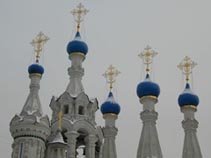
Wednesday, April 20, 2011

Great & Holy Thursday Friday & Saturday

Holy and Great Thursday

THE GOSPELS OF HOLY and Great Thursday tell how our Savior and His disciples came to Jerusalem to celebrate His last feast of the Passover, how He washed their feet. They tell the account of that Mystical Supper when our Lord ordained the Mystery of His Most Holy Body and Blood "for the remission of sins and life everlasting." They speak of Christ's instruction to the Apostles, and how He told them that they would all forsake Him that night; they speak of Peter's rash promise that he would always remain faithful; of Christ's vigil in the garden; of how He was seized and led away to the high priest's court; of the scene in the courtyard; of Peter's three-fold denial and his grief; of the high priest's mocking questions; and of how our Savior Christ God, wearing the crown of thorns, beaten and insulted by the soldiers, was led before Pilate.

The readings and hymns of Matins dwell on Judas' betrayal, on "the dark night" which settled in his soul. We pray that we may keep ourselves from greed and deceit, and be made pure by partaking of the holy Mysteries of Christ's Body and Blood. The Dismissal Hymn after the "Alleluia" at Matins speaks of this:

The Dismissal Hymn (Eighth Tone)
When the glorious disciples were enlightened at the washing of the feet, then Judas the ungodly one was stricken and darkened with the love of silver. And unto the lawless judges did he deliver Thee, the righteous Judge. O thou lover of money, behold thou him that for the sake thereof did hang himself, flee from that insatiable soul that dared such things against the Master. O Thou Who art good unto all, Lord, glory be to Thee.
The Synaxarion and the Kontakion also reiterate the themes of Christ God's betrayal at the hands of "an incorrigible disciple:"

On the evening of this day, which was the eve of the feast of unleavened bread (that is, the Passover), Jesus supped with His twelve disciples in the city. He blessed the bread and the wine, and gave us the Mystery of the Divine Eucharist. He washed the feet of the disciples as an example of humility. He said openly that one of them was about to betray Him, and He pointed out the betrayer by revealing that it was he "that dippeth his hand with Me in the dish." And after Judas had straightway gone forth, Jesus gave the disciples His final and sublime instructions, which are contained in the first Gospel reading of the Holy Passion. After this the God-man went forth to the Mount of Olives, and there He began to be sorrowful and in anguish. He went off alone, and bending the knees He prayed fervently. From His great anguish, His sweat became as it were great drops of blood falling to the ground. As soon as He had completed that anguished prayer, lo Judas came with a multitude of soldiers and a great crowd, on greeting the Teacher guilefully with a kiss, he betrayed Him.

Jesus was then apprehended and taken prisoner to the high priests Annas and Caiaphas. The disciples dispersed, but Peter, who was more fervent than the others, followed Him even into the court of the high priest, but in the end denied that he was His disciple.

Then our divine Teacher was brought before the lawless Sanhedrin and was interrogated concerning His disciples and His teaching. The high priest adjured Him before God that He tell them whether He was truly the Christ. And having spoken the truth, He was judged guilty of death, supposedly as one who had blasphemed. Then they spat in His face, beat Him, smote Him with the palms of their hands, and mocked Him in every way, throughout the whole night until the morning.

The Kontakion (Second Tone)
Taking the bread into his hands, the betrayer stretcheth them forth secretly and receiveth the price of Him That with His own hands, fashioned man. And Judas, the servant and deceiver, remained incorrigible.
On this day the Liturgy of Saint Basil the Great is celebrated together with Vespers. Before the Great Entrance, instead of the Cherubic Hymn, the special hymn of Great Thursday is chanted:
Of Thy Mystical Supper, O Son of God, receive me today as a communicant; for I will not speak of the Mystery to Thine enemies; nor will I give Thee a kiss as did Judas; but like the thief do I confess Thee: Remember me, O Lord, when Thou comest in Thy Kingdom.
This hymn is also chanted before and during Communion.

The whole narration of our Lord's Passion is given at the Matins of Great Friday, sung on Thursday evening. It is commonly called "the Service of the Twelve Gospels." A tall Crucifix usually stands in the middle of the church with many candles lighted round it. After the Six Psalms and the Great Litany, the choir chants, "Alleluia" and the Troparion of Holy and Great Thursday. The priest and deacon come out of the Sanctuary carrying the Book of Gospels. It is placed on a podium and the priest begins the reading. The whole story of the Passion is read from the four evangelists and is divided into twelve parts. It begins with the "Gospel of the Testament" and the prayer at the Mystical Supper, from Saint John's Gospel, and continues through the four Gospels to the burial of Christ by Joseph of Arimathea. After each reading the choir chants, "Glory to Thy forbearance, O Lord, glory to Thee." Between the readings special antiphons and hymns are chanted. They speak of Judas' betrayal; of the cruelty of the Jews; of our Savior's infinite patience and meekness; of the awe of all creation when the Lord of all was nailed to the Cross between two thieves. The canon has only three odes. All recount the Passion and foretell the glory of the Resurrection. Matins ends shortly after the twelfth Gospel.


Holy and Great Friday

GREAT FRIDAY is the most solemn day of Holy Week. In awe and trembling, we stand before the Cross on which our Savior died and we see the image of Him dead, lying in our midst, on the Epitaphios (the Winding Sheet).

During the Service of Matins, which by anticipation is chanted on Thursday evening, we will hear some of the most compunctionate hymns of the ecclesiastical year. The following are but a few examples:

(Fourth Tone)
Thou didst ransom us from the curse of the Law by Thy precious Blood. Nailed to the Cross and pierced with the lance, Thou didst pour forth immortality for men. O our Savior, glory be to Thee.
(Second Tone)
Today there is hung upon the Tree, He that suspended the earth upon the waters. A crown of thorns is placed upon Him Who is the King of the Angels. With false purple is He wrapped about, He that wrappeth the Heavens with clouds. Buffetings did He receive, Who freed Adam in the Jordan. With nails was He affixed, He that is the Bridegroom of the Church. With a lance was He pierced, He that is the Son of the Virgin. We worship Thy Passion, O Christ. Show also unto us Thy glorious Resurrection.
(Third Tone)
Two evils hath Israel, my first-born son, committed: He forsook Me, the Source of the water of life, and he dug for himself a broken well; he crucified Me upon the Tree, and asked for Barabbas and released him. Heaven was astonished at this, and the sun hid its rays; but thou, O Israel, wast not ashamed, but didst deliver Me up to death. Forgive them, O holy Father, for they know not what they have done.


Every member of Thy holy Flesh endured dishonor for us; Thy head, the thorns; Thy face, the spittings; Thy cheeks, the smitings; Thy mouth, the taste of vinegar mingled with gall; Thine ears' the impious blasphemies; Thy back the lash; Thy hand, the reed; the whole length of Thy body, the stretching upon the Cross; Thy joints, the nails; and Thy side, the spear. O Thou Who didst endure the Passion for us, and from the passions didst set us free, and didst condescend to us in Thy love for men and raise us up, O Almighty Savior, have mercy on us.
The Synaxarion and the Kontakion of this day sum up the history and the significance of the sacred events that came to pass for our eternal salvation:

When Friday dawned, Jesus was sent bound from Caiaphas to Pontius Pilate, who was then Governor of Judea. Pilate interrogated Him in many ways, and once and again acknowledged that He was innocent, but, to please the Jews, he later passed the sentence of death against Him. After scourging the Lord of all as though He were a runaway slave, he surrendered Him to be crucified.

Thus Jesus was handed over to the soldiers, was stripped of His garments, was clothed in a purple robe, was crowned with a wreath of thorns, had a reed placed in His hand as though it were a scepter, was bowed before in mockery, was spat upon, and was buffeted in the face and on the head. Then they again clothed Him in His own garments, and bearing the cross, He came to Golgotha, a place of condemnation, and there, about the third hour, He was crucified between two thieves. He was blasphemed by those who were passing by, was mocked by the high priests, and by the soldiers was given vinegar to drink mixed with gall. About the ninth hour, He cried out with a loud voice, saying, "It is finished." And the Lamb of God "which taketh away the sin of the world" (John 1:29) expired on the day when the moon was full, and at the hour when, according to the Law, there was slain the Passover lamb, which was established as a type of Him in the time of Moses.

Even lifeless creation mourned the death of the Master, and it trembled and was altered out of fear. Yet, even though the Maker of creation was already dead, they pierced Him in His immaculate side, and forthwith came there out Blood and Water. Finally, at about the setting of the sun, Joseph of Arimathea came with Nicodemus (both of them had been secret disciples of Jesus), and they took down the all-holy Body of the Teacher from the Cross and anointed it with aromatic spices, and wrapped it in a clean linen cloth. When they had buried Him in a new tomb, they rolled a great stone over its entrance.

Such are the dread and saving sufferings of Jesus Christ commemorated today, and in remembrance of them, we have received the Apostolic commandment that a fast be observed on every Friday.

Kontakion (Fourth Tone)
Come, let us all praise Him Who was crucified for us; for Mary beheld Him on the Tree, and said: Though Thou dost endure the Cross, yet Thou art my Son and my God.
On this day, a day of mourning and strict fasting, the service of the "Royal Hours" is celebrated. At each Hour, beside the psalms, prophecies from the Old Testament, an Epistle and a Gospel are read about Holy and Great Friday.

The solemn Vespers of Great Friday is chanted in the afternoon at the time of our Lord Jesus' death. Again all the readings remind us of the suffering Christ and His glory. After the Entrance, lections are read in which the Prophet Isaiah speaks of "the Lamb led to the slaughter," and an Epistle of Saint Paul on the power and wisdom of the Cross; again a Gospel is read describing our Lord's trial before Pilate, His Crucifixion and burial. Near the end of this reading, the Body of our Savior is taken down from the Cross and placed in the Sanctuary, just as the noble Joseph took our Lord's body from the Cross and placed it in the grave.

After the usual petitions, "Let us all say…," "Vouchsafe…," "Let us complete…," etc., the choir slowly chants the Aposticha, during which a procession exits from the Sanctuary, with the priest and deacon bearing the Shroud, their heads uncovered, proceeded by candles and censer. All kneel with head bowed low before the image of our dead Savior. A bier stands in the middle of the church, with candles lit round it. On it the Epitaphios is laid reverently and censed all round by the priest. The people come up to make a prostration before it and kiss it, while the Aposticha are completed and the following hymn is chanted:
O Thou Who puttest on light like a garment, when Joseph with Nicodemus, took Thee down from the Tree and beheld Thee dead, naked, and unburied, he struck up a compassionate dirge, and with mourning he said: Woe is me, O sweetest Jesus! When but a short while ago the sun beheld Thee hanging upon the Cross, it shrouded itself in darkness, and the earth quaked with fear, and the veil of the Temple was rent asunder. But, behold, now I see Thee willingly submitting to death for my sake. How shall I bury Thee, O my God? Or how shall I wrap Thee with winding sheets? With what hands shall I touch Thine undefiled Body? Or what dirges shall I sing at Thy departure, O Compassionate One? I magnify Thy Passion; I praise Thy Burial and Resurrection, and I cry out: O Lord, glory be to Thee.
Then, after the Lord's Prayer, the dismissal hymns are chanted: "The noble Joseph…" and "Unto the myrrh-bearing women…" (see below), followed by the prayers of dismissal.

On this day there is no Liturgy or Communion.


Holy and Great Saturday

Holy and Great Saturday is a reverent vigil at the tomb of the Son of God, slain for our sins. By anticipation, the Saturday Matins is held on Friday evening. The Synaxarion for this day, which is called the "First Resurrection," narrates the following:

The Synaxarion:

On Saturday, the high priests and Pharisees gathered together before Pilate and asked him to have Jesus' tomb sealed until the third day; because, as those enemies of God said, "We suspect that His disciples will come and steal His buried body by night, and then proclaim to the people that His resurrection is true, as that deceiver Himself foretold while He was yet alive; and then the last deception shall be worse than the first " After they had said these things to Pilate and received his permission, they went and sealed the tomb, and assigned a watch for security, that is, guards from among the soldiers who were appointed to guard the city (Matt. 27:62-66). While commemorating the entombment of the holy Body of our Lord today, we also celebrate His dread descent with His soul, whereby He destroyed the gates and bars of Hades, and made His light to shine where only darkness had reigned; death was put to death, Hades was stripped of all its captives, our first parents and all the righteous who died from the beginning of time ran to Him Whom they had awaited, and the holy angelic orders glorified God for the restoration of our fallen race.

After the Six Psalms and the Great Litany, the Royal Doors are opened; the priest and deacon come out with candles and censer. The choir chants "God is the Lord and hath appeared unto us," and then the following dismissal hymns:
The noble Joseph, taking Thine immaculate Body down from the Tree, and having wrapped It in pure linen and spices, laid It for burial in a new tomb.


When Thou didst descend unto death, O Life Immortal, then didst Thou slay Hades with the lightning of Thy Divinity. And when Thou didst also raise the dead out of the nethermost depths, all the powers in the Heavens cried out: O Life-Giver, Christ our God, glory be to Thee.


Unto the myrrh-bearing women did the Angel cry out as he stood by the grave: Myrrh-oils are meet for the dead, but Christ hath proved to be a stranger to corruption.
In the meantime, the priest and deacon cense the Epitaphios, then stand in front of it. The priest and the choir then chant the "Lamentations" with the verses of the 118th Psalm: "Blessed are the blameless in the way, who walk in the law of the Lord." Each verse of the Psalm is followed by a verse of the Lamentations. It is like a long poem depicting the Angels in Heaven and all creatures on earth overwhelmed by the death of their Creator, and their gratitude at being freed from death's power by Christ. The following are examples of these most compunctionate hymns:
In a grave they laid Thee, O my Life and my Christ; and the armies of the angels were sore amazed, as they sang the praise of Thy submissive love.


Lo, how fair His beauty! Never man was so fair! Yet how doth He seem a dead man bereft of form, though all nature's beauty had Him as its source.


Right it is indeed, Life-bestowing Lord, to magnify Thee; for upon the Cross were Thy most pure hands outspread, and the strength of our dread foe hast Thou destroyed.


Every generation chanteth hymns of praise at Thy burial, O Christ God.


Lo, myrrh-bearing women to Thy tomb, O Savior, are come, their myrrh to offer.


Grant that we who serve Thee may see the Resurrection of Thy Son, O blest Virgin.
After the Lamentations, the Resurrection Evlogitaria are chanted. Then, following the customary litanies, the choir chants the canon, where the note of joy and triumph is heard more and more clearly. At the end of the Doxology of Matins, the priest raises the Epitaphios, which is then taken by four pall-bearers, the deacon waking in front, the people following, all carrying candles. The procession walks out of, and around, the church, with the bells tolling and the choir chanting, "Holy God, Holy Mighty, Holy Immortal, have mercy on us." This represents the burial of Christ. Then, when the procession re-enters the church, the priest and deacon carry the Epitaphios into the sanctuary and lay it on the Holy Table. It will lie there until Ascension Eve, as a symbol that Christ appeared among His disciples for forty days after His Resurrection. Then, the Prokeimenon is chanted, and the glorious prophecy of Ezekiel is read about the dry bones of Israel, out of which arose "an exceeding great host" quickened to life by the breath of God. Then follows Saint Paul's Epistle about Christ our Passover, and the Gospel about the sealing of Jesus' tomb. Matins then ends as usual. In many places, especially in the monasteries and convents, a very moving homily on the burial of Christ is read after the completion of the service. This homily was written by Saint Epiphanios of Cyprus, a Jewish convert to Christianity.

The Liturgy of Holy and Great Saturday is that of Saint Basil the Great. It begins with Vespers. After the entrance, the evening hymn "O Joyous Light" is chanted as usual. Then fifteen Old Testament readings are recited. They tell of the most striking events and prophecies of the salvation of mankind by the death of the Son of God. The account of creation in Genesis is the first reading. The sixth reading is the story of Israel's crossing of the Red Sea and Moses' song of victory over Pharaoh, with its refrain: "For gloriously is He glorified". The last reading is about the Three Children in the fiery furnace of Babylon, and their song of praise with its repeated refrain: "O praise ye the Lord and supremely exalt Him unto the ages." In the ancient church the catechumens were baptized during the time of these readings. The Epistle which follows speaks of how, through the death of Christ, we too shall rise to a new life. After the Epistle, the choir chants, like a call to the sleeping Christ: "Arise, O Lord, judge the earth, for Thou shalt have an inheritance among all the nations...." While this is being chanted the priest scatters bay leaves and flower petals throughout the entire church, symbolizing the fragrance of life coming forth from the grave.

In ancient times it was the custom to scatter flowers in the path of a victorious ruler when he returned in triumph to his city, even as our Savior will return triumphant from Hades. The deacon carries out the Book of the Gospels, and reads the first message of the resurrection from Saint Matthew. Because the Vespers portion of the service belongs to the next day (Pascha) the burial hymns of Saturday are mingled with those of the resurrection, so that this service is already full of the coming Paschal joy.

After the Gospel the Liturgy proceeds as usual. Instead of the Cherubic Hymn, a special Great Entrance Hymn is chanted:

Let all mortal flesh keep silence and stand with fear and trembling, and take no thought for any earthly thing, for the King of kings and Lord of lords cometh to be slain and given as food for the faithful. Before Him go the choirs of the angels with all sovereignty and power: the many-eyed Cherubim and six-winged Seraphim, covering their faces and crying out the hymn: Alleluia, Alleluia, Alleluia.

Later in the Liturgy of Holy and Great Saturday, the beautiful and compunctionate Communion Hymn, based on Psalm 77, is chanted: "The Lord awoke as one that sleepeth, and is risen, saving us. Alleluia."

After the Liturgy the faithful take their one meal of the day, and that strict fast food, to strengthen them to keep watch the rest of the day and evening. In church the Acts of the Apostles are read aloud. This is the only Saturday of the year on which a strict fast is kept. In the monasteries and convents, the refectory meal is taken in complete silence, out of reverence for the burial of Christ.

The Kontakion of Matins sums up the significance of this solemn day:
He that shut up the abyss is seen to be dead, and like a mortal, the Immortal One is wrapped in linen and myrrh, and placed in a grave. And women came to anoint Him weeping bitterly and crying out: This is the most blessed Sabbath whereon Christ, having slept, shall arise on the third day.

Great & Holy Wednesday

ON GREAT WEDNESDAY the Church commemorates the act of contrition and love of the sinful woman who poured precious myrrh-oil on our Savior's head, and, though she did not know it, "prepared Him for burial." And in contrast we hear of the dark act of Judas, whose greed led him to betray his Master. All the readings and hymns of the day warn us to beware of greed and love of money, which even tempted a disciple of Christ. We too can betray Him, if we let greed and selfishness get hold of us, while every deed of humility and love at once brings us near to Him.

Concerning these incidents recorded in the Holy Gospels, the Synaxarion has the following account:
Two women — say the more discerning interpreters of the Gospel — anointed the Lord with myrrh; the one, a long time before His Passion; the other, a few days before. The one was a harlot and sinner; the other, chaste and virtuous. The Church commemorates this reverent act today. While mentioning herein the person of the harlot, it also mentions Judas' betrayal; for, according to the account in Matthew, both of these deeds took place two days before the Passover, on Wednesday.
That woman, then, anointed Jesus' head and feet with very precious myrrh, and wiped them with the tresses of her hair. The disciples, especially the avaricious Judas, were scandalized, supposedly because of the waste of the myrrh. Jesus reproved them and told them not to trouble the woman. Indignant, Judas went to the high priests, who were gathered in the court of Caiaphas and were already taking counsel against Jesus. On agreeing with them to betray his Teacher for thirty pieces of silver, Judas sought from that time opportunity to betray Him (Matt. 26:14-16). Because the betrayal took place on Wednesday, we have received the tradition from Apostolic times to fast on Wednesday throughout the year.

It is on this day also that one of the most beautiful and compunctionate hymns ever composed is chanted in the Holy Church. This hymn, composed in the early part of the ninth century by the nun Cassiane, has as its theme the anointing of our Savior's feet by the harlot:

The Troparion of Cassiane
O Lord, the woman who had fallen into many sins perceived Thy divinity, and taking upon herself the duty of a myrrh-bearer, with lamentation she bringeth Thee myrrh-oils before Thine entombment. Woe unto me! saith she, for night is become for me a frenzy of licentiousness, a dark and moonless love of sin. Receive the fountain of my tears, O Thou Who gatherest into clouds the water of the sea. Incline unto me, unto the sighings of my heart, O Thou Who didst bow the Heavens by Thine ineffable condescension. I will kiss Thine immaculate feet and wipe them again with the tresses of my head; those feet, at whose sound Eve hid herself for fear when she heard Thee walking in Paradise in the cool of the day. As for the multitude of my sins and the depths of Thy judgments, who can search them out, O Savior of souls, my Savior? Do not disdain me, Thy handmaiden, O Thou Who art boundless in mercy.
The Kontakion for this day continues the theme of contrition and remorse, and confronts us with our unworthiness before God:

The Kontakion (Fourth Tone)
Though I have transgressed more than the harlot, O Good One, I have in no wise brought forth streams of tears for Thee; but in silence I supplicate Thee and fall down before Thee, kissing Thine immaculate feet with love, so that, as Master that Thou art, Thou mayest grant me the forgiveness of debts, as I cry to Thee, O Savior: From the mire of my deeds do Thou deliver me.
On Holy Wednesday night the Orthodox Church administers the Mystery of the Holy Unction for the bodily and spiritual health of the participants. At this Mystery, the oil is consecrated by prayer and the clergy anoint the people. When this is done, the priest recites the prayers for the remission of sins, while the clergy hold the open Gospel over the heads of the people.

The Psalter is not used after Holy Wednesday until Thomas Sunday.
 Source

LORD SAVE THY PEOPLE

Romanian Monks During Holy Week

Tuesday, April 19, 2011

150 Years Ago

April 14 – 20, 1861

Fort Sumter has capitulated. Major Anderson’s gallant band of troops have arrived in New York, where a crowd counted in the tens of thousands jammed the never more determinedly named Union Square to salute his bullet-torn flag. Now the Stars and Bars, the newfangled flag of the Confederacy, ripples in the breezes over Charleston Harbor. But the battle that ended that crisis has resolved only a minor issue, clearing the stage for a conflict that promises to be ever so much more lethal.

The battle has galvanized both sides. Southerners, who are seldom reluctant to boast about their fighting skills or to invent occasions to demonstrate them, have been crowing like a rooster who has made a thousand suns arise. The Atlanta Confederacy wrote, “If the fanatical Nigger Republican North is resolved to force [war] upon us, we are ready to meet it.” Governor Francis Pickens of South Carolina — a man whose ridiculous wig and ham-handed leadership were much mocked by Charleston’s elites during the Sumter crisis, but who is now lauded as one of the many fathers of this glorious victory — thumped his chest and boasted, “Let it lead to what it might, even if it leads to blood and ruin. … We have defeated their twenty millions, we have met them and conquered them. We have humbled the flag of the United States before the Palmetto and the Confederate.”

But Major Anderson’s steely defense of Sumter and the insult inflicted on Old Glory have inspired the North as well. “All squeamish sentimentality should be discarded, and bloody vengeance wreaked upon the heads of the contemptible traitors,” said the Columbus (Ohio) Daily Capital City Fact. Said Senator Stephen Douglas, the president’s erstwhile electoral rival, “There can be no neutrals in this war, only patriots or traitors.” Everywhere in the North, flags and bunting were hung from every window and porch rail; in Pittsburgh, lampposts sported nooses, sashed with the slogan “Death to Traitors!” The word seldom spoken as states seceded is now on every lip.
Read the rest here.

Before Kennedy International Airport there was...

New York's Lower West Side seen in the 1930's (click to enlarge).

Shown starting at the bottom are the liners Hamburg, the Bremen, the Columbus, the De Grasse, the Normandie, the Britannic, the Aquitania, the Conte de Savoia, the Fort Townsend and the Monarch of Bermuda.


I think I will weep the next time I have to get on one of those overcrowded flying aluminum tubes and pay $5 for a can of soda and a small bag of peanuts.  On a side note I am quite certain that Orville and Wilbur were Protestants.  Their approach to travel bears the same attributes as Protestant worship... short and bland, (tending towards ugly).

Monday, April 18, 2011

Presanctified Liturgy in a monastery & Bridegroom Matins in a convent


Inflation Actually Near 10% Using Older Measure

After former Federal Reserve Chairman Paul Volcker was appointed in 1979, the consumer price index surged into the double digits, causing the now revered Fed Chief to double the benchmark interest rate in order to break the back of inflation. Using the methodology in place at that time puts the CPI back near those levels.

Inflation, using the reporting methodologies in place before 1980, hit an annual rate of 9.6 percent in February, according to the Shadow Government Statistics newsletter.

Since 1980, the Bureau of Labor Statistics has changed the way it calculates the CPI in order to account for the substitution of products, improvements in quality (i.e. iPad 2 costing the same as original iPad) and other things. Backing out more methods implemented in 1990 by the BLS still puts inflation at a 5.5 percent rate and getting worse, according to the calculations by the newsletter's web site, Shadowstats.com.

"Near-term circumstances generally have continued to deteriorate," said John Williams, creator of the site, in a new note out Tuesday. "Though not yet commonly recognized, there is both an intensifying double-dip recession and a rapidly escalating inflation problem. Until such time as financial-market expectations catch up with underlying reality, reporting generally will continue to show higher-than-expected inflation and weaker-than-expected economic results in the month and months ahead."
Read the rest here.

Even the mainstream media is starting to question the BS statistics being put out by the government.

Quote of the day...

“I’ll tell you one thing, if things keep going the way they are, it’s going to be impossible to buy a week’s groceries for $10.00.”

-From 1955 

Source

What is past is prologue

History may not always repeat itself but it does tend to move in predictable cycles.  Great nations rise and eventually peak.  Then they get overconfident and too comfortable riding the wave and they over extend themselves.  After that they often get brought back down to Earth with startling swiftness.

The United States is I fear at the tipping point. If you want an idea of where we might be fifty years from now consider the case of the last nation to go through the rise-peak-collapse cycle, Great Britain.  Watch the video and ponder where Britain was in the early 1930's and consider where she was fifty years later.
Empire Day 1930's

S&P lowers outlook on US debt; financial markets plunge

The United States on Monday was warned that it could lose its coveted status as the world’s most secure economy if lawmakers don’t rein in the nation’s debt, pushing U.S. financial markets down.

The ratings agency Standard & Poor’s issued a “negative” outlook on the United States, sending a shot across the bow of Washington politicians in the midst of a contentious debate over how to curtail the nearly $14.3 trillion debt.

Stock prices immediately fell and the dollar dropped against competing currencies before stabilizing late in the morning. The yields on long-term Treasury bonds spiked, indicating that people loaning the U.S. government money wanted more of a return to offset the risk of extending credit to the United States.

“We believe there is a material risk that U.S. policy makers might not reach an agreement on how to address medium-and long-term budgetary challenges by 2013,” S&P one of the nation’s three major credit-rating agencies, said in a report.

S&P added: “If an agreement is not reached and meaningful implementation does not begin by then, this would in our view render the U.S. fiscal profile meaningfully weaker than that of peer ‘AAA’ sovereigns.”
Read the rest here.

Sunday, April 17, 2011

Super-rich pay less in taxes

WASHINGTON — As millions of procrastinators scramble to meet Monday's tax filing deadline, ponder this: The super rich pay a lot less taxes than they did a couple of decades ago, and nearly half of U.S. households pay no income taxes at all.

The Internal Revenue Service tracks the tax returns with the 400 highest adjusted gross incomes each year. The average income on those returns in 2007, the latest year for IRS data, was nearly $345 million. Their average federal income tax rate was 17 percent, down from 26 percent in 1992.

Over the same period, the average federal income tax rate for all taxpayers declined to 9.3 percent from 9.9 percent.
Read the rest here.

The GOP in never-never land

The Republican self-deception that draws the most attention is the refusal to believe that Barack Obama is American-born.

But there are Republican doctrinal fantasies that may be more dangerous: the conviction that taxes can always go down, but never up, for example, and the gathering consensus among Republican leaders that human-caused climate change does not exist.

I’m not saying that Democrats’ answers to the budget or climate challenges are necessarily right. You can make a case for smaller government or argue that there’s no point in America curbing greenhouse gases if China won’t.

But it’s hard to debate blind faith. When President George W. Bush and Congress lowered taxes in 2001, the justification, unlikely as it seems today, was a budget surplus. When the surplus melted away, that didn’t affect the ideology. Surplus or deficit, peace or war, healthy growth or steep recession — anything is an argument for tax cuts.

You can get a taste of this illogical arithmetic in Rep. Paul Ryan’s budget. The Wisconsin Republican lays out some ideas worth discussing to control entitlement costs. But by refusing to acknowledge that revenue will ever have to rise, even as society ages, he ends up, as the Congressional Budget Office noted (though not in so many words), in fiscal never-never land.

In Ryan’s vision, all federal spending other than Medicare, Medicaid, Social Security and interest payments will decline from 12 percent of the national economy (GDP) in 2010 to 6 percent in 2022 to 3.5 percent in 2050.

“For comparison, spending in this category has exceeded 8 percent of GDP in every year since World War II,” the CBO said. “The proposal does not specify the changes to government programs that might be made in order to produce that path.”

Of course not — because they are changes that few Americans would ever support.
Read the rest here.

Behold the bridegroom comes at midnight

Great and Holy Week

In keeping with the custom of this blog since its inception we will begin winding down as the week progresses with little or no posting from Great and Holy Thursday until Bright Monday.

Saturday, April 16, 2011

Palm Sunday Vigil in Moscow

Texas University has about $1 Billion in Gold Bullion

The University of Texas Investment Management Co., the second-largest U.S. academic endowment, took delivery of almost $1 billion in gold bullion as the metal reaches a record, according to the fund’s board.

The fund, whose $19.9 billion in assets ranked it behind Harvard University’s endowment as of August, according to the National Association of College and University Business Officers, last year added about $500 million in gold investments to an existing stake, said Bruce Zimmerman, the endowment’s chief executive officer. The holdings reached about $987 million yesterday, as Comex futures closed at $1,486 an ounce.

The decision to turn the fund’s investment into gold bars was influenced by Kyle Bass, a Dallas hedge fund manager and member of the endowment’s board, Zimmerman said yesterday at its annual meeting. Bass made $500 million on the U.S. subprime- mortgage collapse.

“Central banks are printing more money than they ever have, so what’s the value of money in terms of purchases of goods and services,” Bass said today in a telephone interview. “I look at gold as just another currency that they can’t print any more of.”
Read the rest here.

HT T-19

‘Gang of Six’ in the Senate Seeks a Plan on Debt

WASHINGTON — Days after President Obama called for forming a bipartisan group in Congress to begin negotiating a $4 trillion debt-reduction package, the parties have not even agreed to its membership. Yet six senators — three Democrats, three Republicans — say they are nearing consensus on just such a plan.

Whether the so-called Gang of Six can actually deliver something when Congress returns from a recess in May could determine whether Democrats and Republicans can come together to resolve the nation’s fiscal problems before the 2012 elections.

As Mr. Obama and Republican leaders have warred publicly over the budget, this small group of senators has spent four months in dozens of secretive meetings in offices at the Capitol and over dinner at the suburban Virginia home of Senator Mark Warner, a Democrat.

The senators have weathered criticism from bloggers and even colleagues, including the leaders of their own parties, who oppose tampering with Social Security or taxes. The gang nearly collapsed several times, including two weeks ago.

The group’s oldest members — Senator Richard J. Durbin, 66, a progressive from Illinois who counts the Senate’s only socialist as a friend and ally, and Senator Saxby Chambliss, 67, a genial Georgia conservative whose nasty first campaign left lingering bad feelings among Democrats, and who is a confidant of Speaker John A. Boehner — illustrate that even with the mounting federal debt intensifying the partisan divide over spending and taxes, the severity of the fiscal threat is forging unlikely alliances.
Read the rest here.

Friday, April 15, 2011

Protestant Proselytizing in Russia

MOSCOW -- In a land where the Russian Orthodox Church dominates, one evangelical charismatic church is creating spiritual waves.

"The Protestant movement is growing very strongly," said Rick Renner, senior pastor of Moscow Good New Church.

Renner and his wife Denise are at the forefront of the movement. In 1991, the couple moved their family to what is now the former Soviet Union with the goal of reaching Russians with the Gospel of Jesus Christ.

Nine years later, in September 2000, they started Moscow Good News Church in the Russian capital city.

"Moscow church is approximately 3,500 people in regular attendance," Renner told CBN News.

That's big for Russia, where most Protestant churches attract less than a thousand people to each of their congregations.

Reaching the Upper Crust

While the goal is to reach a broad section of those living in the Moscow metropolis, the church puts a special emphasis on reaching the upper class.

"Specifically, a part of our vision is to reach a higher class of people," Renner said.

That's because "they need God, too, and there aren't many churches that they can actually feel comfortable in," he explained.

Most Russians belong to the Orthodox Church. Currently, there are an estimated 30,000 churches dotting the Russian landscape.

The church is gaining more prominence after decades of persecution under the Soviet system. Yet, this newfound role isn't necessarily translating into regular attendance or observance.

"Most people don't even know the tenets of the faith," Roman Lunkin of the Slavic Center for Law & Justice, explained. "They don't have a personal relationship with Jesus Christ. Nowadays, it is hip to be religious in Russia."

A Whole New Experience

But Renner said something different happens at Moscow Good News. Those from an Orthodox background find the evangelical church community a whole new experience.

"Some of them are shocked!" he exclaimed. "Some of them think, 'Wow, I've only seen this in movies!'"

Along with the preaching of the Gospel, worship and style of music played in church is a big draw, too.

"I say, 'Hey, come to church. We have music in church and it is fun," Renner said. "'Like what, Gospel music?' I said, 'Yeah, come see it!'"

In addition to the main service, Moscow Good News has an active children's ministry that puts on regular drama performances about the life of Christ.

They also have an entire church dedicated entirely to reaching the elderly.

House Divided

Despite the tremendous success of Moscow Good News Church, it faces a huge public perception problem.

In Russia, charismatic churches are often considered cults. Consequently, the government puts laws on the books to restrict religious freedom.

Because the Russian Orthodox Church views the evangelical churches as competitors, they often side with the government trying to limit evangelical church growth.

"The official position of the Russian Orthodox Church is that everything besides them is a cult," Renner told CBN News.

Hope in a New Generation

However, a new generation of young Russians are emerging with different views on the matter.

"I have evangelical Christians who are friends of mine," one young woman said. "I enjoy talking with them and appreciate things they share with me."

"I know the Orthodox Church doesn't have a good opinion of the Protestant churches, but that has to change," another young woman said.

It is that sentiment that Renner and members of Moscow Good News Church hope lead to more Russians embracing the message of Jesus Christ.

"Capitalism has come. Many people are successful. Many people have made money," Renner said.

"Many people have huge amounts of money, and they've found out for themselves that it is not the answer to all of their problems," Renner noted. "And so there's a new wave of interest in spiritual things."

What Europe's coming debt default will look like

I’m not sure why everyone thought comments the other day from the German Finance minister, Wolfgang Schäuble, to the effect that Greece may eventually face a sovereign debt restructuring, were such a revelation. This is in fact only a statement of the blindingly obvious, has been apparent in the market price of Greek sovereign debt for more than a year now, and was in any case implicit in the statement issued after the European Council meeting of March 24-25, when ministers said restructuring would be a pre-condition to borrowing from the European Stability Mechanism if debt was judged to be on an unsustainable path.

Even so, combined with the latest Moody’s downgrade on Friday of Irish sovereign debt, his comments have sparked a fresh round of jitters in markets, and led some commentators to think an act of default among the peripheral eurozone economies is imminent. I don’t doubt that certainly Greece, and possibly Ireland and Portugal will eventually have to restructure, but here’s why it’s not going to happen any time soon.
Read the rest here.

I think the author is underestimating the speed with which bond prices can collapse irretrievably once the markets lose confidence in them.

EU debt costs rise after Ireland downgrade, Greek delays

Borrowing cost for the eurozone's most indebted economies rose on Friday after Moody's cut Ireland's rating to just above "junk" and Greece delayed fleshing out fresh austerity and privatisation plans.

Greek, Irish, Spanish, and Portuguese 10-year government bond yields rose as markets continued to believe further debt restructurings will be needed eventually.

Fears that Greece will default rose to fresh highs yesterday after Wolfgang Schaeuble, the German Finance ministers, that a further restructuring of the company's debt may be needed, despite last year's €110bn (£97bn) bail-out.

George Papandreou, the Greek Prime Minister, did little to appease market jitters when he presented the outline of fresh fiscal plans but said the measures would only be spelled out in detail after Easter.
Read the rest here.

China sees inflation jump as blistering growth continues

China's turbo-charged growth eased slightly in the first quarter, while inflation jumped to a 32-month high, putting pressure on the government to do more to rein in prices and keep the economy on an even keel.

China's gross domestic product (GDP) increased by 9.7pc in the first quarter from a year earlier, down from 9.8pc in the final three months of 2010 but ahead of an expected growth rate of 9.5pc.

However consumer price inflation sped to 5.4pc in the year to March, the fastest since July 2008 and ahead of market forecasts for a 5.2pc increase.

Agricultural prices have been the main driver of Chinese inflation and that remained the case, with food costs up 11.7pc in the year to March. But there were also signs of a broadening of pressures, with non-food inflation up 2.7pc year on year, the fastest in more than a decade.

Taken together, the data published by the National Bureau of Statistics on Friday showed that the world's second-largest economy was still sizzling, little hindered by the central bank's half-year tightening campaign that many investors had feared would undermine growth.

"The figures show that [China's] inflation pressure will not taper off in the short term and we expect the consumer inflation to remain high in the second quarter," said Sun Miaoling, an economist with CICC, the largest Chinese investment bank.
Read the rest here.

No-tax-hike pledge creates Republican rift

Republicans are feuding over whether to abandon the party’s long-held opposition to higher taxes in pursuit of a deficit-cutting deal with Democrats.

The rift in the Republican ranks has surfaced in a bitter back-and-forth between two heroes of the conservative movement: Sen. Tom Coburn of Oklahoma, who has been working with a bipartisan group of senators on a compromise to reduce government borrowing, and Grover Norquist, author of the no-tax-increase pledge that has become a rite of passage for GOP candidates.

At stake is a pillar of Republican orthodoxy that has for decades united every wing of the party in a quest to shrink government’s reach.

As the battle over the federal deficit escalates in Washington, the two men are sparring over Coburn’s seemingly narrow proposal to eliminate a $5 billion annual tax break awarded to companies that blend ethanol into gasoline. But both sides say this cuts to the core of a quandary for the GOP: Will the cause of trimming deficits run aground on the conservative principle that the government must not increase the amount of money it takes in through taxes?

Coburn has been the most visible Republican to challenge Norquist, perhaps the country’s most influential anti-tax advocate, but other Republicans have been willing to discuss a budget deal that would include raising more money through taxes, along with making deep spending cuts, to help reduce the deficit.

These include stalwart conservatives such as Sens. Saxby Cham­bliss (R-Ga.) and Mike Crapo (R-Idaho). And on the ethanol issue, Coburn has drawn support from such conservative-movement fixtures as the Heritage Foundation and the Wall Street Journal editorial board.

And even some House leaders, including Budget Chairman Paul Ryan (R-Wis.) and Ways and Means Chairman Dave Camp (R-Mich.), have left the door open to negotiation.

For anti-tax purists, including many in the Republican Party, eliminating the ethanol break is unacceptable — measures that roll back corporate subsidies, individual deductions or loopholes of any sort without comparable tax cuts elsewhere are considered tax increases.
Read the rest here.

Muslims want, and Orthodox Church opposes, Crescent added to Russian Eagle

"The Russian state emblem has a history of many centuries and it has stood the test of time. It has not been supplanted by Soviet symbols, which are falling into oblivion at an enormous speed, while the symbols, historically justified, are again finding their due place in Russia's life," Archpriest Vsevolod Chaplin, the head of the Synodal Department for Church and Society Relations, told Interfax-Religion on Friday.

"It would be unfair to revise this symbol from the point of view of Russia's historical heritage, the more so since the Muslim symbols - the Crescent, for instance - could be very well used in the regional emblems in the predominantly Muslim regions - there are such regions in this country," he said.

Father Vsevolod was commenting on head of Russia's Muslim Board Talgat Tajuddin's interview. "We are only asking to crown one head of the double-headed eagle on the state emblem with the Crescent and the other with the Orthodox Cross. And let the Cross and the Crescent be capped by the crown in the middle," Tajuddin said.

The Mufti backed polygamy, saying, "Some are putting this Koran principle into life already, marrying two, three, or four women." "Four lawfully-wedded wives are better than 40 mistresses. Russian men have 40 mistresses, each," he said.

Father Vsevolod said in this connection that he profoundly respects Mufti Tajuddin and the Russian Muslim community.

"However, Orthodox Christians have always cherished the union between one man and one woman as their marriage ideal. This is the choice the religious majority has made in our society. This choice must always be kept in mind, for all respect for traditional exceptions," he said.

On this date...

On April 15th 1846 the Donner party departed for California.

On April 15 1861 Abraham Lincoln responded to the Confederate attack on the American flag and military garrison at Fort Sumter by calling for 75,000 militia to suppress an armed insurrection against the United States.  Until the rebels attacked, much of the North was ambivalent and divided about how to respond to Southern secession.  That changed overnight. All across the country telegraph offices and newspapers were mobbed by people waiting for the latest bulletins.  The attack on Sumter instantly galvanized the North and at a stroke the South lost whatever sympathy and support she had hitherto had.  In its place a cold fury took hold of the entire country the likes of which had never been seen, and would not be seen again until December 7th 1941.

Military recruiting offices were mobbed even before Lincoln issued his call to arms.  Politicians of every party damned the South and called for an end to forbearance and the immediate suppression of the rebellion.  State governors of both parties burned up the telegraph lines to Washington begging for a call to arms and instructions on where to send troops.  Some states reported that they could supply all 75,000 men on their own.  New York City, which in the previous winter had contemplated seceding itself, cabled that it could offer 50,000 of the requested troops.

Rage and war fever swept the North.

On April 15th 1865 Abraham Lincoln died from a gunshot wound inflicted the night before.

On April 15th 1912 the brand new British trans-Atlantic passenger ship Titanic sank just under three hours after striking an iceberg with a horrific loss of life.

On April 15th 1927 the Great Mississippi Flood of 1927, the most destructive river flood in U.S. history, began.

And of course... it's income tax day.

Thursday, April 14, 2011

Some uncomfortable observations on taxes

Via the Orthodox Caveman
For three decades we have conducted a massive economic experiment, testing a theory known as supply-side economics. The theory goes like this: Lower tax rates will encourage more investment, which in turn will mean more jobs and greater prosperity—so much so that tax revenues will go up, despite lower rates. The late Milton Friedman, the libertarian economist who wanted to shut down public parks because he considered them socialism, promoted this strategy. Ronald Reagan embraced Friedman’s ideas and made them into policy when he was elected president in 1980.

For the past decade, we have doubled down on this theory of supply-side economics with the tax cuts sponsored by President George W. Bush in 2001 and 2003, which President Obama has agreed to continue for two years.

You would think that whether this grand experiment worked would be settled after three decades. You would think the practitioners of the dismal science of economics would look at their demand curves and the data on incomes and taxes and pronounce a verdict, the way Galileo and Copernicus did when they showed that geocentrism was a fantasy because Earth revolves around the sun (known as heliocentrism). But economics is not like that. It is not like physics with its laws and arithmetic with its absolute values.

Tax policy is something the framers left to politics. And in politics, the facts often matter less than who has the biggest bullhorn.

The Mad Men who once ran campaigns featuring doctors extolling the health benefits of smoking are now busy marketing the dogma that tax cuts mean broad prosperity, no matter what the facts show.

As millions of Americans prepare to file their annual taxes, they do so in an environment of media-perpetuated tax myths. Here are a few points about taxes and the economy that you may not know, to consider as you prepare to file your taxes. (All figures are inflation-adjusted.)
Read the rest here.

Do Cellphones Cause Brain Cancer?

On Jan. 21, 1993, the television talk-show host Larry King featured an unexpected guest on his program. It was the evening after Inauguration Day in Washington, and the television audience tuned in expecting political commentary. But King turned, instead, to a young man from Florida, David Reynard, who had filed a tort claim against the cellphone manufacturer NEC and the carrier GTE Mobilnet, claiming that radiation from their phones caused or accelerated the growth of a brain tumor in his wife.

“The tumor was exactly in the pattern of the antenna,” Reynard told King. In 1989, Susan Elen Reynard, then 31, was told she had a malignant astrocytoma, a brain cancer that occurs in about 6,000 adults in America each year. To David Reynard, the shape and size of Susan’s tumor — a hazy line swerving from the left side of her midbrain to the hindbrain — uncannily resembled a malignant shadow of the phone (but tumors, like clouds, can assume the shapes of our imaginations). Suzy, as she was known, held her phone at precisely that angle against her left ear, her husband said. Reynard underwent surgery for her cancer but to little effect. She died in 1992, just short of her 34th birthday. David was convinced that high doses of radiation from the cellphone was the cause.
Read the rest here.  (long article.)

My sister is among those convinced that cell phones (she calls then "tumor phones") are a carcinogen. But then again she refuses to allow anything more modern than a rotary phone in her house.

In Financial Crisis, No Prosecutions of Top Figures

It is a question asked repeatedly across America: why, in the aftermath of a financial mess that generated hundreds of billions in losses, have no high-profile participants in the disaster been prosecuted?

Answering such a question — the equivalent of determining why a dog did not bark — is anything but simple. But a private meeting in mid-October 2008 between Timothy F. Geithner, then-president of the Federal Reserve Bank of New York, and Andrew M. Cuomo, New York’s attorney general at the time, illustrates the complexities of pursuing legal cases in a time of panic.

At the Fed, which oversees the nation’s largest banks, Mr. Geithner worked with the Treasury Department on a large bailout fund for the banks and led efforts to shore up the American International Group, the giant insurer. His focus: stabilizing world financial markets.

Mr. Cuomo, as a Wall Street enforcer, had been questioning banks and rating agencies aggressively for more than a year about their roles in the growing debacle, and also looking into bonuses at A.I.G.

Friendly since their days in the Clinton administration, the two met in Mr. Cuomo’s office in Lower Manhattan, steps from Wall Street and the New York Fed. According to three people briefed at the time about the meeting, Mr. Geithner expressed concern about the fragility of the financial system.

His worry, according to these people, sprang from a desire to calm markets, a goal that could be complicated by a hard-charging attorney general.

Asked whether the unusual meeting had altered his approach, a spokesman for Mr. Cuomo, now New York’s governor, said Wednesday evening that “Mr. Geithner never suggested that there be any lack of diligence or any slowdown.” Mr. Geithner, now the Treasury secretary, said through a spokesman that he had been focused on A.I.G. “to protect taxpayers.”

Whether prosecutors and regulators have been aggressive enough in pursuing wrongdoing is likely to long be a subject of debate. All say they have done the best they could under difficult circumstances.

But several years after the financial crisis, which was caused in large part by reckless lending and excessive risk taking by major financial institutions, no senior executives have been charged or imprisoned, and a collective government effort has not emerged. This stands in stark contrast to the failure of many savings and loan institutions in the late 1980s. In the wake of that debacle, special government task forces referred 1,100 cases to prosecutors, resulting in more than 800 bank officials going to jail. Among the best-known: Charles H. Keating Jr., of Lincoln Savings and Loan in Arizona, and David Paul, of Centrust Bank in Florida.

Former prosecutors, lawyers, bankers and mortgage employees say that investigators and regulators ignored past lessons about how to crack financial fraud.
Read the rest here.

Duke (false) rape accuser faces possible murder charge

DURHAM, N.C. — A man who police say was stabbed by a woman who falsely accused Duke lacrosse players of rape has died, and the woman could face murder charges in the death.

Durham Police Chief Jose Lopez Jr. told The Herald-Sun of Durham Wednesday that 46-year-old Reginald Daye was dead.

According to WRAL-TV and the newspaper, Daye had been taken to Duke University Hospital after being stabbed with a kitchen knife on April 3.
Story: Duke lacrosse accuser convicted of child abuse

Crystal Mangum was charged with assault with a deadly weapon with intent to kill inflicting serious injury and has been jailed since the stabbing.

"More than likely, we will be upgrading the charge to murder," Lopez told the Herald-Sun.

It was not immediately clear where or how Daye died.
Story: Duke lacrosse players relieved case has ‘closure’

Durham police didn't immediately return messages from The Associated Press.

Jail officials said they didn't know if the 32-year-old Mangum had an attorney.
Source.

Prayers for the approach of death

1. When, exhausted by illness, I sense that the end of my earthly existence is approaching: Lord, have mercy upon me.


2. When my poor heart, beating its last, is languishing and pining in the pangs of death: Lord, have mercy upon me.


3. When for the last time, my eyes fill with tears at the thought that with sins throughout my life I have offended Thee, O God: Lord, have mercy upon me.


4. When my rapid heartbeat speeds the departure of my soul: Lord, have mercy upon me.


5. When my face‘s deadly pallor and my cooling body strikes fear into those dear to me: Lord, have mercy upon me.
Read the rest here.

Wednesday, April 13, 2011

David Cameron: Unrestricted immigration threatens our way of life

David Cameron will claim today that uncontrolled immigration has undermined some British communities.

In his most forthright speech on the issue since he became Prime Minister, he will say that mass immigration has led to "discomfort and disjointedness" in neighbourhoods because some migrants have been unwilling to integrate or learn English.

Pledging to cut the numbers entering Britain to tens of thousands, rather than hundreds of thousands, Mr Cameron will say that "for too long, immigration has been too high".

He will also promise to "stamp out" forced marriages, saying that "cultural sensitivity" cannot be allowed to stop the Government from acting.
Read the rest here.

The Young Fogey: Britain and Commonwealth nations in discussions over law of succession

The Young Fogey (no not that one, this one) reports in a television interview that there are very discreet discussions going on between No. 10 and the governments of the sixteen Commonwealth Nations that recognize the British Monarch as their head of state over possible changes in the laws of succession.  According to the Statute of Westminster any change in the law of succession would have to be agreed on unanimously by all of the member states.  Two changes in particular are seen as enjoying enormous public support.  The first would be to strip the preference for male succession in favor of the first born child of the sovereign, irrespective of gender.  Currently it is the first born male child with a female succeeding only if there is no son.  And the second would be to remove the prohibition against Roman Catholics from succeeding to the throne.  This prohibition has been in place since the overthrow of James II, a Catholic, in the (not so) Glorious Revolution of 1688 in favor of his daughter and son in law Mary and William (II/III) of Orange who were Protestants. 

While the changes under discussion are popular according to polls, implementing them would be tricky.  If unanimous consent were not obtained it could create a situation where in the future one of the Commonwealth states could wind up with a different monarch than the rest.  It is also feared that republicans in some countries, especially Australia, might seize on any proposed changes as an opportunity to abolish the monarchy altogether.

Neither of these proposed changes would affect the current line of succession. 

Most Mutual Funds Are Ripping You Off, Says IFA’s Mark Hebner

Source.

I am generally very cautious when it comes to offering any specific advice on investments and have almost never done so on here.  That said, I will give a thumbs up to Hebner's comments.  Anyone interested in the subject is encouraged to do a little research or just read any of the works by Jack Bogle.  Yes, there are a VERY few exceptions, but in general I don't like managed mutual funds, especially when it comes to stocks.  Low cost index funds are almost always your best long term investment for stocks.

They give you instant diversification (a broad based index), added security (individual companies could go belly up, whereas an index might take a hit but you will never lose all your money in one), and the costs are much lower than managed funds.  Fees and expenses matter.  They cut into your long term profits big time because they detract from your compound returns. And then again you come back to a mountain of data and studies going back decades that show index funds outperforming actively managed mutual funds or privately managed portfolios.

Breaking News: Barry Bonds guilty of obstruction of justice

SAN FRANCISCO - Barry Bonds was found guilty of obstruction of justice Wednesday, but a jury failed to reach a verdict on three other counts that the home run king lied to a grand jury in 2003 when he specifically denied that he knowingly used steroids and human growth hormone.

Following a 12-day trial and almost four full days of deliberation, a jury could not reach a unanimous vote on three of four counts, a messy end to a case that put the slugger in the spotlight for more than three years.

Bonds sat stone-faced through the verdict, displaying no emotion.
Read the rest here.

Note: This is a breaking story so the text of the linked article is likely to change.

Banks facing $3.6 trillion 'wall of maturing debt', IMF Global Financial Stability Report says

Debt-laden banks are the biggest threat to global financial stability and they must refinance a $3.6 trillion "wall of maturing debt" which comes due in the next two years, the International Monetary Fund said in its Global Financial Stability Report.

Many European banks need bigger capital cushions to restore market confidence and help reduce the risk of another financial crisis, according to the IMF's report, published on Wednesday.

Banks around the world are facing a $3.6 trillion "wall of maturing debt" coming due in the next two years, and the rollover requirements are most acute for Irish and German banks, the report said.

"These bank funding needs coincide with higher sovereign refinancing requirements, heightening competition for scarce funding resources," the IMF said.
Read the rest here.

Obama unveils framework for cutting deficit by $4 trillion over 12 years

President Obama urged lawmakers Wednesday to reduce borrowing by $4 trillion over the next 12 years by cutting spending and raising taxes on the wealthy. But he steered clear of fundamental changes to Medicare, Medicaid and Social Security — the primary drivers of future spending.

The proposal, announced at an afternoon speech at George Washington University, falls short of targets set by Obama’s deficit commission and House Republicans. But it builds on the budget blueprint he sent to Congress in February and revises that plan to include many recommendations from the bipartisan fiscal commission he appointed last year.

The plan is the president’s most ambitious effort yet to claim the mantle of deficit cutter, and he is seeking deep new cuts to domestic and military spending.

Obama also called on congressional leaders to appoint a panel of 16 lawmakers who would develop a concrete spending plan under the leadership of Vice President Biden. The group would report back with an agreement by the end of June, just before a crucial deadline on extending a limit on how much the country can borrow.
Read the rest here.

So far I have seen nothing serious from either party. It's politics as usual. Fasten your seat-belts folks, we are going over the cliff.

Tuesday, April 12, 2011

Say it aint so! "Study: Banks hiding fee info, skirting law"

There's only one way to get the best price on a service: Shop around. And there's only one way to shop around: Compare prices. But banking consumers who try to engage in this pillar of free market economic activity often simply can't, according to a study released Tuesday by a consumer group.

At nearly one in four banks, consumers can't learn the price of doing business because fee schedules are unavailable before they sign up, according to the Public Interest Research Group (PIRG), which conducted the study. Those banks are breaking the Truth in Savings Act, which requires such up-front fee disclosures, it said.

The results are all the more concerning because they mirror results from a similar study conducted by Congress' Government Accountability Office three year ago, which spurred government regulators to reiterate banks’ obligation to offer fee disclosures in 2010.

PIRG conducted an extensive "secret shopper" study to craft the report, “Big Banks, Bigger Fees: A National Survey of Bank Fees.” PIRG sent staff members to 392 banks and credit union branches in 21 states and reviewed online fees at banks over the past six months.

Only 38 percent of banks produced fee schedules after the first request, PIRG found. After three requests, compliance jumped to 55 percent. Still, about one-quarter of banks provided incorrect information and 23 percent never produced fee information at all, it said.
Read the rest here.

Once again... All together now;  "BANKS ARE THE ENEMY!"

150 Years Ago

Confederate artillery opens fire on the United States flag and military garrison at Fort Sumter.
"The firing upon that fort will inaugurate a civil war greater than any the world has yet seen. Mr. President, at this time it is suicide, murder, and will lose us every friend at the North. You will wantonly strike a hornet's nest which extends from mountains to ocean and legions now quiet will swarm out and sting us to death. It is unnecessary; it puts us in the wrong; it is fatal."
-Robert Toombs: Confederate Secretary of State to President Jefferson Davis on learning of plans to attack Fort Sumter.

Brother can you spare a Trillion?

Monday, April 11, 2011

For lovers of classic jazz


Rube Bloom & His Bayoo Boys - St. James Infirmary
-New York, January 16, 1930.
Click to enlarge.

Cuccinelli says guns in churches are okay if they’re for self-defense

Virginians may carry weapons for personal protection into places of worship while religious services are being conducted, according to a new legal opinion by Attorney General Ken Cuccinelli II (R).

Virginia law bars carrying weapons in churches and other worship houses while a religious meeting is being held unless a person has “good and sufficient reason.”

In an opinion written Friday and posted on Cuccinelli’s Web site Monday, Cuccinelli indicates that the “right of self-defense lies at the heart of the right to keep and bear arms.” Therefore, he concludes that “carrying a weapon for personal protection constitutes a good and sufficient reason under the statute.”

However, Cuccinelli indicates that places of worship can choose to restrict or bar weapons if they wish, indicating that churches, synagogues, mosques and other institutions have a private property right to set their own rules with regards to guns.

The legal opinion comes in response to an inquiry from state Del. Mark Cole (R-Fredericksburg), who had sponsored an unsuccessful bill in 2010 to make it legal for a concealed weapons permit holder to carry a handgun in a place of worship during religious services with the permission of a religious leader.

If widely followed, Cuccinelli’s ruling would have the same effect — opening places of worship to weapons unless they are barred by the religious institution.

Cuccinelli’s opinion is only advisory and does not carry the force of law.
Source.

A Suicidal Government

We in America have created suicidal government; the threatened federal shutdown and stubborn budget deficits are but symptoms. By suicidal, I mean that government has promised more than it can realistically deliver and, as a result, repeatedly disappoints by providing less than people expect or jeopardizing what they already have. But government can’t easily correct its excesses, because Americans depend on it for so much that any effort to change the status arouses a firestorm of opposition that virtually ensures defeat. Government’s very expansion has brought it into disrepute, paralyzed politics and impeded it from acting in the national interest.

Few Americans realize the extent of their dependency. The Census Bureau reports that in 2009 almost half (46.2 percent) of the 300 million Americans received at least one federal benefit: 46.5 million, Social Security; 42.6 million, Medicare; 42.4 million, Medicaid; 36.1 million, food stamps; 3.2 million, veterans’ benefits; 12.4 million, housing subsidies. The census list doesn’t include tax breaks. Counting those, perhaps three-quarters or more of Americans receive some sizable government benefit. For example, about 22 percent of taxpayers benefit from the home mortgage interest deduction and 43 percent from the preferential treatment of employer-provided health insurance, says the nonpartisan Tax Policy Center.

“Once politics was about only a few things; today, it is about nearly everything,” writes the eminent political scientist James Q. Wilson in a recent collection of essays (“American Politics, Then and Now”). The concept of “vital national interest” is stretched. We deploy government casually to satisfy any mass desire, correct any perceived social shortcoming or remedy any market deficiency. What has abetted this political sprawl, notes Wilson, is the rising influence of “action intellectuals” — professors, pundits, “experts” — who provide respectable rationales for various political agendas.

The consequence is political overload: The system can no longer make choices, especially unpleasant choices, for the good of the nation as a whole. Public opinion is hopelessly muddled. Polls by the National Opinion Research Center at the University of Chicago consistently show Americans want more spending for education (74 percent), health care (60 percent), Social Security (57 percent) and, indeed, almost everything. By the same polls, between half and two-thirds of Americans regularly feel their taxes are too high; in 2010, a paltry 2 percent thought them too low. Big budget deficits follow logically; but of course, most Americans want those trimmed, too.

The trouble is that, despite superficial support for “deficit reduction” or “tax reform,” few Americans would surrender their own benefits, subsidies and tax breaks — a precondition for success. As a practical matter, most federal programs and tax breaks fall into one of two categories, each resistant to change.
Read the rest here.

Debt ceiling brawl threatens economy, consumers

Washington is gearing up for a battle over how many trillions the federal government can borrow to pay its bills, and it's shaping up to be an even bigger brawl than the one just resolved over funding the government for the next six months.

While investors viewed last week's budget brinksmanship as a minor event, they are beginning to grow concerned that many lawmakers and ordinary Americans, fail to grasp the implications of even suggesting the United States would default on its debt obligations.

What is a political football to Congress could end up flattening the economy and hurting consumers by lowering the nation's pristine credit rating and sending interest rates sharply higher.

The Treasury is warning it will reach its $14.3 billion limit on borrowing, known as the debt ceiling, in early May. Instead of a straight up-or-down vote on raising the cap, Republicans are threatening to attach policy measures on issues such as abortion funding and environmental regulation. Such "riders" were the main sticking point's in last week's budget showdown.

Anything that threatens to derail or delay the process of raising the debt ceiling is a red flag for markets. The longer it takes and the deeper the divide in Washington, the more markets will worry that the United States, the world's largest debtor nation, will default on its debt obligations with economy-rattling consequences.

On Saturday, House Speaker John Boehner told reporters that President Barack Obama had asked him for a "clean bill" on raising the debt ceiling.

"Well, guess what, Mr. President, not a chance you're going to get a clean bill," said Boehner. "And I can just tell you this. There will not be an increase in the debt limit without something really, really big attached to it."
Read the rest here.

World's largest bond fund bets against U.S. bonds

The world's largest bond fund began betting against U.S. government debt last month on the expectation that shaky finances will jolt interest rates higher.

PIMCO, through its outspoken co-chief investment officer, Bill Gross, have been raising alarms about a lack of buyers for Treasuries once the Federal Reserve ends its own bond purchase program, also known as QE2, in June.

In February Gross revealed his ultra-bearish view on the United States by dumping all of his fund's U.S. government-related debt holdings.

The portion of PIMCO's $236 billion Total Return Fund held in long-term U.S. government debt, including U.S. Treasuries, declined to "minus 3" percent in March from zero in February and 12 percent in January.

In a short position, an investor sells a borrowed security on a bet it can buy the bond back later at a lower price.

Cash equivalents, including Treasury bills and other debt with maturities of less than a year, rose to 31 percent of the fund's assets from 24 percent in February.

PIMCO also expects the lingering U.S. budget deficit and the Fed's easy monetary policy will fuel faster inflation and hurt the dollar.
Read the rest here.

Paul Voclker: Breaking up big banks "nearly impossible"

Paul Volcker, the former head of the Federal Reserve and a driving force behind financial reform in the US, has said that the task of splitting up Wall Street banks now seems "almost impossible".

"I don't like these banks being as big as they are," Mr Volcker told a conference at Bretton Woods in New Hampshire on Sunday night. But "to break them up to the point where the remaining units would be small enough so you wouldn't worry about their failure seems almost impossible," he said.

The concern about the effectiveness of the reform of Wall Street since the crisis from Mr Volcker, who was chairman of the Fed for almost a decade from 1979 and, more recently, an adviser to President Barack Obama, comes as the Independent Banking Commission (ICB) today delivered its report on the future structure of British banks.

Regulators in the world's financial capitals are wrestling with how to make the financial system safer without prompting banks to leave for jurisdictions where regulation is lighter.
Read the rest here.

WAPO: Obama to lay out deficit reduction plan

President Obama this week will lay out a new approach to reducing the nation’s soaring debt, proposing reductions in spending on entitlements such as Medicare and Medicaid and renewing his call for tax increases on the rich.

In an effort to go on the offensive in the battle over government spending, Obama will look for cuts in “all corners of government,” senior adviser David Plouffe said on several Sunday talk shows.

Although Obama’s health-care law is projected to curtail Medicare spending over time, “we have to do more,” Plouffe said Sunday, marking the first time the administration has made an explicit commitment to changes in entitlement programs for the purpose of deficit reduction.

Contrasting the president’s approach with what Republican leaders have put forward, Plouffe said Obama will use a “scalpel” and not a “machete” as he seeks to preserve funding for education and other areas he considers crucial to the country’s long-term economic success.

Still, Plouffe said Obama is committed to doing more to slash the fast-rising cost of Medicare and Medicaid, to roll back George W. Bush-era tax cuts for those earning more than $250,000 and to even discuss changes to Social Security.
Read the rest here.

Saturday, April 09, 2011

There is nothing new going on


It has all happened before.  If you know history you will understand that what we are seeing today is just the latest chapter in the cycle of massive government debt followed by money printing to try and pay it off either directly (debt monetization) or through currency debasement (inflation).  America may have pioneered paper money, but the cycle of running up unsustainable levels of government debt and then debasing the currency is at least as old as the Roman Empire.

For those whose eyes don't glaze over at the mere mention of history or economics, I STRONGLY recommend Murray Rothbard's A History of Money and Banking in the United States, part 1 of which is embedded above.  The rest may be found here, or you can check your local library-bookstore for a copy.

Marc Faber on debt and money printing

In Portugal Crisis, Worries on Europe’s ‘Debt Trap’

PARIS — For the third time in a year the European Union is going through the same ritual, bailing out another insolvent country. Portugal now follows Greece and Ireland to the European welfare office to ask for new loans on the condition of ever more drastic spending cuts.

So far the markets have taken Europe’s third successive sovereign financial crisis in stride. But many economists are a good deal more alarmed, most notably because the bailout formula European leaders keep applying to their most indebted member nations shows no signs of working.

Greece, Ireland and now almost certainly Portugal have access to hundreds of billions of dollars in emergency European aid to help them avoid defaulting on their debt. But the aid is really just more loans, and the interest rates the countries are paying, if a little lower than what the private market would charge, are still crushingly high. Their pile of debt gets bigger with every passing day.

Moreover, the price of these loans has been a commitment to slash government spending far more drastically than domestic leaders would have the desire or the political power to accomplish on their own. And for countries that depend a good deal on government spending to generate growth, rapid decreases in spending have meant sustained economic stagnation or outright recession, making every dollar of debt that much harder to pay back.

Economists call this “the debt trap.” Escape from the trap generally requires devaluation of the currency, which cannot happen among countries that use the euro as their common currency, or strong economic growth, which none of the three have, or some kind of bankruptcy process, which all three forswear. Add to that the likelihood that all three countries will continue to have unstable governments until they figure a way out, and Europe’s financial crisis has no end in sight.

“What has been missing, in the debate about how countries can restore their finances to some kind of sustainability, is the limit of how much they can cut in a period of austerity,” said Simon Tilford, chief economist for the Center for European Reform in London. “There is a limit of how much any government can cut back spending and survive politically unless there is a light at the end of the tunnel, a route back to economic growth.”
Read the rest here.

Friday, April 08, 2011

Yes I'm back, but....

I have been pretty busy. This is likely to continue through the weekend. Sorry about the minimal posting. I hope to resume regular posting next week.

Wednesday, April 06, 2011

Inflation Fears: Fed is Underestimating the Escalating Threat

Pretty much everyone but U.S. Federal Reserve Chairman Ben S. Bernanke sees that inflation is returning: After all, even Bernanke's favorite inflation measure, the Personal Consumption Expenditure (PCE) deflator, was up 0.4% in February - which hints at an annualized inflation rate of almost 5%.

What folks don't see, however, is just how bad inflation will get.

Look Beyond the Numbers

At first glance, the most recent inflation statistics are disquieting, but no more.

Bernanke would tell us that "core" consumer price inflation, excluding food and energy, rose at only 1.2% in the last six months. Overall consumer price inflation rose 0.4% in February, and has risen at an annual rate of 3.7% in the last six months.

Even Bernanke's favorite indicator - the price index for Personal Consumption Expenditures - was up 2.7% over the last six months, suggesting that inflation is indeed stirring.

The inflation "hawks" - who want Bernanke to stop buying U.S. Treasury bonds and raise interest rates - believe that the worst we'll see is a reprise of the stagflation-ridden 1970s, wheninflation rose from 3.6% in 1973 to a year-over-year peak of 14.6% in 1980.

The reality is that the United States does not have the same policy mix today as it did in the 1970s. So there's no reason to expect the same gradual inflationary escalation, which was ultimately fixed by then-Fed Chairman Paul A. Volcker's painful - but not-too-damaging - tight-money policy.

This time around, things could get much worse.
Read the rest here.

GOP issues sweeping (and politically risky) budget proposal

House Republicans' ambitious plan to cut $5.8 trillion in federal spending over the next decade is built on a politically risky revival of the longtime GOP quest to scale back the healthcare safety net and hand consumers primary responsibility for controlling costs.

The budget resolution unveiled Tuesday by House Budget Committee Chairman Paul D. Ryan (R-Wis.) would dramatically improve the nation's overall fiscal picture, reducing deficits projected in President Obama's budget and moving the federal government into surplus by 2040, according to the nonpartisan Congressional Budget Office.

Republicans are betting that a high-profile fight over government spending will swing budget-minded voters their way in the 2012 campaign.

But the largest savings in their plan would come from slashing popular programs that cover about 100 million Americans.

The GOP proposal would phase out direct payments to doctors and hospitals under Medicare, scale back the Medicaid program for the poor and disabled, and throw out government insurance subsidies that the new healthcare law is to make available to millions of Americans starting in 2014.

That would force seniors to pay more for their healthcare and would likely make states cut back their Medicaid programs, the Congressional Budget Office concluded.

Gone would be Medicare's open-ended pledge that the government will pay providers for all services the program covers. Republicans instead propose to provide fixed subsidies and let seniors shop for private insurance.

In place of the federally overseen Medicaid insurance plan, the proposal would allow states to construct their own plans with their own standards and pay the costs with block grants from Washington.

House Republican leaders argue that cuts are necessary to save the programs. "This is not a budget. This is a cause," Ryan said. "The social safety net is fraying at the seams."

Former House Speaker Newt Gingrich espoused similar transformations to government healthcare programs when Republicans swept to power in 1994, and George W. Bush ran for president on a promise to introduce more market forces into Medicare.

Despite decades of experiments, however, it is far from clear that market forces will hold down the nation's skyrocketing healthcare tab. It is equally uncertain that states will be able control Medicaid costs without stripping away benefits from millions of people.
Read the rest here.

Sunday, April 03, 2011

Traveling

On my way back to the left coast tomorrow. No posting before Tuesday.

Saturday, April 02, 2011

Patriarchal Liturgy in the Church of the Transfiguration

In Israel, Time for Peace Offer May Run Out

JERUSALEM — With revolutionary fervor sweeping the Middle East, Israel is under mounting pressure to make a far-reaching offer to the Palestinians or face a United Nations vote welcoming the State of Palestine as a member whose territory includes all of the West Bank, Gaza and East Jerusalem.

The Palestinian Authority has been steadily building support for such a resolution in September, a move that could place Israel into a diplomatic vise. Israel would be occupying land belonging to a fellow United Nations member, land it has controlled and settled for more than four decades and some of which it expects to keep in any two-state solution.

“We are facing a diplomatic-political tsunami that the majority of the public is unaware of and that will peak in September,” said Ehud Barak, Israel’s defense minister, at a conference in Tel Aviv last month. “It is a very dangerous situation, one that requires action.” He added, “Paralysis, rhetoric, inaction will deepen the isolation of Israel.”
Read the rest here.

California's Debt: Scenarios for the State in 2011

On January 18, 2011, the original article asked, “Will the State deliver cash or warrants on its revenue anticipation notes maturing or issued in 2011? Benchmark Bond Ratings puts the probability of note default, or payment in other than cash, at 10%. That is a protection margin for investors we describe as 'Thin.' Current yields and the public rating companies suggest risk is much lower.”

March 31, The Bond Buyer reported: "California Notes in Question - Collapse of Budget Talks Hinders Plans." The report cites S&P as saying, “If the state is unable to enact a budget prior to the start of the fiscal year on July 1, we expect its cash-flow borrowing options to be complicated because it will be precluded from publicly issuing revenue anticipation notes,” Standard & Poor’s said.

“Extraordinary cash management actions such as certain payment deferrals or IOUs might in our view again prove critical to the state’s credit level if fiscal 2012 were to begin without a budget in place,” according to the rating agency.

We are reducing our protection margin rating on the notes to “Less Than Thin,” a 25% probability of monetary default up from 10% in January.
Read the rest here.

Friday, April 01, 2011

A quick note

My long stay on the east coast is winding down. Although there remain many family issues that need to be dealt with it is time for me to head home before my landlady forgets who it is who keeps sending her a check every month. I leave for the left coast on Monday. Between now and then I expect to be fairly busy with family stuff. And after liturgy on Sunday if all goes well I hope to take the day off and head to the beach. Thus there will be limited blogging over the next few days and probably none at all on Monday.

Have a great weekend!

United Nations Workers Killed by Afghan Mob

KABUL, Afghanistan — Thousands of demonstrators angered over the burning of a Koran in Florida mobbed offices of the United Nations in northern Afghanistan on Friday, overrunning the compound and killing at least seven foreign staff workers, according to Afghan officials.

There were conflicting reports on the total number of people killed and whether two of the victims had been beheaded. Five Afghans were also reported killed.

The incident began when thousands of protesters poured out of the Blue Mosque in Mazar-i-Sharif after Friday prayers and attacked the nearby headquarters of the United Nations, according to Lal Mohammad Ahmadzai, spokesman for Gen. Daoud Daoud, the Afghan National Police commander for northern Afghanistan.

After disarming or shooting the United Nations compound’s guards, the crowd surged inside. Mr. Ahmadzai said that eight of the foreign staff workers, whose nationalities were not known immediately, were killed by gunfire, and that two others were captured by the mob and beheaded. Other reports said that the operations center was burned down as well.
Read the rest here.

U.S. Economy Added 216,000 Jobs in March; Rate at 8.8%

The United States economy added 216,000 jobs in March, the Labor Department reported Friday, adding to hopes that hiring was finally on a steadier track despite concerns about overseas turmoil.

The gain in jobs slightly exceeded economists’ expectations. The unemployment rate continued to decline, to 8.8 percent.

Quite a few signs have pointed to this economic recovery finally gaining some momentum. The weekly unemployment claims have declined steadily, from the mid-400,000s to the neighborhood of 385,000. In most contexts, the latter would be a grim number. But in this slowest and most sluggish of recoveries, it points to fewer layoffs, and presumably to more hiring.

Still, threats to a more robust recovery remain, of course, including a surge in energy and food prices, with the possibility of disruptions in oil production in the Middle East continuing to weigh on the financial markets. State and local governments have also been shedding jobs as they grapple with budget woes.
Read the rest here.