Monday, November 20, 2023
Rome: The synodal Church will be guided by the spirit of the age
The camera never lies; except that it does. A still photograph taken out of context can be wholly misleading. A video less so, since it provides context. The October Synod in Rome has produced two contradictory responses in observers.
Those who look at the still photograph have been saying “nothing has changed. The catastrophists were wrong. See, no women priests, no homosexual blessings, no change”.
But the opposite is the case. The video tells a different story. One might begin any assessment by asking, if there is no change, what was the Synod all about? Why the cost, the enormous expenditure of effort? Was it really all to enable a couple of hundred hand-picked people the opportunity to self-soothe and engage in ecclesiastical group therapy?
Clearly not. Instrumentum Laboris offered a clear indication that a new kind of theological language was being used, and for a purpose: to facilitate the evolution into a new kind of Church. Salvation was replaced by politics and therapy. The Catholic journalist Jeanne Smits argued that evolution was the wrong term.
She said: “It’s a revolution that’s fundamentally abandoning the definition of the Church as the mystical body of Christ, in order to see it as … a new Church.”
For observers who have watched other ecclesial bodies over the last 50 years, the strategies employed by the proponents of the new synodality look very familiar.
The Episcopalians in America trod this path in the 1980s, as did the Anglicans in England in the 1990s. When the Anglicans turned to the device of detaching theology from the tradition and moving it into encounter groups they chose the term “indaba”.
Indaba is a Zulu concept which describes a gathering for purposeful discussion. It was designed to facilitate “listening as well as speaking and the emergence of wisdom and a common mind”.
Does that sound a little familiar?
It does all the more so when you add the trope “listening to, or in, the ‘spirit’”.
The Anglicans failed to define what they meant by the “spirit”, in exactly the same way as members of the recent Synod bandied about the word as if it should deflect all criticism or save them from any further accountability of examination of what they meant by it.
The task of discernment was equally foreign to both Anglican and Catholic progressives. Traditional Christianity, on the other hand, has always placed considerable emphasis on being able to tell the difference between the different spirits.
Even Hegel knew enough to define what “spirit” meant for him, but political or therapeutic Christianity has no experience or expertise in this. The strategy was as clear as it was pneumatically incompetent.
It was intended to relocate the epistemology that defines the Church – to detach it from Scripture, Tradition and the Magisterium and relocate it in the newly authoritative context of therapeutic “group encounter” precisely so that it could be claimed that the “spirit” had informed the Church. But all the indications are that this is not the Holy Spirit. How otherwise could one explain the Holy Spirit was contradicting what He effected in the past?
Instead this appears to be the spirit of the age, since the values it stimulates and promotes are the opposite of those of the apostolic or renewed Church. How is the anticipated revolution to be achieved, given that no significant decision were arrived at on this occasion?
Answer: by establishing two effective mechanisms to change what the Church believes and practises; the creation of the principle and process of synodality itself and the adjudicating concept of the sensus fidei.
Read the rest here.
HT: Dr. Tighe
Napoleon's hat sells for $2 million
PARIS — A faded and cracked felt bicorne hat worn by Napoléon Bonaparte sold for $2.1 million at an auction of the French emperor’s belongings Sunday.
"On a field of battle his hat is worth 50,000 men. But it doesn't matter. He is not a gentleman."
-Arthur Wellesley, 1st Duke of Wellington
Sunday, November 19, 2023
Another 261 churches leave the United Methodists
The exodus has been going on for a while. But here I must give a polite nod to the liberals who are running the UMC. Rather than adopt the scorched earth approach that the leadership of the Episcopal Organization chose in response to its own defections, the Methodists handled this in a fairly civilized way. The national congregation granted a generous period of time for reflection by individual churches during which they were given the opportunity to disaffiliate on terms that might be described as the ecclesial version of a "no-fault divorce."
Story here.
Franklin Pierce (Strictly for history lovers)
Who?
You may be forgiven for asking the question. Pierce is one of those presidents that even students of history have a hard time remembering. That said, I have long had a morbid fascination with this obscure and mostly forgotten figure. Wideley regarded as one of our worst presidents by historians, and for once I agree with the general assessment, his personal life was a succession of private struggles and tragedies that would have broken most men. This is easily the best video summary that I have come across on the life and times of our 14th president.
Friday, November 17, 2023
Elon Musk and Henry Ford
The parallels are uncanny. Both men were/are geniuses, with a vision of the future that fundamentally changed the world and made them spectacularly wealthy. Both were pioneers in the transportation industry, specifically cars. Both had a reputation for treating their employees well, while being fiercely hostile to unions. And both were antisemitic bigots, and prone to bizarre conspiracy theories.
Liberals vs Progressives: The deepening divide in the American left
Remember when “liberal” was a dirty word? In the 1980s, Ronald Reagan, who often prefaced it with a damning “tax and spend,” may have been the most effective of bashers. But the most blatant attack was in the early ’90s, after Newt Gingrich’s political organization GOPAC sent out a memo, “Language: A Key Mechanism of Control,” urging fellow Republicans to use the word as a slur.
It worked. Even Democrats began avoiding the dread label. In a presidential primary debate in 2007, Hillary Clinton called herself instead a “modern progressive.” She avoided the term “liberal” again in 2016.
Now the word is back. The portion of Americans who told Gallup pollsters they were “liberal” has increased from 17 percent in 1992 to 25 percent in 2021 (still lower than the proportions of those who said they were “conservatives” or “moderates”).
But the way “liberal” is being used now is more confounding than ever. Never Trump conservatives tout their bona fides as liberals in the classical, 19th century sense of the word, in part to distinguish themselves from hard-right Trumpists. Others use “liberal” and “progressive” interchangeably, even as what progressivism means in practice today is often anything but liberal — or even progressive, for that matter.
For those of us who never abandoned the term — why let Republicans define us? — liberal values, many of them products of the Enlightenment, include individual liberty, freedom of speech, scientific inquiry, separation of church and state, due process, racial equality, women’s rights, human rights and democracy.
Unlike “classical liberals” (i.e., usually conservatives), liberals do not see government as the problem, but rather as a means to help the people it serves. Liberals fiercely defend Social Security, Medicare, Medicaid, Obamacare, the Voting Rights Act and the National Labor Relations Act. They believe government has a duty to regulate commerce for the benefit of its citizens. They tend to be suspicious of large corporations and their tendency to thwart the interests of workers and consumers.
As recently as the 2000s, the difference between liberals and progressives was often a matter of degree — Obamacare versus Medicare for All, or increasing the top marginal tax rate versus imposing a wealth tax. But while liberalism’s most strenuous threat comes from the Trumpian right, a split over basic principles and the purpose of the left has been widening.
In an increasingly prominent version of the progressive vision, capitalism isn’t something to be regulated or balanced, but is itself the problem. White supremacy doesn’t describe an extremist fringe of racists and antisemites, but is instead the inherent character of the nation.
Some aspects of contemporary progressivism look less like actual progress and more like a step in reverse.
Read the rest here.
Labels:
democratic party,
liberalism,
philosophy,
Politics
Ray Dalio is worried about the US debt
![]() |
Soaring U.S. government debt is reaching a point where it will begin creating larger problems, Bridgewater Associates founder Ray Dalio said Friday.
The hedge fund titan warned during a CNBC appearance that the need to borrow more and more to cover deficits will exacerbate the political and social problems the country is facing.
“Economically strong means financially strong,” Dalio said on “Squawk Box.” “Financially strong means: do you earn more than you spend? Do you have a good income statement as a country? And do we have a good balance sheet?”
The U.S. is $33.7 trillion in debt, a total that exploded by 45% since the Covid pandemic in early 2020, according to Treasury Department data. Of that total, $26.7 trillion is owed by the public. Last year, the government rang up a $1.7 trillion deficit as it sought to keep up the pace of spending.
As the debt built up and the Federal Reserve raised interest rates to try to tamp down inflation, the government spent $659 billion on net interest costs in fiscal 2023 to finance the debt.
Dalio said that is a recipe for trouble.
“The worse that gets, the more we are going to have that long-term problem,” he said. “You can see it in the numbers. It’s just a matter of numbers. We are near that inflection point.”
Along with the basic budget issues, Dalio also cautioned that foreign buyers, who make up about 40% of demand for U.S. Treasurys, have been backing off, creating a supply-demand problem.
Read the rest here.
Labels:
budgets,
debt,
economics,
Politics,
sovereign debt
Thursday, November 16, 2023
Quote of the day...
"Before we work on artificial intelligence, maybe we should try reducing natural stupidity."
-Anonymous
‘Tons of Crazy’: The Inside Story of How Fox Fell for the ‘Big Lie’
Less than an hour after Rupert Murdoch’s Fox News projected that Joe Biden had defeated Donald Trump in the 2020 presidential election, Murdoch decided to send Trump a message: You lost, get over it.
“Should we say something Donald might see?” the mogul wrote to Col Allan, his friend and handpicked editor of the New York Post, midday on Nov. 7.
The resulting editorial was titled “President Trump, your legacy is secure — stop the ‘stolen election’ rhetoric.” Murdoch and his son Lachlan reviewed the draft in advance. Lachlan said it looked great. Murdoch agreed but, ever the newspaperman, he flagged a few typos before it went to press.
The editorial gave Trump point-by-point directions on handling his loss with decency, starting with advice about his personal attorney: “Get Rudy Giuliani off TV. Ask for the recounts you are entitled to, wish Biden well, and look to the future.” As soon as it was posted online, Fox News Media CEO Suzanne Scott told Lachlan she would circulate it inside Fox, and then she wrote to PR chief Irena Briganti, “I’m sending this around to our staff.”
The Post editorial eliminated any doubt about the POV of Fox’s patriarch. Behave with “dignity,” the editorial said. Stop with the “baseless conspiracies.” Start planning for the transition.
The next day, Sunday, Nov. 8, the hosts of Fox & Friends Weekend were told to stay away from election fraud claims. But the show that followed, Maria Bartiromo’s Sunday Morning Futures, defied the guidance. Bartiromo, all gassed up on rage and righteousness, heaped shame onto the network and spurred a $787.5 million settlement payment. That’s because Bartiromo became the first Fox host to utter the name “Dominion.”
Bartiromo did it intentionally and repeatedly in front of millions of viewers. She mainstreamed a conspiracy theory which, by the end of the week, was being repeated in all caps by the president.
This episode — drawn from court records, television transcripts and interviews with people involved — is worth analyzing in detail because Bartiromo’s source was so unhinged; because the segment foreshadowed months of smears; and because it provided a predicate for the “Big Lie” that Trump continues to promote to this day. Six in 10 Republican voters say they believe the 2020 election was “stolen” from Trump. But “stolen” how? One day after Biden became president-elect, Bartiromo used her Fox megaphone to tell a story that Trump and the heartbroken MAGA base embraced, to the detriment of Trump’s party and the country writ large.
Rupert and Lachlan Murdoch let it happen. If father and son have regrets, they have not expressed any publicly. Rupert is slated to step aside at his media companies, News Corp and Fox Corp, later this week, taking the title of chairman emeritus while Lachlan fully inherits control of the companies. While the transition is supposed to be a forward-looking celebration, Fox is still tied into knots by Trump — who now calls himself a “proud election denier” — and the falsehoods that Fox beamed into homes all across the country.
Read the rest here.
Labels:
conspiracy theories,
Donald Trump,
Fox News,
media bias
Wednesday, November 15, 2023
Are billionaires turning charity into a tax dodge?
Americans sent half a trillion dollars to charity last year—a substantial chunk of money to pay for worthy causes left unaddressed by the government and corporations.
But a huge portion of that money isn’t going to food pantries or scientific research or even churches. Instead, the ultrawealthy, including many billionaires who have pledged to give away their technology or stock-market-fueled fortunes, are funneling their wealth through opaque financial instruments, where it can sit for years tax free without touching an actual charity, according to a new report from the progressive think tank Institute for Policy Studies.
“There's a fair amount of charitable dollars that are not being deployed, where the donors have already gotten a tax break,” Chuck Collins, director of the Program on Inequality at IPS, told Fortune.
More than one-quarter of charitable giving in the U.S. last year went to donor-advised funds, or DAFs, according to the National Philanthropic Trust. DAFs are vehicles that give the donor an immediate tax deduction, but allow money to sit potentially for decades without being used for actual charitable work.
DAFs are the fastest-growing type of charitable investment, according to Fidelity. Among the ultrawealthy, they are the most popular, and many of the headline-grabbing billionaire donations in recent years have gone to DAFs.
In 2021, Bill Gates donated $15 billion; Elon Musk gave $5.7 billion, Jack Dorsey gave $700 million, and Mark Zuckerberg $700 million—but rather than individual charities, those donations all went to the donors’ DAFs or family foundations, IPS notes. Last year, more than two-thirds of the billionaires who signed the Giving Pledge, a nonbinding promise to give away the bulk of their wealth to charity in their lifetimes, gave either to donor-advised funds or their family foundations.
Proponents of DAFs say that their structure encourages giving: The tax deduction encourages wealthy patrons to dedicate money for charity even before they’ve decided which cause to support. “Donors may have good reasons to postpone grants,” a Stanford Law School article says.. In one hypothetical, a tech founder who “sells a startup for millions of dollars” may want to donate her takings but is too busy to immediately decide how to direct the funds; a DAF is a good choice for this person, the law article notes.
However, while DAFs could in theory grow the charitable pie, in practice, they too often allow the donor the illusion of charity while letting them keep control of their funds, critics say.
Read the rest here.
For the record...
The CofE has been apostate for years. But FWIW, who didn't see this coming?
Saturday, November 11, 2023
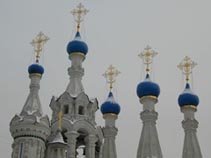
The strange story and rumors surrounding St. Feodor Kuzmich
I have been intrigued for years by the rumors and conspiracy theories surrounding this famous Russian saint. Was he really Czar Aleksandr I? The idea that a Russian czar might have faked his own death to live his life as a quasi-hermit makes for a very pious (and entertaining) story. But as with most conspiracy theories, I am at least slightly skeptical. The first question I ask whenever a conspiracy theory comes my way is, how many people would have had to been in on the plot, and then kept their mouths shut for the rest of their lives? Ben Franklin once famously observed that three people can keep a secret if two of them are dead.
In this case, the number would have had to have been pretty high. And while a lot of rumors did start to crop up, most did not do so until quite a while after the czar's death. To the best of my knowledge none of those who attended the czar in his final days, or his funeral arrangements, ever made any statement that might have implied that things were not as they had been made to appear. I have also been on the lookout for years for a reliable source confirming the story about the Communists opening his grave, only to find it empty. Empty is also a good word for the results of that search thus far. If anyone has a reliable source for that story, please share it in the comments.
None of this is to say that I firmly disbelieve the stories. Only that hard evidence is extremely lacking and that commonsense inclines me towards a certain degree of skepticism. Unlike with some other popular conspiracy theories, such as the Kennedy assassination, or the alleged faking of the moonshot, both of which don't pass the laugh test when you consider the mountains of confirmed evidence; here there is no hard evidence on either side of the debate. And yes, there is some interesting, mostly circumstantial evidence that lends itself to the rumors. As such, while I remain skeptical, I am also keeping an open mind pending a DNA test or some other really hard proof one way or the other.
Labels:
conspiracy theories,
history,
Russia,
Russian Orthodox Church,
saints
News from Rome
Tuesday, November 07, 2023
Report: Pope Francis Planning Radical Changes to Papal Elections
Given what he is obviously trying to do; wouldn't it have been easier to just give voting rights to all the "bishops" of the American Episcopal Church?
Story here.
Monday, November 06, 2023
High Mass for XXII Sunday After Pentecost (Orthodox Western Rite)
St. Patrick's Orthodox Church Bealeton, VA.
Sunday, November 05, 2023
Good News for the Oriental (non-Chalcedonian) Orthodox
Friday, November 03, 2023
Catholic bishop asks pastors to bless same-sex couples
Bishop Karl-Heinz Wiesemann said in the Nov. 2 letter to priests, deacons, and lay pastoral workers that the blessings — which he also extended to remarried couples — could take place in churches in the Diocese of Speyer.
Read the rest here.
HT: Dr. Tighe
Every Catholic in the world is in communion with this heretic. Just saying.
Gall Effrontery Temerity
Call it what you will. Today I got a spam text on behalf of the former grifter N chief complaining about political persecution and begging for money. I'm not generally a fan of coarse language but I spent ten years in the navy, so I'm not exactly unfamiliar. The response I sent back would have peeled the paint off the wall in a Marine Corps barracks.
Thursday, November 02, 2023
Pope Francis calls for ‘paradigm shift’ in theology for world of today
Pope Francis has called for a “paradigm shift” in Catholic theology that takes widespread engagement with contemporary science, culture, and people’s lived experience as an essential starting point.
Citing the need to deal with “profound cultural transformations,” the pope presented his dramatic vision for the future of Catholic theology in a new motu proprio issued earlier today.
Titled Ad Theologiam Promovendam, or “to promote theology,” the document revises the statutes of the Pontifical Academy of Theology (PATH) “to make them more suitable for the mission that our time imposes on theology.”
“Theology can only develop in a culture of dialogue and encounter between different traditions and different knowledge, between different Christian confessions and different religions, openly engaging with everyone, believers and nonbelievers,” the pope wrote in the apostolic letter.
Read the rest here.
Past popes saw themselves as missionaries from God to a fallen world. This pope sees himself as a missionary from the world to a fallen God.
Labels:
Heresy,
Modernism,
Pope Francis,
Roman Catholic Church
Subscribe to:
Posts (Atom)