Showing posts with label Ukrainian Orthodox Church. Show all posts

Monday, June 15, 2026

Historic Orthodox Monastery Burns After Russian Attack


Kyiv —  A prominent Ukrainian monastery complex in the heart of Kyiv was set on fire following a massive Russian attack overnight into Monday that killed at least five people and wounded more than two dozen in the capital, according to local authorities.

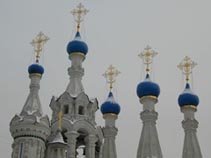
Images showed flames billowing from the UNESCO-listed Kyiv Pechersk Lavra, which traces its roots back almost 1,000 years, and firefighters beneath the towers and domes of its Dormition Cathedral battling to control the blaze.

A CNN journalist reported hearing several explosions during the overnight attack, during which Russia launched 611 long-range strike UAVs and 70 missiles, according to Ukraine’s Air Force.

By daybreak, firefighters were still working to douse the flames at the complex. Ukraine’s emergency services said a fire had affected 800 square meters of the roof of the Dormition Cathedral, and released images that showed damage to the building.

The Metropolitan Epiphanius of Kyiv and All Ukraine asked for “prayers for the salvation of the shrine from destruction,” in a statement. “Another Russian crime against humanity, against history, against Christianity.”

A fire also broke out in the building of the National Cultural, Art and Museum Complex, covering an area of 1,000 square meters, according to Ukraine’s emergency services.

Read the rest here.

Friday, December 02, 2022

Ukraine moves against Ukrainian Orthodox Church (MP)

Ukraine's President Volodymyr Zelensky announced Thursday a coming major crackdown on the operation of Moscow-affiliated Orthodox churches in Ukraine. The move came after weeks of raids on Orthodox rectories and chanceries have reportedly uncovered stocks of Russian propaganda, which denies the right to Ukrainian independence.

“The National Security and Defense Council has instructed the government to propose to (parliament) a bill to prevent the activities in Ukraine of religious organizations affiliated with the centers of influence in the Russian Federation, in accordance with international law in the field of freedom of conscience and Ukraine's obligations in connection with accession to the Council of Europe.”

“National security officials should intensify measures to identify and counteract the subversive activities of the Russian special services in the religious environment of Ukraine,” the president added, highlighting the Ukrainian government's view that some Orthodox churches have become distribution centers for propaganda, and intelligence sources for Russian spies and collaborators.

Zelensky’s decree obliges Ukrainian cabinet ministers to submit within two months a bill to the country’s legislature that would could see Ukrainians face “personal, economic, and restrictive sanctions,” for continued religious activity overseen by Moscow.

The plan takes aim squarely at the Ukrainian Orthodox Church of the Moscow Patriarchate (UOC-MP), which exists under the leadership of Orthodox Patriarch Kiril of Moscow.

The president's announcement came hours after Ukraine’s Security Service, an intelligence and counterintelligence service, raided a monastery of Orthodox nuns in Transcarpathia, a far-Western region of Ukraine.

According to a government briefing after the raid, agents “found a large number of propaganda materials. Most of the literature is authored by Russian figures and published by Russian printers.”

“The law enforcement officers discovered books of xenophobic content with offensive fictions about other nationalities and religions. The pamphlets found deny Ukraine's right to independence and emphasize that Russia, Ukraine, and Belarus ‘cannot be divided.’”

Read the rest here.

Hardly surprising in the circumstances. There is a good likelihood that Putin will be remembered as the John Ireland of Ukrainian Orthodoxy. 

Tuesday, May 31, 2022

THE ORTHODOX CHURCH IN UKRAINE: WAR AND “ANOTHER AUTOCEPHALY”

War changes many things, primarily people’s minds, but also the usual flow of time. What takes years or even decades in peacetime takes a few months, or sometimes even days, during war. 

On May 27, the Council of the Ukrainian Orthodox Church (UOC), the highest governing body of the church, after much debate, expressed its disagreement with Patriarch Kirill’s support for the war in Ukraine and adopted amendments to the Statute of the UOC, “Testifying to the full independence and autonomy of the Ukrainian Orthodox Church.”

It is beyond the scope of this report to analyze in detail the decisions of the UOC Council—not all of the documents have been published, nor have there been official statements from the hierarchy. My aim is to explain the logic of Metropolitan Onufry’s actions, because I hope that this will allow me to put the decisions of the Council of the UOC into the appropriate context.

It is not surprising that, confronted with a lack of information, commentators are divided into two antagonistic camps. Some believe that the UOC is simply salvaging its reputation, that the distancing from Moscow is insincere and coordinated with the Moscow Patriarchate. Others believe that this is an important step towards the autocephaly of the Church and true independence from Moscow.

From the first days of the war, a number of UOC dioceses refused to commemorate Patriarch Kirill in protest of his anti-Ukrainian stance, and this decision received the tacit support of Metropolitan Onufry. A little later, there were efforts to hold a council to make a decision “about the future of the Church,” which many understood to be the groundwork for a complete separation from the Moscow Patriarchate. Metropolitan Onufry was slow to convene the council, and his inner circle, Metropolitan Anthony (Pakanich) and the oligarch deacon Vadim Novinsky, took an openly pro-Moscow position. It is hard to assess how well Metropolitan Onufry understood the mood of the Ukrainian flock in the initial months of the war. Yet Onufry understood Patriarch Kirill’s position: while during the pandemic the Patriarch called him almost every week, he did not call him even once during the three months of the war. For Onufry, Kirill’s silence spoke volumes.

The situation changed dramatically on May 12. On that day there was a meeting of the Holy Synod of the UOC, whose documents were prepared as usual by Metropolitan Anthony, the Chancellor. There was not a single word about holding a council in these documents. Until that point, Moscow had made every effort to maintain the current status quo and did not approve the gathering of any council. The first surprise occurred during the gathering of bishops. Metropolitan Onufry demanded that the Synod’s decisions include a response to the calls of the clergy and that a meeting with clergy and laity be held. Thus, the Synod declared...

Read the rest here.
HT: Blog reader John L.

Note: The author of this piece is Fr. Sergei Chapnin. This piece is published by Public Orthodoxy, a website of which in the past, I and many others have been critical for their open promotion of heterodox beliefs. That said, I have no reason to doubt the factual details of this essay. 

Friday, May 27, 2022

Ukraine: The jurisdictional mess deepens

The canonical Ukrainian Orthodox Church (MP) has taken steps towards ending its ties to the Russian Church. 

Details

Sunday, February 27, 2022

AXIOS

In a rare break with Moscow, the leaders of the Ukrainian Orthodox Church of the Moscow Patriarchate (UOC-MP) have denounced the Russian invasion and urged their countrymen to support the Kiev government.

“Defending the sovereignty and integrity of Ukraine, we also appeal to the President of Russia to stop the fratricidal war immediately,” said Metropolitan Onufry, head of the UOC-MP. Father Mykola Danilevich, a spokesman for the UOC-MP, was more outspoken, saying: ““Putin treacherously attacked our country! We bless everyone for the defense of Ukraine!”

From here

Tuesday, September 08, 2020

Schismatic Patriarch Filaret is hospitalized with COVID-19

Patriarch [sic] Filaret, 91, who leads the large Ukrainian Orthodox Church - Kyiv Patriarchate, contracted COVID-19 and was subsequently hospitalized, the church confirmed Friday in a statement shared on its website and on Facebook. In a follow-up statement shared Tuesday, the church said its leader’s health is “stable” as “treatment continues...”

Read the rest here.

Saturday, February 01, 2020

Quote of the day...

“I was pleased by the recent decisions by the Greek and Alexandrian Orthodox Churches to recognize the Orthodox Church of Ukraine as a fellow autocephalous church. Russia should never stand in the way of the Ukrainian people’s fundamental right to exercise their religious freedom. The Ukrainians can count on American support in that regard.”

-US Secretary of State Mike Pompeo

Source

Tuesday, November 19, 2019

Ukrainian schismatics discuss adopting New Calendar Christmas to differentiate from Russia

 “Metropolitan” Mikhail Zinkevich of Lutsk and Volyn of the schismatic “Orthodox Church of Ukraine” has expressed his support for a group of Lutsk activists who asked a blessing to celebrate the Nativity of Christ according to the New Calendar on December 25 in order to differentiate themselves from Russia.

The request came from Provincial and Lutsk City Council Deputies, members of the “Prosvita” society, and other activists, reports the site of schismatic diocese. According to pershyj.com, it came from more than 300 activists altogether.

Although Ukrainian Orthodox Christians have always celebrated feasts according to the Old Calendar, with Nativity falling on January 7, the petitioners argue that this tradition keeps Ukraine too much like Russia and the Soviet Union, and so it should be changed.

“December 25 is not only the Catholic Christmas, but the general Christian Christmas. The pan-Orthodox Council in Constantinople decided in 1923 that Orthodox Christians, according to the more accurate Gregorian calendar, should celebrate Christmas on December 25. All countries except those that were under the influence of the Soviet Union agreed to it,” the petition reads.

“Most Local Orthodox Churches celebrate Christmas on December 25. However, Ukraine still remains in the Soviet (now—Russian) paradigm, celebrating Christmas on January 7 in the company of the aggressor Russia,” it continues.

Accordingly, the activists asked to begin the Nativity Fast on November 15 rather than November 28. 


Read the rest here.

It's worth noting that the Greek Rite Catholics in Ukraine are still mostly on the old calendar.

Wednesday, October 30, 2019

Greek Church Recognizes Ukrainian Schismatics

While the stance of the Archbishop Ieronymos, the primate of the Greek Orthodox Church, towards the schismatic “Orthodox Church of Ukraine” remained unclear after the Bishops’ Council of the Greek Church on October 12, it has now been clarified. 

As Romfea and its English edition Orthodox Times both report, Abp. Ieronymos sent an “irenic letter” to “Metropolitan” Epiphany Dumenko, the primate of the schismatic OCU on October 21. 

According to established tradition, every new primate of a Local Church sends “irenic letters” to the primates of the other Local Churches of the Orthodox Church, officially announcing his elevation. Response letters from the other primates constitute an official recognition of the new primate. 

Read the rest here

This, at last, appears definitive.

Saturday, October 19, 2019

For the record

And getting back to the troubles in our own house; the primate of the Church of Greece has concelebrated with the Ecumenical Patriarch where they commemorated the head of the schismatic Ukrainian sect. Moscow having issued a clear warning against this last Thursday; it can be assumed that a formal breach in communion is now imminent.

Lord have mercy.

Monday, October 14, 2019

Greek recognition of the OCU... maybe not?

While media reports have stated that the Bishops’ Council of the Greek Church resolved to recognize the schismatic “Orthodox Church of Ukraine” on Saturday, drawing on Metropolitan Hierotheos Vlachos’ statements to the press, two prominent hierarchs of the Greek Church say this is not true. 

Both Metropolitans Seraphim of Piraeus and Seraphim of Kythira, both of whom have addressed the Ukrainian issue several times before, have issued statements in the wake of Saturday’s session, stating that the issue of recognizing the OCU was not put to a vote and that the hierarchs simply reaffirmed the Holy Synod’s earlier decision. 

Read the rest here

If you are getting a sense of ecclesial whiplash, join the club.

Friday, May 24, 2019

Report: Greek Church released Archimandrite Epiphanius to schismatic Ukrainian Church

No official confirmation from the Greek church, but if true this would be a serious development. Allowing your clergy to be consecrated a bishop by another "church" would certainly be seen as a specie of formal recognition of that entity. To date no canonical Orthodox church, excepting the EP, has recognized the schismatic OCU.

Details.

Tuesday, May 21, 2019

Fr. Theodore Zisis on the Greek Church and the Situation in Ukraine

 For the first time, the Constantinople Church has found itself isolated from the other autocephalous Churches, due to its anti-canonical and anti-conciliar actions in granting autocephaly to the Ukrainian schismatics.

Thus, it itself has placed under doubt its accepted coordinating role as a unifying factor and driven its hitherto proven and effective ecclesiastical politics into complete failure. It all began with the incomplete, truncated representation of the Body of Christ at the pseudo-council in Kolymvari, Crete.

In our previous articles we noted the unavoidable danger arising for the Grecophone leaders of many Local Churches (Alexandrian, Jerusalem, Cypriot, Greek, and Albanian) of falling into the temptation of following ethnophytelistic criteria, supporting the Greek first-throne Church. This would in fact mean falling into the heresy of ethnophyletism, which was condemned by the Local Synod of Constantinople in 1872 due to the Bulgarian ethnophyletistic demands of the time.

Unfortunately, such criteria dominate amongst a significant part of the Grecophone clergy, theologians, and specialists in canon law who place patriotism and ethnic origins higher than the national integration of all Orthodox into one body of the Church of Christ, Where there is neither Greek nor Jew, circumcision nor uncircumcision, Barbarian, Scythian, bond nor free: but Christ is all, and in all (Col. 3:11).1

Thus, it is clear as God’s day that the Constantinople Church’s interference in the Russian Orthodox Church’s jurisdictional territory, to which the Ukrainian Church has belonged for over three centuries since 1686 with total and uncontested recognition by all the Local Churches and even the Ecumenical Patriarchate itself (as scholarly research into the historical and sacred canonical aspect demonstrates), is anti-canonical.2 However, despite this fact, today we have a planned attempt by researchers to present a different picture that favors the supposedly existing jurisdiction of the Ecumenical Patriarch over the territory of Ukraine, and what is worse, a jurisdiction that supposedly allows it to independently grant autocephaly without the agreement of the entire body of the Church, expressed in a conciliar and pan-Orthodox manner.

This newly-proclaimed ecclesiology is trying to represent the Ecumenical Patriarch not as the “first among equals” (primus inter pares)—and thus expressing and accepting decisions on a par with others—but as the “first without equal” (primus sine paribus), ruling in the papal-monarchical manner. Its apotheosis is the Ecumenical Patriarch’s completely self-willed “restoration” of the Ukrainian schismatics without meeting the conditions stipulated by the sacred canons, namely public expression of repentance and their re-ordination or re-consecration.

In the case of the Ukrainian schismatics, even worse and unthinkable from the ecclesiological and pastoral point of view is that they are not returning to the bosom of the canonical Church that has existed for centuries, which is led by Metropolitan Onuphry, and from which they broke off. But Patriarch Bartholomew has instead created a parallel jurisdiction on the same territory and a new synod, and thus has become the initiator of a schism with painful consequences not only for Ukraine, but also for Universal Orthodoxy.

Read the rest here.

Wednesday, January 23, 2019

Metropolitan Jonah (Paffhausen): A Canonical Crisis in the Orthodox Church

 The actions of the Patriarchate of Constantinople (EP) in its process of granting a Tomos of autocephaly to the schismatic groups in Ukraine have created a canonical crisis. This point of “judgment” (the real meaning of “crisis”) is not so much about Ukraine, per se; but about the nature of the authority of the Ecumenical Patriarchate, and of primacy, indeed of episcopacy in the Orthodox Church. Thus, it affects every Orthodox Church and every Orthodox Christian. It has nothing to do with nationalism, though this has been a tool for manipulation of various parties involved; it has nothing to do with a rivalry between Moscow and Constantinople, though this is certainly exacerbated by the situation. It has nothing to do with Greeks versus Russians, or with Constantinople’s frustration with Moscow over the Cretan council. The roots of this crisis are a hundred years old, and its foundations date back to the Roman Empire.

It is a time of judgment for Orthodoxy, to make us deal with reality as it is, and not how we imagine it to be, not how we would like it to be. This means that to resolve this crisis we have to look at the history of the past several hundred years, and the current situation, and make some decisions as to how we are going to proceed as the Church. This brings up many corollary questions: What is the relationship between the Church and the world, the Church and secular governments, the Church and the nation-state? How does the Church engage in missionary outreach, and the nature of those missions? How do the Local Churches relate to one another, maintain communion with one another and support one another, in relation to the secular world?

The real issue is, what is the nature of the primacy of the Ecumenical Patriarch in Orthodoxy and how does it work in relation to the Synodal constitution of the Church?

There are two systems of presuppositions which have clashed in Ukraine. First, the conciliar vision of the Church which sees Local autocephalous Churches as having full authority over their defined territories, and missions, with full jurisdiction over juridical, canonical and disciplinary matters residing in the Synod of that Local Church. The Patriarch of Constantinople has primacy of honor as the first among equals, on the basis of the ancient canons. However each Synod has its own primate, and each functions independently as autocephalous. The second system has a set of presuppositions which vest final authority in the Ecumenical Patriarch over all canonical decisions, with a right of appeal and the right to overrule the other patriarchs, primates and their Synods, and whose decisions cannot be appealed. The conciliar/synodal model has been the operating principle of most of the Orthodox Churches for the past several hundred years. The Constantinopolitan model has been developing over the last century, on the basis of interpretations of the ancient canons, and has most recently been applied in Ukraine. It relativizes the autocephalies of the national Churches, and asserts not only primacy of honor but primacy of jurisdiction over all the Orthodox Churches, and sole jurisdiction outside of their national territories.

The specific conflict between these two visions of the Church manifested itself in Ukraine. While the interference of political powers and their financial ability to influence the leading actors, as well as the personal motivations of various actors involved, are important,they are side issues. The current conflict arose from the process of granting the Tomos of autocephaly to the schismatics in Ukraine, and especially, the validation of their schism. This was done despite the presence of the much larger canonical Ukrainian Orthodox Church, an autonomous Church under the Moscow Patriarchate. There was no consultation nor agreement with the UOC-MP, and they did not request autocephaly. The process involved the petition to the Ecumenical Patriarchate for autocephaly from the President of Ukraine, P. Poroshenko, on behalf of two groups that had long been in schism from the canonical Church in Ukraine. These bodies were led by former clerics who had been legitimately defrocked and anathematized by the Russian Orthodox Church, of which they had been members: the so called “Patriarch” Philaret Denisenko and “Metropolitan” Makary. The excommunication and expulsion of Denisenko had been universally recognized as just, for abuse of power and corruption, and for schism; and supported, even by Patriarch Bartholomew, who had also affirmed the complete competence and jurisdiction of the Russian Church to deal with these issues. Poroshenko’s petition included an appeal to overrule the decisions and disciplines levied against these clerics by the Russian Synod. The EP appointed two Exarchs, bishops from North America, to work out the details of the relationship with Constantinople and bring the two groups together. By entering Ukraine on official Church business without the blessing of the canonical Metropolitan of Kiev, Metropolitan Onuphry, the Exarchs of Constantinople violated the canonical territory of the autonomos Ukrainian Orthodox Church, and of the Patriarchate of Moscow of which it is part. Interfering in the Church affairs of another Local Church, and invading their territory are major canonical infractions. As a result, Moscow resolved to cease commemorating the Patriarch Bartholomew. Constantinople then withdrew the 300-year-old document, ceding jurisdiction of Kiev to Moscow. The biggest canonical infractions came, however, when the EP validated these schismatic groups and declared them fully canonical, took them under his jurisdiction, and validated the priesthood and episcopacy of their clergy. Moscow had no choice but to break communion with Constantinople at this point. Constantinple later established them with a Tomos of Autocephaly. In addition, the EP has established a stavropegial diocese, under himself, on the territory of Ukraine. He is operating on the basis of his own presuppositions; but they are not shared by the rest of the Church. Rather, he is seen as operating unilaterally, without consultation or conciliar consensus with the other Orthodox Churches.

Perhaps the most significant act in this process has been the validation of the clergy of the schismatic groups, and the recognition of their organization as a legitimate church within the Patriarchate of Constantinople, albeit nominally autocephalous. None of the other actions of this process touch on the sacramental constitution of the Church; these, however, cut to the very nature of episcopacy and priesthood, and of the Church itself. Everything else, as offensive as it has been to the Ukrainian and Russian Orthodox Churches, is essentially administrative and juridical. Not that these are not important, but they do not have any implications for sacramental integrity of the Church or the continuity of the Tradition. If this schism was just administrative, the parties would eventually reconcile, even if grudgingly, as after Constantinople invaded and divided the Church in Estonia. There was a break in communion for a time, as there is now between Jerusalem and Antioch. But there was no issue that forced the rest of the Churches to take sides and go into schism with the others.

The schismatic clergy all had cut themselves off from the canonical Church. Some had been canonically ordained, most were uncanonically ordained by schismatic bishops, and some had never been ordained as bishops. In an unprecedented sweep of the pen, the Patriarch of Constantinople declared all these clergy valid and canonical, lifting the defrockings and anathemas, and placing them under his omophorion—figuratively. Then the EP demands that they commemorate the new primate as the head of a legitimate Orthodox Church, and serve with him and his clergy, and does so himself. So all the Churches, the primates and Synods, must choose: Will they serve with clergy from this new Ukrainian Church under the Ecumenical Patriarchate? Those clergy and faithful will also go all over the world, to Jerusalem, Mt. Athos, Cyprus, Greece, Serbia, Romania. Will they be received to communion? Will they be allowed to serve? Will their Baptisms be recognized?

Read the rest here.

Saturday, January 05, 2019

For the record

The Ecumenical Patriarch has signed the tomos recognizing the schismatic Ukrainian church. I will be interested to see what's in the fine print. Beyond which, unless the local churches can be moved to take a stand, I see no end to this schism in the foreseeable future.