Tuesday, December 12, 2006

December 13 Feast of St. Herman of Alaska

Venerable Herman of Alaska, Wonderworker of All America. A spiritual mission was organized in 1793 with volunteers from the monks of the Valaam Monastery. They were sent to preach the Word of God to the native inhabitants of northwestern America, who had come under the sovereignty of Russia only ten years before. St Herman was one of the members of this mission.

St Herman came from a family of merchants of Serpukhov, a city of the Moscow diocese. His name before he was tonsured, and his family name are not known. There is a possibility, however, that his baptismal name was Gerasimus. He had a great zeal for piety from his youth, and he entered monastic life at sixteen. (This was in 1772, if we assume that Herman was born in 1756, although sometimes 1760 is given as the date of his birth.) First he entered the Trinity-Sergius Hermitage which was located near the Gulf of Finland on the Peterhof Road, about 15 versts (about 10 miles) from St Petersburg. He also spent time at at Sarov, where he first met Fr Nazarius, who became his Elder at Valaam. Later, St Herman followed him to Sanaxar where St Theodore (February 19) was their igumen.
Read the rest here.

ROCOR / MP communion update

The Russian news service TASS/ITAR reports that a formal signing ceremony will be held for the Act on Canonical Communion in Moscow probably in May 2007. They did not cite a specific source for this date although they made reference to the recent meeting of the Holy Synod of the Church Abroad in New York.

Will it be a Merry Christmas for Roman Catholic Traditionalists?

(Back at the keyboard after a very hectic week and largely recovered from a nasty cold/flue bug...)

An Italian news report posted over at NLM suggests that the publication of a long anticipated indult liberalizing the Rite of Pius V may be imminent. This would be good news for many Roman Catholics who are hoping that their principal Christmas present is coming from the Holy See. Unlike many reports which are often little more than anonymous gossip, this one has a pretty authoritative source cited.

Thursday, December 07, 2006

The date that lives in infamy...

Before 9/11 there was another date Americans recalled for a treacherous surprise attack. Lest we forget...

Wednesday, December 06, 2006

Feast of St. Nicholas

Today is the feast of St. Nicholas . It is one of the most popular feast days on the Orthodox Church calendar and his name is among the most common in many Orthodox countries. There are many traditions associated with this saint which can be read about here . It is also a custom (imported from the west I believe) that on his feast day decorations for Christmas are usually put up. To all of the Nicks Nikkies Nikolaiis and Nicholes out there... many years!!
------------------------------------------------------------------------------------------------
Update: I just got an email which informs me that apparently a movie is now in the works about the real St. Nicholas. The link to the official web site of the film is here.

Monday, December 04, 2006

Feast of St Alexander Hotovitzky (New Martyr)

This saint was born in Russia and it was there that he would later be martyred by the Communists. But much of his priestly service was here in North America. Read his biography here.

There's diversity and then there's...

December 4, 2006 -- DiD you hear the one about the Marines that Columbia University invited to campus for Fleet Week?

Not any time in the last few decades, you didn't.

But you might have heard the one about the Marine who was told by a fellow Columbia student that he was stupid for joining the military because he's Hispanic and didn't realize he was being used for cannon fodder.

It's actually kind of funny - but when it happened to me during Columbia's Activities Day last year, I was fighting mad. Not because I was publicly humiliated in front of several hundred of my fellow classmates (any devil dog who has spent a summer on Parris Island gets used to insults), but because of what the incident showed about New York's most prestigious university.

On the surface, Columbia is all for diversity (good, very good) and completely opposed to intolerance (bad, really bad). On any given day, eager undergrads can speak out for Starbucks employees forced to make coffee with non-ergonomic espresso machines, or call for the school to install non-gender-specific bathrooms.

Read the rest here.

Some thoughts on the Pope,western phronema, & Orthodox Doctrinal Development

Ben of the Undercroft has posted an interesting essay on an often undiscussed aspect of the Rome Orthodox reunion debate. We Orthodox tend to spend a great deal of time discussing what changes the Latins will have to make for reunification to occur. But we frequently ignore the reality of the current situation in the West. And that reality is that the Roman Catholic Church has become to a certain degree dependent on a strong centralized administration for government. As I noted in a post on this subject a long time ago over in Free Republic; Rome having decided to ride the tiger may find it hard to dismount without injury.

The West largely lacks what we would call an Orthodox phronema. The Latin sensus fidei if you will has become severely eroded. The idea that Rome could just snap its fingers and become Orthodox in its ecclesiology is naive. The Roman Church has over the course of a thousand years become very dependent on the power of the papacy. Given the disciplinary and theological chaos now rampant in the Roman Catholic Church, a reasonable argument could be made that the Latin Church would suffer significant harm if it were not for a powerful papacy. Ben makes the point well in his essay.

I can think of several Roman bishops and at least one cardinal here in the United States who I strongly suspect would be ordaining women and marrying same gender couples the day after the Pope renounced his universal and absolute jurisdiction over the church. I can’t say that about any Orthodox hierarchs. Again this comes down to sensus fidei. When was the last time a Roman Catholic bishop called one of his brothers a heretic (excepting the schismatic Lefebvrists)? Has that happened in my lifetime? If so I am unaware of it. I think this is in part due to the subserveint role that Latin bishops have been relegated to in the Roman ecclesiology. This is alien to Orthodoxy. The faith in the Orthodox Church is not the property of just one supreme bishop. It is the property of The Church as a whole including even the laity. And in that context it has been jealously guarded for a thousand years.

I have occasionally asked Orthodoxy's critics for an explanation for its remarkable theological stability in various forums and discussions. Generally I don’t get much in the form of a response. Fr. Kimel (I am going to have get used to the new/old title) however gave a brief glimpse of his thinking on the subject in his comment on Ben’s article. He is rather dismissive of Orthodoxy’s lack of doctrinal development, attributing it to the historic conditions of the Orthodox Church under Ottoman and Communist oppression. This is in my opinion both an historically weak argument and also a double edged one that could cut the other way with equal force.

First the Orthodox world has never been completely under the heal of oppression. The (Eastern) Roman Empire lasted up until the XV century before its final collapse. And the Ottoman Empire had lost much of its grip on traditionally Orthodox lands by the end of the XIX century. It was not until 1918 that the Communists became a great power and threat to the Church. And while the injury done was great (we will never know the number of martyrs but certainly they are in the millions), the Communist yoke was from an historical point of view rather short lived. Other than that bloody space of roughly three quarters of a century the Russian Church was never directly repressed on a large scale.[1]

Depending on when you date Rome's departure an argument can be made that the Orthodox Church enjoyed at least moderate freedom for more than half of the period since the schism and in the case of Russia almost the entire post schism period less the heart of the XX century. Additionally, during this time there were some fairly long periods in certain locals where Ottoman rule was relatively tolerant of Christianity. Add to this the combination of a lack of central authority and the autonomous national churches and you have what should be a recipe for one schism after another.

And yet in the eight or so centuries since Rome’s departure there have been no significant schisms in the Orthodox Church over matters of faith. Nor has there been any major reinterpretation or “doctrinal development” of the faith. When one examines the totality of historical circumstances and also the ecclesiology of the Orthodox Church (which at a casual glance bears a frightening similarity to Anglicanism) the above statement becomes truly astonishing.

The inverse of Fr. Kimel’s argument of course is that one could look at a great deal of the development of Latin doctrine especially in relation to the Petrine ministry and see powerful links to the historical and political circumstances then present in the West. I alluded to this in a previous discussion over at Sacramentum Vitae.[2] Fr. Kimel also appears to date ultramontanism from the First Vatican Council.[3] To say that Fr. Kimel’s dating shocked me would be putting it mildly. The language of the decrees of Vatican I is the epitome of moderation compared to some of the pretensions to papal power and prerogatives which preceded it. One need only glance at the wording of the Bull Unam Sanctam of Boniface VIII for evidence of this.[4] One may indeed look as far back as the remarkable claims of St. Leo the Great, pointed out to me in a gentle but well aimed rebuke to one of my earlier posts by Dr. William Tighe.[5]

On one point I am in strong agreement with Father Kimel. The East has suffered from its estrangement from the Christian West. This tragic truth is undeniable. But again this cuts both ways. In its isolation from her sister churches and the theological phronema of the East following the schism, Rome had virtually no restraints or temporizing influence on its ambitions and claims. And there was no effective counterbalance to the rise of the scholastics which wreaked so much havoc theologically in the Latin Church. Nor was the isolation of the East as complete as Fr. Kimel seems to imply. Russia, especially from the time of Czar Peter (the not so great), was heavily exposed to all things western. And yet the Russian Church seems to never have seriously considered reunion with Rome. This was certainly not for want of exposure. Exposure was everywhere as a result of Peter’s efforts to “modernize” Russia and also from the periodic invasions from Catholic Poland and other locals. Nor did Peter for all of his occidentophile tendencies attempt to force the Russian Church into any union with Rome. [6]

Fr. Kimel asserts that the Roman Catholic Church is more catholic as a result of its centralization. He correctly identifies the cafeteria style theology now prevalent in much of Europe and the United States as one of the major problems facing the Roman Catholic Church. However I would respectfully argue that the long term solution is not a papal monarchy but rather the restoration of an Orthodox phronema or sensus fidei to the faithful of the Western Church. A short term abandonment of the papal prerogatives is unrealistic given the present situation in the Western Church. However long term this would be the best course of action.

Despite the fairly chaotic jurisdictional soup that is the Orthodox Church today we share one faith. We may occasionally throw furniture at each other when someone mentions the word “calendar” but we still recite the same creed and no one is arguing for the ordination of women. Fr Kimel also comments on the centralized powers of the papacy… “This is the great advantage in possessing a divinely instituted center of unity: it keeps, as Stanley Hauerwas likes to quip, the Irish and Italians, the Franciscans, Dominicans, and Jesuits, in one Church.” Try keeping Greeks Russians Arabs and Serbs in one church without a central authority! There is no other way to explain that beyond the working of the Holy Spirit.


[1] Obviously there were exceptions on the fringes of the Russian state where territory traded hands as a result of wars and other occurrences.

[3] “I'm know that papalist positivism--whatever the Pope speaks is God's truth--characterized post-Vatican I Catholicism for a hundred years; but this certainly is no longer the case.” Fr. Al Kimel

[4] It is also worth noting that the aforementioned bull was issued at a time when the Holy See was involved in a highly political and nasty feud with Philip IV of France. Mere coincidence of course.

[6] In fairness this was as likely a political consideration as much as anything else.

Sunday, December 03, 2006

The Pontificator is Ordained


Al Kimel of Pontifications was ordained as a Roman Catholic priest today. This is the culmination of his long journey from the Episcopal Church. He will exercise his ministry under the pastoral provision for former Anglican clergy granted by HH +John Paul Magnus of blessed memory. I hope that pictures of this joyous event will soon be posted. May God grant Fr. Alvin Kimel many many years!

Saturday, December 02, 2006

San Joaquin Secedes

I am not sure if this is the equivalent of Ft. Sumter. But the diocese of San Joaquin in CA (I actually live within its geographic boundaries) has become the first diocese of The Episcopal Church (TEC) to take formal steps to end its affiliation with the radical liberal denomination whose actions are threatening to tear apart the World Wide Anglican Communion (WWAC). Undeterred by bullying and threats from the liberals now running TEC bishop Schofield has been firmly guiding his diocese (the only one in the US that does not ordain women) towards the exit ever since the General Convention last summer.

In his remarks he has consistently referred to TEC's broad church theology as heresy, and has been unwavering that neither he nor his diocese were prepared to remain in a denomination that had so blatantly abandoned the Apostolic Christian faith. The resolutions passed by the diocese overwhelmingly have replaced all references to TEC with the term Anglican and make it clear the diocese considers itself a part of the WWAC. Bp. Schofield is fairly certain that TEC's days in the WWAC are numbered and he has made it clear where he wants to be when the dust settles.

Now if only we could get him to look at Orthodoxy...

Energetic Procession is back!

It is with great pleasure that I can report that Dan Jones web site Energetic Procession has returned after a long absence. It's been once again restored to my "A" list in the sidebar of recommended web sites. Please note the new web address for your book marks. This is one of the best sites on the web for discussion of serious theological issues with an emphasis on Orthodox Triadology.

The Filioque (Again)

Michael Liccione has posted an essay on the perennial topic of the Filioque over at Sacramentum Vitae. In addition to this interesting article I would recommend the articles posted by Al Kimel on the subject. Finally there is a pretty descent overview of the issue from an Orthodox POV located here. It also has some links to excellent essays and articles on the subject. Caution some of these articles are not light reading.

Under the Turkish Guns, the Christians Roar

It is the peculiar genius of Byzantine history that its glory reached its apogee in the era known to the West as the Dark Ages. It has no great literary heritage – a half-millenium of Muslim domination ensured the annihilation from memory of its major works beyond the Alexiad of Anna Comnena, the anonymous epic of Digenes Akritis, and various religious texts. The latter survived because the Church survived, even as the Empire did not. Chief among them are the great liturgies, and chief among the great liturgies is the Liturgy of St John Chrysostom. It is the queen of liturgies: a Greek epic of its own, also of the Western Dark Ages, emphatic and deliberate in its insistent worship of Christ. The liturgy has a heavenly glory in its song and prayer. It also has a mundane length to it. Properly done, it lasts hours. Yesterday, it lasted five hours, from 8am to 1pm. It’s a feat of endurance for the best Christian – particularly as the great majority of it has one standing. I am not among the best Christians. But yesterday, I did it.

Yesterday, I was in the Church of St George at the compound of the Ecumenical Patriarchate in the Fener district of Istanbul. Across from me sat the Ecumenical Patriarch Bartholomew I, holder of the last office of the Eastern Empire, and spiritual leader of the Orthodox Christians of the world. Mere feet away, within arm’s reach, sat Pope Benedict XVI....

Read the rest here.
Hat tip to Fr. Huneycutt

DESECRATION OF A HOLY SITE, TURKEY, AND THE POPE

by

Theodoros Karakostas

The Church of Aghia Sophia has special meaning for Greek Orthodox Christians. Aside from its obvious religious and spiritual value, Aghia Sophia is a site of Hellenic
martyrdom and suffering. Following the Ottoman Turkish conquest of Constantinople in 1453, Ottomans soldiers interrupted the last liturgy held in the Great Church and
began dragging men, women, and children by the hair, tied them, and began sending them back to Adrianople to be sold into slavery. The Crucifix that stood on the altar was desecrated and mocked as the Janissaries rounded up the faithful while the Great Church was filled with the cries of family members being separated. Mehmet the conquering Sultan had previously told his soldiers and Janissaries that the people of the City would be theirs to enslave while the buildings such as Aghia Sophia would
belong to him.

On November 22, 2006 a pathetic and outrageous spectacle ensued. The notorious Grey Wolves entered the Great Church and defiled it once again. The bloodthirsty
killers who have killed Greek Cypriots in the past, and who are attempting to deprive the Ecumenical Patriarchate of its rights, proceeded to chant "Allahu Akhbar" in the
Church while proceeding to pray in the Muslim fashion. The members of the Grey Wolves shouted "Aghia Sophia is ours"....

This action was carried out less than a week before the visit of Pope Benedict to Constantinople. If there is any reason that should make it quite obvious as to why Turkey does not belong in the European Union, it is the very existence of this wicked racist organization.

The Grey Wolves obviously remember that when Pope Paul VI visited Ecumenical Patriarch Athenagoras in 1967, he prayed inside the Great Church of Aghia Sophia. As such, Turkish extremists of all factions believe that a plot is under way to restore Aghia Sophia as a Church.

This of course is even less outrageous than the assertion of the Grey Wolves that the Ecumenical Patriarch is attempting to revive the Megali Idea on behalf of Greece. The violent demonstrations outside the Ecumenical Patriarchate have included the declaration by the Grey Wolves that their City is Turkish and will never be given up.

There has been a petition in Turkey circulated by the Turkish extreme right that is demanding the outright expulsion of the Ecumenical Patriarchate.

And what actions has the Turkish government taken to protect one of its minority populations? Ankara continues to insist that the Ecumenical Patriarchate has no right
to use the title "Ecumenical", and that the Ecumenical Patriarch is merely the local Bishop of the Greek minority. By undercutting the proper title of the Ecumenical Patriarch, Ankara is directly fueling the paranoia of the Grey Wolves and the violence against the
Ecumenical Patriarchate.

During the fall of 1993, Turkish extremists attempted to set fire to the Patriarchate. Between May 1994 and October 2004, the Ecumenical Patriarchate was bombed
on four occasions. In late 1997, the Greek caretaker of a Church was brutally murdered, and in October 1999, a nine year old Greek boy on the island of Imbros died in an arson attack. During the fall of 2004, the Greek orphanage at Prinkipos was seized, and during the Spring of 2006 the Monastery of Saint George was confiscated.

The continued seizure of Greek property and the refusal of Turkey to allow the reopening of Halki makes very clear that the Grey Wolves are not acting alone in their terror campaign against the few remaining Greeks. Both the civilian Islamic authorities in Turkey and the Kemalist Generals are contributing to the atmosphere of terror that is again resurfacing in Turkey against the Greek minority and the Ecumenical Patriarchate. News reports in September 2004 indicated that the notorious National Security Council ruled that Halki would not be allowed to reopen.

There is no greater evidence of the lack of remorse on the part of Turkish leaders for the past policies pursued against the Greeks than by the activities of the Grey Wolves. A responsible and democratic government worthy of joining the European Union would not be permitting reprehensible displays of hatred against a vulnerable minority.

It is beyond bizarre that demonstrations in which the Patriarch is burned in effigy are permitted outside the Ecumenical Patriarchate considering the four bomb attacks
at the Phanar!

Last January, the Grey Wolves gathered in Smyrna where a figure made up to look like the Patriarch was dismembered in a way that recalled the horrific murder and mutilation of Metropolitan Chrysostom in 1922. It is ironic because by touching on the murder of the last Bishop of Smyrna, the Grey Wolves were in effect conceding the reality of the Turkish Genocide against the Greeks.

The present Pope may be one that the Orthodox can work with. As former Cardinal Ratzinger, he openly opposed Turkey's bid to join the European Union. Considering
the reception that the Grey Wolves and others are planning for the Pope, it is unlikely he will reconsider his stance on Turkey. In all likelihood, the Papal visit is going to bring the attention of the world on Turkey, and the world is going to get a rare opportunity to actually see beyond the propaganda of Turkey's American, Israeli, and British partners. The Pope recently received President Papadopoulos of Cyprus in Rome where the latter presented him with a book on the destroyed Greek Churches in occupied Cyprus.

The Pope was widely condemned by the politically correct for quoting Byzantine Emperor Manuel II Palaiologos back in September. The words of Emperor Manuel about Islam were expressed when Constantinople was surrounded by the Islamic armies of the Ottoman Empire. It is unlikely any of these critics know or care to know about the fate of Manuel's last descendants in Constantinople today.

There are those who will blame the quote of Emperor Manuel II for the hostile reception that the Pope will receive in Turkey. This is a completely false and inaccurate assumption. The Turkish government blocked the Papal visit which was supposed to take place last year. The Ecumenical Patriarchate has been harassed by Islamic
militants other than the Grey Wolves over the past decade, so a hostile reception to the Pope was inevitable under any circumstances.

The Pope is scheduled to visit Aghia Sophia and Turkish extremists are likely concerned that the Pope may actually pray inside the Great Church. I hope the
Pope does pray inside Aghia Sophia. Perhaps he will pray for the Christians who fell during the fall of Constantinople, or perhaps he will pray for the plight of Christianity in Turkey and the Islamic world?

The horrors and the evils that transpired in Asia Minor which resulted in the Genocides of the Armenians, Assyrians, and Greeks have bee hidden from the Western world for too long. Hopefully, the Papal visit will begin the process of shedding much needed light on the political realities of Turkey today, and its past.

Friday, December 01, 2006

The Visit

As of this writing Pope +Benedict XVI has safely returned to Rome (Deo Gratias) after his trip to Turkey and the seat of the Ecumenical Patriarch. Just a few quick thoughts on the trip.

First, as expected the real reason for the trip received negligible attention in the mainstream media. As far as they were concerned this was all about the Muslims. To some degree that was probably unavoidable given the Pope's comments at Regensburgh and the violent reaction from the Islamic world. Turkey is 99% Muslim and there were some cool feelings towards a Pope who had dared to sharply criticize their religion and also who was on record opposing their country's admission to the EU. But I must confess to my profound disappointment at the blinders that the MSM wore in covering this story. It really was all about how Muslims were offended by this Pope. In yesterday's NY Times article on the papal visit there was all of one sentence about the plight of the Orthodox Church in Turkey.
Turkey’s small population of Orthodox Christians complains of official harassment and bureaucratic obstacles that have prevented its members from operating freely.
This out of a two page story on their website. No mention or discussion of how this country became 99% Muslim nor of its treatment of religious and ethnic minorities. The above complaints aside the trip did go off more or less without major incident even if the MSM declined to spend any time discussing what it was really about.

Those of us who pay attention to what's going on however were gratified to witness only the third visit by a Roman Catholic Pope to the seat of the Ecumenical Patriarchate. Nothing really dramatic came of it. No announcement of restored communion or some major breakthrough in the theological discussions that have been ongoing. But the symbolism alone was very powerful. People in many parts of the world were able to witness live a Roman Pope being received at the Phanar with the ceremonial normally reserved for an Orthodox hierarch and seated in a place of honor during the celebration of the Divine Liturgy which was also broadcast live. That alone was worth the trip. (On a side note many comments on Roman Catholic blogs by those who watched the liturgy on EWTN made rather unfavorable comparisons between the current Roman liturgy and the Orthodox one. See comments by Fr. John Zuhlsdorf and also comments on Rorate Caeli)

What is important here are not the documents issued, but the mere presence of the Pope in Constantinople, a city where the bishop who preceded the future Pope John XXIII as the Catholic hierarch there had a sign nailed over the door to his residence that read "qui ex Patre Filoque procedit." There are some on Catholic blogs who have made snide comments about the Pope meeting with the EP. And I have read equally snarky comments on some Orthodox e-lists about "black Bart's meeting with the Roman heretic." These are people who have apparently never read the scriptural injunctions against schism. Yes these do occur. But they are to be deplored. And every effort must be made to heal wounds in the Church of Christ.

This did not heal those wounds. Still, it was a step in that direction. This division is unnatural and deeply offensive to God. And I firmly believe it is a positive duty for all Christians (at least those belonging to the apostolic churches), to do all that can be done to restore unity not just in photo ops but where it counts, in the recitation of the same creed and the sharing of the cup.

------------------------------------------------------------------------------------------------

Update: It would appear that there is at least one mainstream news publication which seems to have noted whats going on. Time Magazine has a brief but good article on the Pope's objectives in Turkey in relationship to the Orthodox Church.

Russian Archipelago renamed for Royal Passion Bearers


The archipelago "Severnaya Zemlya" has been renamed for Emperor Nicholas II

Moscow, Dec. 1, 2006:

The Duma of the Taimyr (Dolgano-Nenetz) autonomous region on Friday approved a resolution to return the names of the family members of Emperor Nicholas II to a series of islands in the Arctic Circle, according to Interfax.

In particular, as the document received by "Interfax" says, the archipelago "Severnaya Zemlya" has been renamed as "arkhipelag Zemlya Imperatora Nikolaia II".

The Deputies explained their initiative by the need "to restore what is historically right, and to perpetuate the memory of the rule of the Romanovs, who in their 305 years in power brought Russia to the level of a world power".

Besides that, the island "Maly Taimyr" is renamed as the island of the Tsarevich Alexy; the island "October Revolution" is renamed as the island of St. Alexandra; the island "Bolshevik" is renamed as the island of St. Olga; the island "Komsomoletz" is renamed as the island of St. Maria; the island "Pioneer" is renamed as the island of St. Tatiana; the island "Domashny" is renamed as the island of St. Anastasia.

The proposal to rename the islands has been sent to the government of the Russian Federation, and to the Federal service of Geodesia and Cartography, for the experts.

Hat tip to JRS

Thursday, November 30, 2006

Reality Check

Julio over at Hispania Sancta has posted an extremely powerful essay. This brings introspection to a new level. I will only excerpt a small part of it. This is one of the better blog posts I have run across in a while.

I haven’t been writing anything of theological content because I can’t stomach the hypocrisy of theologizing and pontificating when I don’t even live a moral Christian life. I started writing something smart-sounding the other day and had to stop myself. Sorry, but I just burst out laughing and deleted the whole thing. I’m starting to wish I had never learned words like “hesychasm”, “monologic self-repeating perpetual prayer of the heart”, “energies/essence”, “penal substitution theory of the atonement”, “hermeneutic”, or “ceasaropapism”. In short, I wish I’d never learned a word that I could use as a weapon towards someone else or as a way of making myself feel like my praxis-less Christianity actually means something. Maybe if I can acquire the moral awareness of a 10 year old catechumen, I’ll talk theology. It has been exceedingly stupid of me to speak at lengths about an interior life the likes of which I have no firsthand knowledge, and I intend to remedy that.

That &%#$! browser!!!

Netscape has been giving me a lot of problems lately including script errors and constantly freezing. So after checking for viruses I decided to just re-download it. Unfortunately when it finished it had deleted every single saved website from my book marks! I had well over a hundred saved sites. I tried doing a system restore to no avail. My frustration level is just through the roof. For the thousandth time (for those that know me)… my next computer WILL BE A MAC!

Wednesday, November 29, 2006

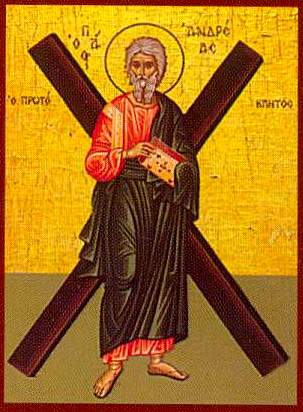
Feast of St. Andrew the First Called.


The Holy Apostle Andrew the First-Called was the first of the Apostles to follow Christ, and he later brought his own brother, the holy Apostle Peter, to Christ (John 1:35-42). The future apostle was from Bethsaida, and from his youth he turned with all his soul to God. He did not enter into marriage, and he worked with his brother as a fisherman. When the holy Prophet, Forerunner and Baptist John began to preach, St Andrew became his closest disciple. St John the Baptist himself sent to Christ his own two disciples, the future Apostles Andrew and John the Theologian, declaring Christ to be the Lamb of God.

After the Descent of the Holy Spirit upon the Apostles, St Andrew went to the Eastern lands preaching the Word of God. He went through Asia Minor, Thrace, Macedonia, he reached the River Danube, went along the coast of the Black Sea, through Crimea, the Black Sea region and along the River Dniepr he climbed to the place where the city of Kiev now stands.

He stopped overnight on the hills of Kiev. Rising in the morning, he said to those disciples that were with him: "See these hills? Upon these hills shall shine forth the beneficence of God, and there will be a great city here, and God shall raise up many churches." The apostle went up around the hills, blessed them and set up a cross. Having prayed, he went up even further along the Dniepr and reached a settlement of the Slavs, where Novgorod was built. From here the apostle went through the land of the Varangians towards Rome for preaching, and again he returned to Thrace, where in the small village of Byzantium, the future Constantinople, he founded the Church of Christ. The name of the holy Apostle Andrew links the mother, the Church of Constantinople, with her daughter, the Russian Church.

On his journeys the First-Called Apostle endured many sufferings and torments from pagans: they cast him out of their cities and they beat him. In Sinope they pelted him with stones, but remaining unharmed, the persistant disciple of Christ continued to preach to people about the Savior. Through the prayers of the Apostle, the Lord worked miracles. By the labors of the holy Apostle Andrew, Christian Churches were established, for which he provided bishops and clergy. The final city to which the Apostle came was the city of Patra, where he was destined to suffer martyrdom.

The Lord worked many miracles through His disciple in Patra. The infirm were made whole, and the blind received their sight. Through the prayers of the Apostle, the illustrious citizen Sosios recovered from serious illness; he healed Maximilla, wife of the governor of Patra, and his brother Stratokles. The miracles accomplished by the Apostle and his fiery speech enlightened almost all the citizens of the city of Patra with the true Faith.

Few pagans remained at Patra, but among them was the prefect of the city, Aegeatos. The Apostle Andrew repeatedly turned to him with the words of the Gospel. But even the miracles of the Apostle did not convince Aegeatos. The holy Apostle with love and humility appealed to his soul, striving to reveal to him the Christian mystery of life eternal, through the wonderworking power of the Holy Cross of the Lord. The angry Aegeatos gave orders to crucify the apostle. The pagan thought he might undo St Andrew's preaching if he were to put him to death on the cross.

St Andrew the First-Called accepted the decision of the prefect with joy and with prayer to the Lord, and went willingly to the place of execution. In order to prolong the suffering of the saint, Aegeatos gave orders not to nail the saint's hands and feet, but to tie them to the cross. For two days the apostle taught the citizens who gathered about. The people, in listening to him, with all their souls pitied him and tried to take St Andrew down from the cross. Fearing a riot of the people, Aegeatos gave orders to stop the execution. But the holy apostle began to pray that the Lord would grant him death on the cross. Just as the soldiers tried to take hold of the Apostle Andrew, they lost control of their hands. The crucified apostle, having given glory to God, said: "Lord Jesus Christ, receive my spirit." Then a blazing ray of divine light illumined the cross and the martyr crucified upon it. When the light faded, the holy Apostle Andrew had already given up his holy soul to the Lord. Maximilla, the wife of the prefect, had the body of the saint taken down from the cross, and buried him with honor.

A few centuries later, under the emperor Constantine the Great, the relics of the holy Apostle Andrew were solemnly transferred to Constantinople and placed in the church of the Holy Apostles beside the relics of the holy Evangelist Luke and St Paul's disciple St Timothy.

Tuesday, November 28, 2006

Broadcast Schedule for Papal Visit to the Ecumenical Patriarchate

EWTN will be broadcasting much of the Pope's visit and then rebroadcasting parts later for those who can't watch the live version. A couple of the highlights are below. Note as far as I can tell the Divine Liturgy is not scheduled to be rebroadcast. This is probably due to its considerable length. Check the EWTN web site for additional events that are scheduled.

MEETING WITH THE ECUMENICAL PATRIARCH BARTHOLOMEW I (90:00)

Wednesday November 29, 2006 12:00 PM Eastern Time
Wednesday November 29, 2006 9:00 AM Pacific Time

MEETING WITH THE ECUMENICAL PATRIARCH BARTHOLOMEW I (90:00)

Wednesday November 29, 2006 11:30 PM Eastern Time
Wednesday November 29, 2006 8:30 PM Pacific Time


ORTHODOX DIVINE LITURGY AT THE PATRIARCHAL CHURCH OF ST. GEORGE (240:00)

Thursday November 30, 2006 2:00 AM Eastern Time
Wednesday November 29, 2006 11:00 PM Pacific Time