HT: Blog reader John L.
Update: Good news. It looks like this was a false alarm. Recent reports and statements from the Egyptian government are categorically denying any change in the monastery's status.
A retired army general says he has filed a court case pushing for Egypt's historic Saint Catherine's Monastery to be demolished and its Greek monks deported on the grounds that they pose a threat to national security.Read the rest here.
In May 2012, Ahmed Ragai Attiya obtained 71 administrative orders regarding the demolition of the monastery's multiple churches, monk cells, gardens and other places of interest on the grounds, which he claims were all built in 2006 and thus not historic, according to Ihab Ramzy, the monastery's lawyer.
However, in an interview with private channel ONTV on Thursday, Attiya said that he has now used the 71 orders to file an official demolition suit with Ismailiya's Administrative Court against the monastery and 10 of the Egyptian authorities concerned, including the president, ministers of tourism and antiquities and the governor of South Sinai, where Saint Catherine's is located.
In the same ONTV interview, Attiya levelled a host of accusations against the monastery's monks, alleging that they have changed the names of landmarks in the surrounding area and tried to hide an underground water source known as Moses' Well (Oyun Moussa).
He also took issue with them supposedly raising the Greek flag on Egyptian land and turning the site into an area occupied by foreigners, both which he says are a breach of national security and Egyptian sovereignty.
Most of the Saint Catherine's 37 monks are Greek.
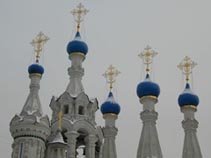
No one knows exactly when the Virgin Mary Church was built, but the fourth and fifth centuries are both possible options. In both cases, it was the time of the Byzantines. Egypt's Coptic Church—to which this church in modern-day Delga belonged—had refused to bow to imperial power and Rome's leadership over the nature of Christ. Constantinople was adamant it would force its will on the Copts. Two lines of popes claimed the Seat of Alexandria. One with imperial blessing sat in the open; the other, with his people's support, often hid, moving from one church to the other. Virgin Mary Church's altar outlasted the Byzantines. Arabs soon invaded in A.D. 641. Dynasties rose and fell, but the ancient building remained strong, a monument to its people's survival.Read the rest here.
Virgin Mary Church was built underground, a shelter from the prying eye. At its entrance were two ancient Roman columns and an iron door. Inside were three sanctuaries with four altars. Roman columns were engraved in the walls. As in many Coptic churches, historical artifacts overlapped earlier ones. The most ancient drawing to survive into the 21st century: a depiction, on a stone near the entrance, of two deer and holy bread. Layers and layers of history, a testament not only to the place's ancient roots but also to its persistence. Like other Coptic churches, the ancient baptistery was on the western side, facing the altar in the east. Infants were symbolically transferred through baptism from the left to the right. The old icons were kept inside the church, the ancient manuscripts transferred to the Bishopric in modern times.
Once there were 23 other ancient churches next to it, all connected through secret passages. Only Virgin Mary Church remained. Decline and survival, loss and endurance, the twin faces of the story of the Copts who built it.
In places such as Beni Mazar — a town on the Nile about 160 miles south of Cairo, in Minya province, which is riven by sectarian tensions — Christian residents made clear their sense of fear and anger. They said they believed Islamists had attacked the churches in retaliation for the police raids on Islamist protest camps in Cairo and also to punish Egypt’s Christian minority for its support of the July 3 coup that ousted president Mohamed Morsi. On the day of the raids, Islamists also attacked police stations across the country.Read the rest here.
But in interviews Monday and Tuesday, many residents suggested that the police had been complicit, at least through a failure to respond.
“Until now, we have not heard about any real or serious investigation,” said Mina Thabet, an activist with the Maspero Youth Union, a Christian activist group, which has charted the attacks that have taken place nationwide since Aug. 14.
Some “five or six” bearded Islamists with assault rifles broke through the evangelical church gate in Beni Mazar around midday Aug. 14, the owner of a Christian bookstore next door said in an interview this week. But he also said those Islamists worked in coordination with dozens of “thugs” who arrived in pickup trucks and didn’t look like Islamists.
The accomplices carried off thousands of dollars’ worth of computer, video and audio equipment, as well as air conditioning units, before setting the church on fire, according to the owner, who for security reasons would only permit the use of his first name, Ayman.
CAIRO — Egyptian security forces stormed two sprawling sit-ins by supporters of ousted president Mohamed Morsi shortly after dawn Wednesday, killing or injuring hundreds of people and igniting a wave of violent clashes across the country.Read the rest here.
Hours after the raids, Egypt’s military-backed interim president declared a state of emergency, imposing a nighttime curfew on Cairo and 10 provinces and allowing security forces to arrest and detain civilians indefinitely without charge. The state of emergency took effect at 4 p.m. local time (10 a.m. EDT).
On July 3, Egypt’s President Mohamed Morsi, a leading member of the Muslim Brotherhood (MB), was ousted from power. His detractors came from many segments of Egyptian society, but it is the Coptic Christian community that the MB is scapegoating as the principal actor behind his removal. The Middle East Media Research Institute reports that, in a recent article on the MB website entitled “The Military Republic of Tawadros” (Tawadros being the Coptic Orthodox pope), the MB urges its followers to believe that the Copts “openly and secretly led the process of opposition to the Islamic stream and this stream’s rise to power.”Read the rest here.
Attacking the Copts will prove to be as destructive to Egypt as to the religious minority itself.
Painful as it was to see the democratic process interrupted so soon after the revolution that overthrew the longtime autocrat Hosni Mubarak in 2011, the military’s action was necessary. At its most blatant level, there was no way that Mr. Morsi and his affiliates in the Muslim Brotherhood were going to leave power willingly, no matter the severity of the civil discontent over the president’s efforts to consolidate his power while mismanaging major problems from fuel shortages to rising inflation.Read the rest here.
When has an Islamist government, however democratically elected, ever ceded power to non-Islamists through a functional political process? Is democracy about periodically displacing absolute power by force or about laying the foundations for its peaceful rotation, including mechanisms not only for transparency in governance but also for the protection of women and religious minorities?
CAIRO — The military’s ouster of President Mohamed Morsi has unleashed a new wave of violence by extremist Muslims against Christians whom they blame for having supported the calls to overthrow Mr. Morsi, Egypt’s first Islamist elected leader, according to rights activists.Read the rest here.
Since Mr. Morsi’s ouster on July 3, the activists say, a priest has been shot dead in the street, Islamists have painted black X’s on Christian shops to mark them for arson and angry mobs have attacked churches and besieged Christians in their homes. Four Christians were reported slaughtered with knives and machetes in one village last week.
CAIRO — The Egyptian military removed President Mohamed Morsi from power Wednesday and suspended the constitution in moves it said were aimed at resolving the country’s debilitating political crisis.Read the rest here.
In a televised address to the nation after a meeting with a group of civilian political and religious leaders, the head of the powerful armed forces, Gen. Abdel Fatah al-Sissi, said the chief of Egypt’s constitutional court “will assume the presidency” on an interim basis until a new presidential election is held. Sissi said the interim president — Adly Mansour, Egypt’s top judicial authority — will have the right to declare laws during the transitional period.
(Reuters) - Egypt's armed forces would suspend the constitution and dissolve an Islamist-dominated parliament under a draft political roadmap to be pursued if Islamist President Mohamed Mursi and his opponents fail to reach a power-sharing agreement by Wednesday, military sources said.Read the rest here.
The sources told Reuters the Supreme Council of the Armed Forces (SCAF) was still discussing details of the plan, intended to resolve a political crisis that has brought millions of protesters into the streets. The roadmap could be changed based on political developments and consultations.
Chief-of-staff General Abdel Fattah El-Sisi called in a statement on Monday for Mursi to agree within 48 hours on power-sharing with other political forces, saying the military would otherwise set out its own roadmap for the country's future.
CAIRO — Millions of protesters filled streets across Egypt on Sunday, loudly calling for Mohamed Morsy to resign on the one-year anniversary of his presidency.Read the rest here.
The turnout in the capital far exceeded the large demonstrations of the 2011 revolution that ousted Morsy's predecessor, Hosni Mubarak.
People filled Tahrir Square, epicenter of the 2011 uprising, and jammed Nile River bridges leading into it. They converged from all areas of Cairo — from poor to upper-class — chanting and waving Egyptian flags.
Column after column of marchers passed the presidential palace with a deafening roar of “Leave!”
Many waved red cards, symbolizing those used by soccer referees to eject players from a game. They blew horns, banged drums and honked car horns to chants of “The people want the downfall of the regime!”
It was the largest display of public anger against Morsy and his ruling Muslim Brotherhood, which seized parliamentary control after Mubarak's fall.
CAIRO — The pale, young Christian woman sat handcuffed in the courtroom, accused of insulting Islam while teaching history of religions to fourth-graders. A team of Islamist lawyers with long beards sang in unison, "All except the Prophet Muhammad."Read the rest here.
The case against Dimyana Abdel-Nour in southern Egypt's ancient city of Luxor began when parents of three of her pupils claimed that their children, aged 10, complained their teacher showed disgust when she spoke of Islam in class. According to the parents, Abdel-Nour, 24, told the children that Pope Shenouda, who led the Egyptian Coptic Church until his death last year, was better than the Prophet Muhammad.
Blasphemy charges were not uncommon in Egypt under the now-ousted autocrat Hosni Mubarak's regime, but there has been a surge in such cases in recent months, according to rights activists. The trend is widely seen as a reflection of the growing power and confidence of Islamists, particularly the ultraconservative Salafis.
"Salafis are the engineers of these stories," said Abdel-Hamid Hassan, a Muslim and the head of the parents' council at the primary school where Abdel-Nour teaches. Hassan's daughter was among several students who denied any wrongdoing by Abdel-Nour.
CAIRO — Wasfi Amin Wassef used to buy and sell jewelry from his shop in Cairo’s vast Khan al-Khalili bazaar. Now he mostly buys it.Read the rest here.
Well into a third year of economic malaise following the overthrow of President Hosni Mubarak, many ordinary Egyptians are selling their most cherished possessions, including heirloom jewelry, to raise cash for a ticket that will let them start a new life abroad. Official figures or estimates are not publicly available, but anecdotal evidence suggests emigration is rising.
“The number of people who sell us their gold since the revolution has increased three times,” Mr. Wassef said during an interview this month.
Some are Muslims but most are Christians, said Mr. Wassef, a member of Egypt’s ancient Coptic Orthodox Christian minority.
(Reuters) - When Egyptian Christian Kerollos Maher watched on television as petrol bombs and rocks rained on Cairo's Coptic Orthodox Cathedral he had only one thought - emigration.Read the rest here.
"Egypt is no longer my country," said the 24-year-old construction worker, standing in the courtyard of the country's largest cathedral where one Copt and one Muslim died in sectarian clashes this week.
"The situation of Christians is worsening from day to day. I've given up hope that things will improve," he said.
CAIRO — Police firing tear gas joined with a rock-throwing crowd fighting a group of Christian mourners Sunday in a battle that escalated into an attack on Egypt’s main Coptic Christian Cathedral that lasted for hours.Read the rest here.
It was the third day of an outburst of sectarian violence that is testing the pledges of Egypt’s Islamist president to protect the country’s Christian minority, and by nightfall Sunday at least one person had died from the day’s clashes, bringing the weekend’s death toll to six.