Showing posts with label scotland. Show all posts

Wednesday, December 27, 2023

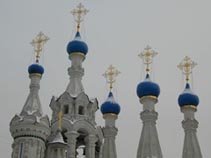
An increasingly secular Scotland is losing its churches

At first sight the lichen-covered sandstone slab seems to be a doorstep for Morham church in East Lothian. Yet four rusting iron rings set into the stone hint at the slab’s true purpose.

Once the slab is lifted by those four iron rings, stairs lead down into a crypt which hold the remains of some pivotal figures in Scottish history. Their presence is delaying the sale of the church overhead, in a controversy that raises significant questions about the ramifications of one of the biggest property selloffs of modern times.

The Church of Scotland, once one of the most powerful forces in Scottish life, is disposing of hundreds of churches, manses, halls and cottages over the next five years as it faces up to a “perilous” transformation in its fortunes and its place in Scottish society.

Congregations are in steep decline, its clergy are ageing and its finances are in disarray. Like hundreds of other churches earmarked for sale, Morham church should be on the market but that has been halted by an unprecedented row over the fate of the nine people interred there more than 300 years ago.

Morham was once the family church of the Dalrymples, a dynasty that built Newhailes House, a Palladian mansion nearby. Interred in the crypt are the remains of Sir David Dalrymple, the lord advocate who oversaw the union of Scotland’s parliament with Westminster in 1707, and his grandson Lord Hailes, an eminent historian and contemporary of Adam Smith and David Hume.

Adam Fergusson, a former Conservative MEP descended from the Dalrymples, is preparing to take the church to court in February unless it drop its plans to disinter his ancestors and cremate them to clear the way for a sale. “I think the coffins should stay in the church, as their final resting place,” he said. “It’s setting a precedent.”

DJ Johnston-Smith, director of Scotland’s Churches Trust, believes there are up to a dozen similar situations around the country. “Scotland has changed remarkably in our lifetimes, in social attitudes and outlook,” he said. “But these building are anchors in our landscapes and in our collective history.”

The row at Morham illustrates a remarkable trend: the retreat of organised religion in Scotland. Churches of all denominations are being sold across Scotland as congregations dwindle, donations plunge and clerics retire.

The Church of Scotland’s property page advertises one of its most prominent churches in Inverness, the Old High Church, for offers over £150,000, with others in Ballachulish near Glen Coe, Orkney, Shetland, Edinburgh and, in Glasgow, St Columba’s, the city’s last Gaelic church.

The data suggests Scotland’s two largest Christian faiths, Presbyterianism and Catholicism, may be in terminal decline.

In 1982 the Church of Scotland had nearly 920,000 members; last year, that stood at 270,300, a decline of 70%. The average age of its congregants is now 62, and only 60,000 worship in person.

In 1982, the Catholic church conducted 4,870 marriages and had 273 men training to be priests. In 2021, there were just 812 Catholic marriages, with just 12 seminarians in training; it attracted only two new recruits this year. It no longer trains priests in Scotland and this year sold off its most famous seminary in Rome, the Pontifical Scots college, moving into another institution.

Read the rest here.

Friday, March 26, 2021

In Scotland- A whiff of scandal


“It’s very clear that Nicola Sturgeon is damaged goods and her days are numbered. She is by no means off the hook.”

The sort of verdict you might expect from a flag-waving Unionist at the end of a tempestuous week for the Scottish National Party. Except that those words were spoken by a former deputy leader of the SNP itself, even before Alex Salmond’s extraordinary return to politics yesterday.

The jubilation among the First Minister’s supporters after she survived two inquiries into her role in the Alex Salmond affair lasted all of three days before Mr Salmond pulled back the tarpaulin on his ultimate vengeance weapon, the Alba Party, which threatens to blow up the SNP’s chances of a Holyrood majority in the May 6 elections.

If the SNP – currently a minority government – achieves an overall majority, the party’s plans to force a second independence referendum will be rapidly accelerated.

There is a growing belief within the SNP, however, that the party will fall short of the mark, and that if “IndyRef2” does happen, it might not be with Ms Sturgeon at the helm.

The SNP’s poll rating peaked at 58 per cent last autumn, and stayed above 50 per cent for the whole of last year, putting the party on course for a majority, but that figure is now 46 per cent, according to a recent Opinium poll, suggesting the controversy has taken its toll.

The twin inquiries into the SNP’s handling of sexual misconduct allegations made against former leader Mr Salmond have exposed to public view the toxic civil war between the Sturgeonites and the Salmondites, like a manhole cover being lifted off a sewer. Mr Salmond now intends to go another round with Ms Sturgeon in a fresh court case that could reveal damaging details suppressed in the inquiries.

Then, at 2pm on Friday, came the unexpected announcement that Mr Salmond is to lead a new party into the elections. Its aim, he claims, is to achieve a “supermajority” for independence in the Scottish parliament, but its effect is more likely to be splitting the vote between the SNP and Alba (the Scottish Gaelic name for Scotland).

Mr Salmond said on Friday that Alba was “planting our saltire on a hill” and that “in the next few weeks we shall see how many will rally to our standard”.

In truth, he is parking his tanks on Ms Sturgeon’s lawn, driving a wedge into the split that already exists in the SNP, and calling on its members, MPs and MSPs to defect to his side.

If he is elected to Holyrood, it will be the start of an all-out war between Ms Sturgeon and Mr Salmond for the leadership, and the future, of Scotland.

Jim Sillars, the former deputy leader of the SNP, said: “I was a long-term critic of Alex Salmond when he led the SNP, and he of me. I take back not a word, and I expect him to be the same.

“But Brexit, the pandemic, the failures of the SNP, the embarrassing stark lack of quality in its ranks in Holyrood, means we are in a new situation when old grievances need to be set aside. I welcome his return to frontline politics.”

He added: “People have seen a face of the Scottish government that is unacceptable. People are not stupid. They know the government has misbehaved and engaged in a gross misuse of power.

“This government is politically corrupt and the tentacles of political corruption have spread to institutions in civic society.”

One serving SNP MP admitted: “Nicola’s brand has been tarnished. I think this will have an impact at the polls because people have seen the in-fighting and the rage.”

Read the rest here.

Saturday, September 20, 2014

After the Vote: Cameron Suggests a Federal System for Great Britain (Updated)

So Scotland is staying with the promise of what will effectively be Home Rule, with Westminster (Parliament) exercising authority over only matters of obvious interest to the entire United Kingdom, i.e. defense, foreign affairs, trade and commerce etc. Pretty much everything else will be handled by the Scottish Parliament. But now Cameron is throwing a wrench into the works and suggesting that what is good for the goose is good for the gander. He wants ALL of the UK to enjoy the same benefits. That would mean Northern Ireland, Wales and yes, England would also have the right to substantially self govern themselves. Predictably the Labor Party is up in arms. It's one thing for Scotland to be largely free of any Tory governance. It is altogether a different matter for the English to be able to govern themselves, likely with very limited input from Labor.

(Update) The BBC has a good story up discussing the constitutional, and political, issues revolving around home rule for England.

Friday, September 19, 2014

Scotland Says "No" to Secession

Scotland has decisively rejected secession from Great Britain. If the current figures hold, the margin of defeat for the nationalists will be near a super-majority of 10 pts. Such a sharp rejection of the proposal should put an end to any serious threat of dis-union for the foreseeable future and cannot be seen as anything other than an electoral rebuke to the SNP.

Still, Westminster would be gravely mistaken in taking too much comfort from this victory. A significant percentage of Scots did vote to secede.  And it is probable that at least some of the No votes were reluctant ones, likely based  more on pragmatic concerns than any affection for the United Kingdom. Clearly there is a strong undercurrent of dissatisfaction north of the border.

Wednesday, September 17, 2014

Six Reasons Scotland Might Vote to Secede

How will it go tomorrow? Nobody really knows. Both campaigns are supremely confident, both can point to polls that show them narrowly ahead. Both have “invisible advantages”. YES probably enjoys the support of thousands of first time voters; NO thinks that it leads comfortably on early postal votes. The NO people are satisfied that they have a “quiet” vote motivated by reason rather than passion, and that with every new outrage perpetrated by YES extremists they gain yet more silent support. One YES person put it to me that the people who tend to break toward NO are the old and English-born.

Personally, I think that YES might indeed enjoy a slight edge. Due to the following factors:

Read the rest here.

Monday, September 15, 2014

Scottish nationalists 'severely underestimate the economic risks of independence

Scottish nationalists have severely underestimated the economic risks of independence, a leading think tank has concluded as it predicted a major black hole in public finances after a Yes vote.

The triple-whammy of declining oil revenues, fleeing financial services and increasing pension costs would see Scottish Government revenues drop more than £13bn after a Yes vote, according to the Centre for Policy Studies (CPS).

The centre-right think tank predicted the Scottish Government would bring in just £50bn in 2015-16 – some £14bn lower than predicted by the Yes campaign.

Read the rest here.

Tuesday, February 18, 2014

Scottish Independence would be a train wreck

There is a simple yet fatal contradiction at the heart of Alex Salmond’s case for Scottish independence. With self-government comes the need to earn economic credibility – and yet Salmond is threatening a confidence-shattering default on Scotland’s share of the national debt, is clueless about which currency he will adopt, has no idea how to retain a financial sector in Edinburgh, doesn’t have a realistic plan to deal with Scotland’s declining oil revenues, hasn’t thought through his future trading arrangements and continues to support a nonsensical, something-for-nothing approach to the public finances. 
It’s a recipe for disaster, and the very opposite of the cautious, prudent, pro-market manifesto that would be needed to make independence succeed. 
Read the rest here.

Monday, May 13, 2013

Gordon Brown Slams Scottish Independence Bid

Gordon Brown has warned the SNP is willing to endanger Scottish jobs, mortgages and state pensions in the hope of winning next year’s independence referendum.

Launching Labour’s campaign to keep together the UK, the former Prime Minister delivered a passionate and sometimes angry critique of the Nationalists’ economic blueprint for separation.

He argued that the consequences of the SNP’s policies would be less money for basic services and pensions, while their desire to keep the pound would mean ceding control of the economy to what would be a foreign country.

Scotland would have no input, either at Westminster or Bank the England, over decisions that would have a major impact on job levels or mortgage repayments, he said.

But the former Chancellor suggested SNP ministers deliberately ignore the risks their plans pose to ordinary families because their overriding concern is the “dogma of separation”
Read the rest here.

Monday, October 15, 2012

Britain prepares for historic referendum on Scottish independence

LONDON – Britain and Scotland signed an accord Monday paving the way for a historic vote for independence that could see this island’s northern lands stand alone for the first time in three centuries as Europe’s newest sovereign state.

Monday’s accord effectively launches a critical two-year independence campaign during which the Scottish National Party — whose surprise victory in regional elections last year laid the path for a referendum — will go toe-to-toe against those fiercely opposed to rupturing modern Britain.
Read the rest here.

Friday, January 27, 2012

In Scotland football (soccer) rivalry is deep and bitter

GLASGOW — It was a normal Saturday game at Ibrox Stadium, home of the Rangers soccer team. A prematch fight broke out on the subway. The crowd lobbed trash onto the field. Fans of Rangers and their mutually despised opponents, Aberdeen, abused one another with traditional chants, songs and obscene gestures.

At times, it seemed that the only thing preventing a violent free-for-all was the heavy presence of police officers and security guards. And lest the message — control yourself, or face the consequences — was lost on anyone, there was a direct request from Rangers authorities.

“If you witness any form of unacceptable or offensive behavior, including sectarian singing,” a notice inserted into the ticket envelopes said, “please advise a steward or police officer.”

No one yet has been able to defuse the visceral hatred that runs through Scottish soccer. But in its latest effort to tackle game-related violence, the Scottish government recently passed a law making it illegal for fans to attack one another using religious, ethnic, regional or violent historical slurs in songs, chants, Internet postings or even stray remarks at a stadium or pub.
Read the rest here.

More nanny state foolishness.  I have no objection to some restrictions at the games themselves.  Inciting a riot has never been protected speech.  But this pretty much just feeds any concept of freedom of expression into the shredder.  Even sadder though is the image of a stadium packed with Protestants and Catholics, but not a Christian to be found anywhere.

Wednesday, January 25, 2012

Scots Begin Bid for Vote on Independence

EDINBURGH — Choosing a day of deep symbolic importance, Scottish authorities set out on Wednesday to prepare the ground for a potentially divisive referendum on their land’s independence after three centuries of union with England that separatist leaders say is becoming increasingly irksome.

Like Northern Ireland and Wales, Scotland already has its own Parliament and administration with powers over areas like health and education as part of the United Kingdom with a dominant England. But now, the country’s political leaders are pressing for a referendum on full independence or at least greatly expanded autonomy.

For its part, the British government, backed by the Labour opposition, wants Scotland to remain part of the United Kingdom and differs with the Scottish authorities on both the timing of a referendum and the nature of the question it should answer.
Read the rest here.