Sunday, April 26, 2009
SSPX calls for consecration of Russia
Bishop Bernard Fellay of the Society of St. Pius X in a recent letter to friends and benefactors, has called for 12 million rosaries to be offered for the cause of the "consecration of Russia to the Immaculate Heart of Mary."
Hmmm...
A schismatic from the Roman Church is calling for prayers for the conversion of those whom Rome considers schismatic. The irony is delicious. And they wonder why so many Orthodox want as little to do with Rome as possible.
Saturday, April 25, 2009
Alarm Over Possible Epidemic
Major news and media outlets are reporting that alarms are sounding in government and major health related agencies over a serious outbreak of Swine Flu in Mexico. The Center for Disease Control has actually uttered the rarely used word "pandemic"* in describing how seriously this is being treated. As I type reports are now coming in of confirmed outbreaks in California, Texas, Kansas and New York City. There are reports of suspected but as yet unconfirmed outbreaks in Minnesota and Massachusetts.
Mexican health officials are reporting at least 1000 confirmed cases with an unknown number of suspected cases. They also are reporting about 70 confirmed fatalities. Mexico is moving aggressively to curb the spread of the disease by closing public schools, theaters and night clubs in the capitol.
Coincidentally the reported symptoms closely approximate what I was sick with during most of Great & Holy Week. I seriously doubt it was the swine flu. But it was certainly enough to make me miserable and cause me to miss most of the services that week.
*Pandemic is a term that refers to a worldwide epidemic. There were three pandemics in the last century, the most recent one being in 1968. That was a relatively mild one with an extremely low mortality rate. The 1957 outbreak, although more severe than the 1968, was still relatively moderate in severity.
The most serious by far was the Influenza of 1918 which killed about 50 million people in roughly six months worldwide. In the United States between September 1918 and November of that year approximately 700,000 people died. The spread of the lethal disease was facilitated by the mass mobilization of the armed forces and the general population for the First World War and efforts by the Wilson Administration to suppress any public alarm over the disease. More than ten times more Americans died from the influenza (mostly in those three months) than from combat related injuries in the front lines during our entire involvement in the World War.
Oddly, what could be fairly described as one of the greatest and most catastrophic events in modern history has garnered relatively little attention among historians.
Friday, April 24, 2009
Will Califronia Default?
Given that CA now has the lowest credit rating of all the states, does that make the high rates CA is offering in recent auctions something to avoid, owing to the risk of default, or something to cherish on the lines of ‘too big to fail’.This is something which came up in conversation today, unsurprisingly, in the wake of my talk to the regional bond dealers. One of them came up to me and indignantly told me that he’d been a muni bond dealer for 38 years, and that of course he knew all about credit risk, as had his forebears before him. To which the natural response is: well, if you’re pricing California debt at these levels, then you must reckon that there’s a pretty substantial probability of default.
The more interesting response was, basically, “my moral hazard trumps your moral hazard”. In other words, it’s true that because California has insured itself against default, there’s moral hazard there: whenever anybody is insured against anything, the likelihood of that thing happening goes up. But at the same time, there’s a bigger moral hazard at play: the federal government will never let California default, it’s too big to fail. And so when push comes to shove, California will get a federal bailout before it defaults on its bondholders.
I suspect, however, that the moral hazard seniority works the other way around: the fact that California’s bondholders are insured means that it’s not too big to fail, and that in fact a payment default by the state would have very little in the way of in-state systemic consequences. (I have no idea what it might do to the monolines, but if they can’t cope with a single credit defaulting, they really shouldn’t be in the business they’re in.) The federal government might step in to mediate the negotiations between the monolines and the state, but it’s not even obvious why it would want to do that.
The more powerful argument why California won’t default is that a payment default is illegal under state law: California’s simply not allowed to default on its bonds. But what are the monolines going to do, sue? If California defaults on say a $1 billion payment which the monolines have to pay, then California owes the monolines $1 billion. If the monolines sue the state and win, then California owes the monolines $1 billion. It’s not clear that they’ve advanced very far. Could they start attaching state assets? I doubt it, somehow.
Read the rest here.
Sunday, April 19, 2009
Thursday, April 16, 2009
Holy Week Hiatus
As we enter the last three days of Great and Holy Week there will be no little or no posting until Bright Monday. Wishing all of you a blessed Pascha...Under the mercy,
John
Tuesday, April 14, 2009
European Union Directives have Christians in the cross hairs
Proposals contained in the EU's draft discrimination directive could lead to churches being sued if they refuse to give communion, baptism or membership to non-Christians trying to get their children into a church school, experts said.
The Church of England said last night that it would raise concerns with the Government over the draft directive.
It fears that if the proposals are approved in their current form, religious bodies would lose an exemption they enjoy under current UK law to discriminate on grounds of conscience.
Religious groups warned that the anti-discrimination measures could also lead to gay marriage and homosexuals demanding wedding services in church.
The draft discrimination directive would make it illegal to offer goods and services only to particular sections of society.
It would apply to all organisations offering a service to the public, including hospitals, charities, businesses and prisons, as well as churches.
Faith-based welfare projects could be outlawed if they failed to comply with the EU rules...
Read the rest here.
Hat tip: T-19
Quote of the day...
- James Callaghan Prime Minister of Great Britain (Labor) in 1976 addressing the collapse of the British Pound resulting from massive deficit spending in an effort to stimulate the British economy.
Source.
Monday, April 13, 2009
Moscow to Constantinople: Back Off
This is not perhaps the best timing for this discussion (the beginning of Great and Holy Week), but the issue is fairly important. In the wake of efforts by the Ecumenical Patriarch's surrogates to assert a claim to universal jurisdiction over the Orthodox world in the "barbarian" lands and a firmly worded response from Metropolitan +Jonah, Moscow has now joined the fray.
From the Russian news service Interfax...
Moscow, 10 April, Interfax - Bishop Hilarion of Volokolamsk, head of the Moscow Patriarchate Department for External Church Relations expressed his disagreement with the Constantinople Patriarchate urge to govern all church communities in the Orthodox diaspora.
"One of the major challenges for inter-Orthodox relations I see the claims of Constantinople Patriarchate to a special role in the Orthodox Church," Bishop Hilarion said at Interfax press conference.
"The Orthodox Church is going to be enforced the model of the Catholic Church, which is the most centralized church power leaded by the one bishop of the Universal Church," the Bishop said.
He reminded that "there was no such a model in the Orthodox Church" and voiced his doubt "that we have the right to review our teaching of the Church."
According to Bishop Hilarion, the leading bishops of Constantinople Patriarchate urge to review the principle of the priority in the Orthodox world. This model envisages that the Constantinople Patriarchate "shall govern all churches in the so-called diaspora." Communities not included within the borders of historical national churches shall assume the jurisdiction of Constantinople.
Bishop Hilarion said that this whole complex issues shall be discussed at the inter-Orthodox meeting, where the Constantinople model shall be imposed on the Russian Church.
Great & Holy Monday: Contemplating the end...
From the website of the OCA.Holy Week: A Liturgical Explanation for the Days of Holy Week
MONDAY, TUESDAY, WEDNESDAY: THE END These three days, which the Church calls Great and Holy have within the liturgical development of the Holy Week a very definite purpose. They place all its celebrations in the perspective of End ; they remind us of the eschatological meaning of Pascha. So often Holy Week is considered one of the "beautiful traditions" or "customs," a self-evident "part" of our calendar. We take it for granted and enjoy it as a cherished annual event which we have "observed" since childhood, we admire the beauty of its services, the pageantry of its rites and, last but not least, we like the fuss about the paschal table. And then, when all this is done we resume our normal life. But do we understand that when the world rejected its Savior, when "Jesus began to be sorrowful and very heavy... and his soul was exceedingly sorrowful even unto death," when He died on the Cross, "normal life" came to its end and is no longer possible. For there were "normal" men who shouted "Crucify Him [" who spat at Him and nailed Him to the Cross. And they hated and killed Him precisely because He was troubling their normal life. It was indeed a perfectly "normal" world which preferred darkness and death to light and life.... By the death of Jesus the "normal" world, and "normal" life were irrevocably condemned. Or rather they revealed their true and abnormal inability to receive the Light, the terrible power of evil in them. "Now is the Judgment of this world" (John 12:31). The Pascha of Jesus signified its end to "this world" and it has been at its end since then. This end can last for hundreds of centuries this does not alter the nature of time in which we live as the "last time." "The fashion of this world passeth away..." (I Cor. 7:31).
Pascha means passover, passage. The feast of Passover was for the Jews the annual commemoration of their whole history as salvation, and of salvation as passage from the slavery of Egypt into freedom, from exile into the promised land. It was also the anticipation of the ultimate passage - into the Kingdom of God. And Christ was the fulfillment of Pascha. He performed the ultimate passage: from death into life, from this "old world" into the new world into the new time of the Kingdom. And he opened the possibility of this passage to us. Living in "this world" we can already be "not of this world," i.e. be free from slavery to death and sin, partakers of the "world to come." But for this we must also perform our own passage, we must condemn the old Adam in us, we must put on Christ in the baptismal death and have our true life hidden in God with Christ, in the "world to come...."
And thus Easter is not an annual commemoration, solemn and beautiful, of a past event. It is this Event itself shown, given to us, as always efficient, always revealing our world, our time, our life as being at their end, and announcing the Beginning of the new life.... And the function of the three first days of Holy Week is precisely to challenge us with this ultimate meaning of Pascha and to prepare us to the understanding and acceptance of it.
1. This eschatological (which means ultimate, decisive, final) challenge is revealed, first, in the common troparion of these days:
Troparion - Tone 8 Behold the Bridegroom comes at midnight, And blessed is the servant whom He shall find watching, And again unworthy is the servant whom He shall find heedless. Beware, therefore, O my soul, do not be weighed down with sleep, Lest you be given up to death and lest you be shut out of the Kingdom. But rouse yourself crying: Holy, Holy, Holy, are You, O our God! Through the Theotokos have mercy on us!
Midnight is the moment when the old day comes to its end and a new day begins. It is thus the symbol of the time in which we live as Christians. For, on the one hand, the Church is still in this world, sharing in its weaknesses and tragedies. Yet, on the other hand, her true being is not of this world, for she is the Bride of Christ and her mission is to announce and to reveal the coming of the Kingdom and of the new day. Her life is a perpetual watching and expectation, a vigil pointed at the dawn of this new day. But we know how strong is still our attachment to the "old day," to the world with its passions and sins. We know how deeply we still belong to "this world." We have seen the light, 'We know Christ, we have heard about the peace and joy of the new life in Him, and yet the world holds us in its slavery. This weakness, this constant betrayal of Christ, this incapacity to give the totality of our love to the only true object of love are wonderfully expressed in the exapostilarion of these three days:
"Thy Bridal Chamber I see adorned, O my Savior And I have no wedding garment that I may enter, O Giver of life, enlighten the vesture of my soul And save me."
2. The same theme develops further in the Gospel readings of these days. First of all, the entire text of the four Gospels (up to John 13: 31) is read at the Hours (1, 3, 6 and 9th). This recapitulation shows that the Cross is the climax of the whole life and ministry of Jesus, the Key to their proper understanding. Everything in the Gospel leads to this ultimate hour of Jesus and everything is to be understood in its light. Then, each service has its special Gospel lesson :
On Monday:
At Matins: Matthew 21: 18-43 - the story of the fig tree, the symbol of the world created to bear spiritual fruits and failing in its response to God.
At the Liturgy of the Presanctified Gifts: Matthew 24: 3-35: the great eschatological discourse of Jesus. The signs and announcement of the End. "Heaven and earth shall pass away, but my words shall not pass away...."
"When the Lord was going to His voluntary Passion, He said to His Apostles on the way: Behold, we go up to Jerusalem, And the Son of Man shall be delivered up As it is written of Him. Come, therefore, and let us accompany Him, With minds purified from the pleasures of this life, And let us be crucified and die with Him, That we may live with Him, And that we may hear Him say to us: I go now, not to the earthly Jerusalem to suffer, But unto My Father and your Father And My God and your God, And I will gather you up into the heavenly Jerusalem, Into the Kingdom of Heaven...." (Monday Matins)
by THE VERY REV. ALEXANDER SCHMEMANN
Sunday, April 12, 2009
Sunday Humor
(In Quick Time Format)
HUZZAH FOR THE NAVY!!!
Friday, April 10, 2009
Tuesday, April 07, 2009
For one day at least all was right in the world
Met. Jonah to Constantinople: Back Off
"To the bishops of the old world, there is an American Orthodox Church. Leave it alone."
For what it's worth, I wholeheartedly concur. I think its time to say some things which have been needing to be said for a while. There are several primary reasons behind the scandalously uncanonical jurisdictionalism here in North America. And none of them are good.
1. Money: North America is a cash cow for financially strapped churches in the old country.
2. Phyletism and extreme ethnocentrism: We can have Orthodox unity without sacrificing legitimate pride in our respective ethnic backgrounds, which will undoubtedly be reflected at the parish level. But we can’t have unity when ethnicity precedes, or is confused with, Orthodoxy. And there is still way too much of that out there.
3. Church politics: I for one am tired of seeing North American Orthodox Christians used like pieces on a chess board by the various old world churches, most of which are either joined at the hip with a national government or under the thumb of a hostile one. And the politics are not confined to the old world either. One need only look at some of the problems in recent years which have plagued all three of the major Orthodox jurisdictions in America (the Greek Archdiocese, the OCA and most recently the Antiochians) to see this. It’s time for a few bishops to get over themselves, and get on with the business of Christ’s Church in America.
Given the history of Orthodoxy in North America (which precedes the establishment of the Greek Archdiocese by roughly 130 years) the claims of the Ecumenical Patriarchate are risible. I am not naïve enough to expect that all of the bishops in the sister churches here in North America are just going to run off and join the OCA. Whatever form the American Orthodox Church eventually takes it will undoubtedly be a bit different than the OCA. But it is time, indeed well past time, to get this ball rolling.
And with due respect to His All Holiness; it is also time to stop trying to play Pope. As His Beatitude noted, if we wanted a Pope we would be under the real one. And the way Bart has been cozying up to the Vatican of late, if we do wind up under the EP that may just be a short prelude to winding up under the real Pope anyways.
Hat Tip: Father David
Monday, April 06, 2009
From my recent trip

Sunday, April 05, 2009
The Soul of Russia
In case there were any who still harbor doubts...
The Episcopal Church (TEC) has an ordained Zen Buddhist nominated to serve as the next "bishop" of Northern Michigan. "Father" Kevin Thew Forrester is on record implicitly or explicitly denying most of the Nicene Creed and last year replaced the normally prescribed New Testament reading at a service with one from the Quran. Meanwhile in New England the Rev. Katherine Hancock Ragsdale, an openly lesbian priestess was appointed as the new President of the Episcopal Divinity School (EDS) in Cambridge MA. A great honor to be sure. Rev. Ragsdale would seem eminently qualified to be the head of an Episcopal seminary given her views on abortion which she outlined in a sermon entitled "Our Work is Not Done."In this sermon, which she had posted on her blog before an avalanche of severe criticism saw its removal, she opined that abortion was a "blessing" and called for the removal of any legal conscience protection for anyone in the medical-health care field who might object to the premeditated killing of children. I don't think the word "demonic" would be too strong a descriptive for her views which you may read about in more detail (if you have the stomach) at LifeSiteNews.com.
As some may have noticed it’s been a long time since I have posted anything on the Episcopal Church. There are a few reasons for this. One is that it gets boring pointing out the obvious, namely that TEC has jumped off a theological cliff and is still in free fall. But apparently they still posses the ability to shock even me.
I guess the only question remaining is, is the Episcopal Church merely heretical or is it institutionally apostate? I believe the evidence points rather strongly to the latter conclusion. Let us consider just a few facts.
There appears to be no article of faith binding on anyone in TEC. The Creeds are all optional and a large and increasing number of parishes openly admit anyone, including the non-baptized and non-Christians to what they term Holy Communion. When the creeds are recited (and in most parishes they still are as a matter of form) many clergy and even prominent bishops have declared they "cross their fingers" during parts of the creed, or in the case of "Bishop" Jack Spong pretty much during the whole thing. The baptismal formula in practice (if not yet theory) varies widely from parish to parish and one has no idea what is being said or done at Episcopal baptisms anymore. Sexual vice is openly promoted as normative and healthy and is being blessed in many parishes and dioceses. Abortion has been endorsed by the national church as a basic human right. The presiding bishop has refused on multiple occasions to affirm the unique role of Christ in salvation and has affirmed the legitimacy of "other paths." The most recent General Conventions were unable to pass resolutions affirming Christ’s unique role in salvation as also the inerrancy of Scripture. I could go on at very great length but I think the point has been made.
The inescapable conclusion is that the Episcopal Church is not merely heretical but is in fact in a state of what Roman Catholics would call material apostasy. Which is to say that while they may not have formally abjured the Creeds they clearly no longer profess them as articles of faith for their church. In short the Episcopal Church is today little more than liturgical Unitarianism. The only absolutely binding article of faith is that there is no binding article of faith. Such a body can not I believe be rightly termed “Christian.” This is not to say that there are no Christians in TEC. But it is to say that TEC is no longer a Christian church, and I think it is time that we stop pretending otherwise.
On a related note, why do so many Orthodox jurisdictions still accept without question Episcopal baptisms from converts as "close enough" on the basis of economy? I seriously think that in light of what's been going on over there that it is time to reconsider this practice.
Friday, April 03, 2009
More prayers requested
Also please note my email has crashed for about the 5th time in the last two weeks. I have decided to change my email address. The link in the sidebar has been updated with the new email address. I am sending out notifications as time permits to everyone in my old email book (which I am able to open).
Thursday, April 02, 2009
An Update
On the upside, the blood clot was on the right side of the brain. It is hoped that this will mean limited or no impediment to speech. However things are still touch and go. It will likely be some days before we have an accurate picture of how extensive the damage is.
Thanking you again, I remain...
Yours in ICXC
John
Sunday, March 29, 2009
Urgent Prayer Request
Under the mercy,
John
Update: Surgeons removed a large blood clot from the right side of her brain. She is in Intensive Care. Doctors believe the next 72 hrs will be of great importance.
A little Sunday humor...
(Link is audio only)
Wednesday, March 25, 2009
"Dear AIG, I quit..."
DEAR Mr. Liddy,
It is with deep regret that I submit my notice of resignation from A.I.G. Financial Products. I hope you take the time to read this entire letter. Before describing the details of my decision, I want to offer some context:
I am proud of everything I have done for the commodity and equity divisions of A.I.G.-F.P. I was in no way involved in — or responsible for — the credit default swap transactions that have hamstrung A.I.G. Nor were more than a handful of the 400 current employees of A.I.G.-F.P. Most of those responsible have left the company and have conspicuously escaped the public outrage.
After 12 months of hard work dismantling the company — during which A.I.G. reassured us many times we would be rewarded in March 2009 — we in the financial products unit have been betrayed by A.I.G. and are being unfairly persecuted by elected officials. In response to this, I will now leave the company and donate my entire post-tax retention payment to those suffering from the global economic downturn. My intent is to keep none of the money myself.
I take this action after 11 years of dedicated, honorable service to A.I.G. I can no longer effectively perform my duties in this dysfunctional environment, nor am I being paid to do so. Like you, I was asked to work for an annual salary of $1, and I agreed out of a sense of duty to the company and to the public officials who have come to its aid. Having now been let down by both, I can no longer justify spending 10, 12, 14 hours a day away from my family for the benefit of those who have let me down...
Read the rest here.
Tuesday, March 24, 2009
Quote of the day...
- A comment by Dilbertnomore on an article posted at T-19.
Friday, March 20, 2009
A sad note on the advances of modern liberalism
Luxembourg was the last European nation to be governed by a real monarch. Although the tiny nation has had a parliamentary chamber, that body functioned as parliaments were originally designed to function. It was an advisory body to the Grand Duke. After new legislation was voted on by the Chamber of Deputies, Article 34 of the Constitution stated: “The Grand Duke sanctions and promulgates the laws. He makes his resolve known within three months of the vote in the Chamber.” This provision permitted the Grand Duke to perform the proper function of a monarch in a mixed form of government. He served as a check on the potential excesses of political parties legislating when they encroached on the principles of the natural law. As a hereditary ruler for life, the Grand Duke is immune from elector politics. He can thus serve as an outside supervisor of the results of the legislative process. This is exactly what he did last year in an act which precipitated the March 12 vote.
In 2008, the Chamber of Deputies voted to approve a law which authorized the intentional killing of human beings, commonly referred to by its morbid proponents as euthanasia. Such a law is contrary to the natural law. For, as St. Thomas observed in his Summa the civil law can not always punish everything that the natural law forbids but it may never sanction such evil. Now we know both by reason and divine authority that euthanasia is prescribed. It violates the first principle of the natural law - self preservation. The Church has confirmed this deduction of reason on several occasions by pronouncing euthanasia to be immoral. Even the sensus Catholicus of this overwhelming Catholic nation was clear; the populace of Luxembourg opposed the bill pushed through by the Socialist and Green parties.
Henri, the current Grand Duke, fulfilled his moral obligation as a good Catholic monarch and refused to sanction this evil legislative act. As a reward for doing the right thing, the so called “conservative” Prime Minister, Jean-Claude Juncker, called for an amendment to the Constitution stripping the Grand Duke of his authority to sanction laws passed by the Chamber of Deputies. The March 12 vote approved the removal of the word “sanctions” from Article 34. Prime Minister Juncker made clear the intention was to remove the right of the Grand Duke to approve of or reject laws. According to Juncker he must be required to promulgate all acts passed by the Chamber. The Luxembourg monarchy has thus entered the realm of Walt Disney monarchs inhabited by the remaining figure heads of Europe such as England, Spain and Belgium. They can parade around for tourists in quaint costumes and live in nice palaces, but they have no authority to protect and defend their nation by governing it.
Read the rest here.
Tuesday, March 17, 2009
Feast of St. Patrick
Happy St. Patty's Day to all my fellow Irish in blood or spirit.
Monday, March 16, 2009
Remembering the Ukrainian Genocide
KIEV, Ukraine — A quarter century ago, a Ukrainian historian named Stanislav Kulchytsky was told by his Soviet overlords to concoct an insidious cover-up. His orders: to depict the famine that killed millions of Ukrainians in the early 1930s as unavoidable, like a natural disaster. Absolve the Communist Party of blame. Uphold the legacy of Stalin.Professor Kulchytsky, though, would not go along.
The other day, as he stood before a new memorial to the victims of the famine, he recalled his decision as one turning point in a movement lasting decades to unearth the truth about that period. And the memorial itself, shaped like a towering candle with a golden eternal flame, seemed to him in some sense a culmination of this effort.
“It is a sign of our respect for the past,” Professor Kulchytsky said. “Because everyone was silent about the famine for many years. And when it became possible to talk about it, nothing was said. Three generations on.”
The concrete memorial was dedicated last November, the 75th anniversary of the famine, in a park in Kiev, on a hillside overlooking the Dnieper River in the shadow of the onion domes of a revered Orthodox Christian monastery. More than 100 feet tall, the memorial will eventually house a small museum that will offer testimony from survivors, as well as information about the Ukrainian villages that suffered.
Read the rest here.
Saturday, March 14, 2009
Why the meltdown should have surprised no one
Friday, March 13, 2009
WHAT A GAME!!!
Not a big bball fan here but the family is die hard Orange. And tonight will probably go down as the greatest hoops match of the March Madness Tournament and one of the greatest games in NCAA history.Thursday, March 12, 2009
More on Roubini and Shiller's Dour Outlook
Well, you guessed it. I'm here to post up even more bullish news! And, by bullish news, I obviously mean bearish news. After all, its Nouriel Roubini and Robert Shiller.
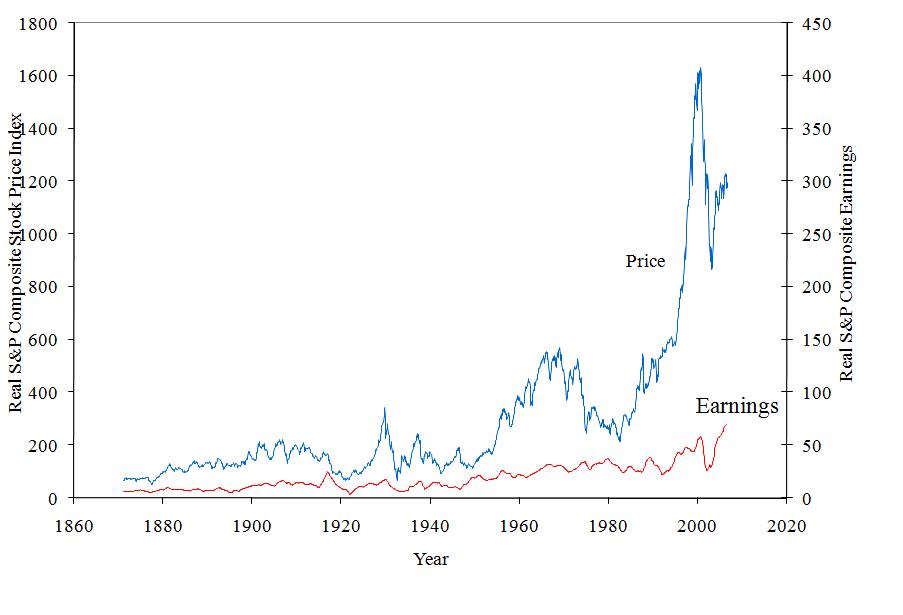
Here's the deal, Shiller has a set of S&P earnings and P/E ratios available in spreadsheet format here. Big hat tip to Cliff Küle for flagging this Shiller data and graphs to our attention. Cliff posts up some historical info, illustrated below. First, real S&P composite earnings:
Click to enlarge:
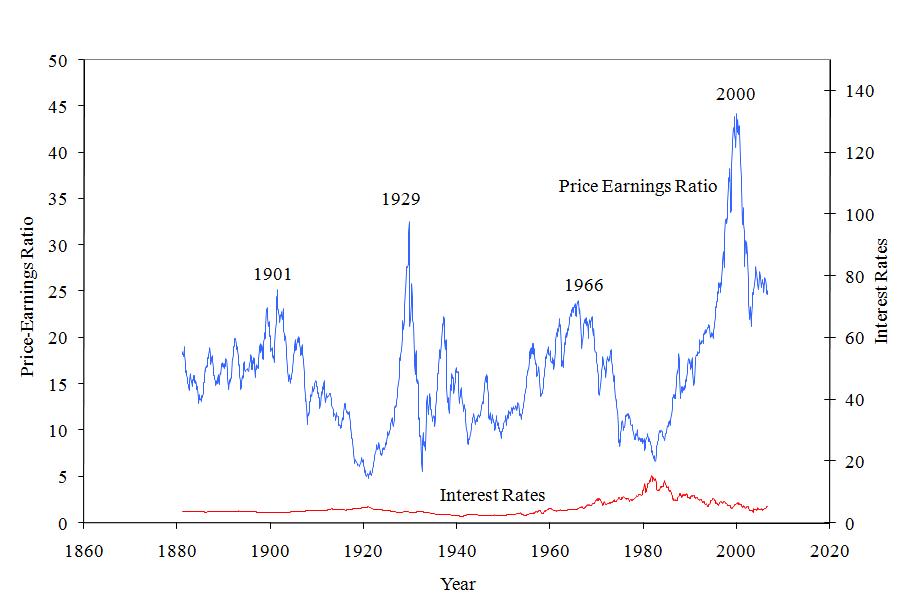
And secondly, historical P/E ratios and interest rates.
Click to enlarge:
By that historical data, you'd think that a 5 P/E could be achieved given the severity of everything that's happened. But, if you're not that apocalyptic, then maybe somewhere around 10x would be more appropriate. And, 'Dr. Doom' himself, Nouriel Roubini thinks that the S&P500 will see 600, which could be somewhat close to 10x by his measurement. Taken from Bloomberg,
The benchmark index for U.S. stocks would have to slump 12 percent from last week’s closing level to meet his forecast. Roubini is assuming that companies in the S&P 500 will report profit of $50 a share this year and investors will pay 12 times that for equities.
My main scenario is that it’s highly likely it goes to 600 or below,' Roubini said Thursday in an interview at the Chicago Board Options Exchange Risk Management Conference in Dana Point, California. A level of '500 is less likely, but there is some possibility you get there.'
SourceWhat Does a Bear Market Rally Look Like?
Excellent chart demonstrating how powerful rallies within bear markets can be. I calculated the average decline/rally, but excluded the last decline and rally as they were so dramatic and would skew the results.
Avg % decline = 40%
Avg $ rally = 33%
Right now we’re roughly 18% off the lows on the Dow & Nasdaq. Bearish sentiment is definitely being relieved, and I can already hear people saying how with a new administration things are going to be different from here on out.
On the way to the bottom, the market must relieve bearish sentiment (make you forget your fear). It can only do this through sharp powerful rallies (where we all laugh for a day with CNBC on how close we came to the brink).
We have described these as “rocket-launched (oh they’ve saved us) bear market rallies.” Investors who cheer these sharp up moves as a sign of the bottom should take note of the chart provided by Tom Denham from Elliotwave.com below.
The treacherous nature of bear market rallies
However, I would be extremely careful in concluding that rising stock prices after a terrific decline, such as we had in the NASDAQ since March 2000, do signal improving business conditions. For a market, which has become very over-sold, it is only natural to rebound, but frequently these rebounds are merely bear market rallies, which are subsequently followed by vicious declines.
Probably the most famous bear market rally in history is the rise, which took place following the October crash of 1929. Stocks began to recover strongly following the November 13th 1929 low amidst wildly bullish comments and confident statements by a very large number of respected Wall Street personalities.
In fact, for a while the bulls were right. From a low at 199 on November 13 - down from the September 4, peak at 381- the Dow Jones Industrial rallied to a high of 294 in April 1930 (up 48%). This famous and well-documented bear market rally took place for a number of reasons. After the October 29 crash, the market had become very oversold - incidentally far more oversold than the US stock market's position on September 21, 2000. Thus, a technical rally was natural.
Also, the Federal Reserve Bank cut the discount rate immediately following the crash from 6% to 5% on November 1, 1929, to 4.5% on November 15, and to 4% on January 30, 1930. Subsequently the discount rate was repeatedly cut to 2.5% in June 1930, to 2% in December 1930, and 1.5% in mid 1931.
The interest rate cuts after April 1930 did, however, no longer support the stock market, which began to sell off once more. And by the end of the year 1930, the Dow Jones Industrial had broken below the November 1929 low and fell to 158 (from there it fell 41 in July 1932). Another reason for the 1929/1930 rally was that the economy held up following the October crash, which led a number of leading business and stock market personalities to make positive comments and to buy equities.
During the first six months of 1930, the business curve of the Harvard Barometer was almost horizontal and, therefore, did not signal a recession. Thus, the October 1929 stock market crash was widely regarded as a financial accident - a direct consequence of excessive speculation, but not as the beginning of an economic crisis that was to jolt the social and economic structure of the entire world.
No one anticipated a recession, let alone a depression. Charles Mitchell who headed the National City Bank, announced soon after the crash that the trouble was 'purely technical' and that 'the fundamentals remained unimpaired'. While President Hoover assured the American people that 'the fundamental business of the country, that is production and distribution of commodities, is on a sound and prosperous basis.'
From an article by noted economist Marc Faber which I strongly recommend.
Benedict XVI writes his bishops on L'Affair Williamson
Monday, March 09, 2009
More of the same
But Mr. Obama also signaled that he intends to use signing statements himself if Congress sends him legislation that has provisions he decides are unconstitutional. He pledged to use a modest approach when doing so, but said there was a role for the practice if used appropriately.I said it about Bush and I will repeat it now about Obama. Signing statements are illegal and unconstitutional period. No president has the authority to pick and choose which parts of a law he will obey. If a president believes that elements in a given bill are unconstitutional his only recourse is to veto the bill. Indeed one could make a compelling argument that failure to do so would be failing to uphold his oath of office. Bush should have been impeached for this and Obama should be too if he tries to imitate W's abuse of power. This is a very slippery slope we are on.
Source
It would appear that whether we are talking about fiscal and monetary policies or respect for constitutional limits on power; Obama is intent on following in George Bush's footsteps.
Peter Schiff explains Obamanomics...
The central tenets of Obamanomics appear to be that access to credit will enable people to borrow money to buy stuff, the spending will spur production and employment, and thus the economy will grow. It's a neat and simple picture, but it has nothing whatsoever to do with how an economy works. The President does not understand that consumption is made possible by production and that credit is made possible by savings. The size and complexity of modern economies has obscured these simple concepts, but reducing the picture to a small scale can help clear away the fog.
Suppose there is a very small barter-based economy consisting of only three individuals: a butcher, a baker, and a candlestick maker. If the candlestick maker wants bread or steak, he makes candlesticks and trades. The candlestick maker always wants food, but his demand can only be satisfied if he makes candlesticks, without which he goes hungry. The mere fact that he desires bread and steak is meaningless.
Enter the magic wand of credit, which many now assume can take the place of production. Suppose the butcher has managed to produce an excess amount of steak and has more than he needs on a daily basis. Knowing this, the candlestick maker asks to borrow a steak from the butcher to trade to the baker for bread. For this transaction to take place the butcher must first have produced steaks which he did not consume (savings). He then loans his savings to the candlestick maker, who issues the butcher a note promising to repay his debt in candlesticks.
In this instance, it was the butcher's production of steak that enabled the candlestick maker to buy bread, which also had to be produced. The fact that the candlestick maker had access to credit did not increase demand or bolster the economy. In fact, by using credit to buy instead of candlesticks, the economy now has fewer candlesticks, and the butcher now has fewer steaks with which to buy bread himself. What has happened is that through savings, the butcher has loaned his purchasing power, created by his production, to the candlestick maker, who used it to buy bread.
Similarly, the candlestick maker could have offered “IOU candlesticks” directly to the baker. Again, the transaction could only be successful if the baker actually baked bread that he did not consume himself and was therefore able to loan his savings to the candlestick maker. Since he loaned his bread to the candlestick maker, he no longer has that bread himself to trade for steak.
The existence of credit in no way increases aggregate consumption within this community, it merely temporarily alters the way consumption is distributed. The only way for aggregate consumption to increase is for the production of candlesticks, steak, and bread to increase.
Read the rest here.
Some recent articles on the economy
The man who predicted the current financial crisis said the US recession could drag on for years without drastic action.
Among his solutions: fix the housing market by breaking "every mortgage contract."
"We are in the 15th month of a recession," said Nouriel Roubini, a professor at New York University's Stern School of Business, told CNBC in a live interview. "Growth is going to be close to zero and unemployment rate well above 10 percent into next year."
Echoing a speech he made earlier in the day, Roubini said he sees "no hope for the recession ending in 2009 and will more than likely last into 2010."
Roubini, who is also known as "Dr. Doom," told CNBC that the risk of a total meltdown has been reversed for now but that the economy is going through "a death by a thousand cuts." He also said that "most of the U.S. financial institutions are entirely insolvent..."
From US Recession Could Last Up to 36 Months: Roubini
March 9 (Bloomberg) -- The Standard & Poor’s 500 Index is likely to drop to 600 or lower this year as the global recession intensifies, said Nouriel Roubini, the New York University professor who predicted the financial crisis.
The benchmark index for U.S. stocks would have to slump 12 percent from last week’s closing level to meet his forecast. Roubini is assuming that companies in the S&P 500 will report profit of $50 a share this year and investors will pay 12 times that for equities.
“My main scenario is that it’s highly likely it goes to 600 or below,” Roubini said today in an interview at the Chicago Board Options Exchange Risk Management Conference in Dana Point, California. A level of “500 is less likely, but there is some possibility you get there.”
The S&P 500 has dropped 25 percent to 676.53 in 2009, its worst start to a year, following a 38 percent decline in 2008 that was the steepest annual retreat since 1937. In response to the U.S. recession that began in December 2007, the Federal Reserve cut its benchmark lending rate to as low as zero and President Barack Obama got congressional approval for a $787 billion economic stimulus plan...
From Roubini Says S&P 500 May Drop to 600 as Profits Fall
The stock market tanked again today, and for 2009 has lost nearly a quarter of its value. And it is only early March.
To put that in perspective, assume that the market ends 2009 at today’s prices. This would be the list of the worst years since 1900 for the Dow industrials:
1. 1931, down 53%
2. 1907, down 38%
3. 2008, down 34%
4. 1930, down 34%
5. 1920, down 33%
6. 1937, down 33%
7. 1974, down 28%
8. 2009, down 25%
9. 1903, down 24%
10. 1932, down 23%
You will note that we have not had consecutive really bad years since 1930, 1931 and 1932.
Here are the rankings for worst two-year periods, again assuming 2009 ends at today’s prices:
1. 1930-31, down 69%
2. 1931-32, down 64%
3. 2008-09, down 50%
4. 1929-30, down 45%
5. 1973-74, down 40%
6. 1906-07, down 39%
7. 2007-08, down 30%
8. 1940-41, down 26%
9. 1916-17, down 22%
10. 1920-21, down 25%
That may mean that the market really is discounting a financial disaster.
Here’s another indication that investors feel more or less the way they did during the last disaster:
It has been 513 calendar days since the stock market peaked on Oct. 9, 2007. Since then, the S.&P. 500 is down 56 percent and the Dow is off 53 percent.
On Jan. 29, 1931 — the identical number of days after the 1929 market peak — the S.&P. 500 was down 49 percent and the Dow was down 56 percent. The 1929 crash got off to a much faster start, but we have now more or less caught up.
You will note, however, that the economic news now is not nearly as bad as it was in 1931. Could there be a tad bit of overreaction this time?
Finally, the good folks at accuweather.com would like to let you know that the weather is also reminiscent of the bad old days:
Dust Bowl II?
The weather pattern has some similarities to that of the 1930s and given the state of the economy these days make it quite sobering. While modern farming practices and technological advances should prevent a 1930s style dust bowl over the southern Plains, indeed some hardship lies ahead unless the current pattern breaks. The spring planting season begins this month in the region and crops need moisture to sprout and grow.From Plunging Markets, Then and Now
...The question that arises then is whether the new US budget will change things. The boost is huge. The budget deficit is projected to rise to 12.5 per cent of GDP. That is higher than at any time since the Second World War. It is double the size, relative to GDP, of Franklin D Roosevelt's New Deal in the 1930s. It is larger than the fiscal deficits run by Japan during the 1990s, which is not an encouraging precedent since they pretty much failed – though arguably Japan's so-called "lost decade" would have been even more lost without them. Finally, it is even larger than the proposed deficit that our present Government plans to run here.
So what should we make of it? I suppose I fear this administration is making the same mistake with fiscal policy that the previous one made with monetary policy. Remember how the Federal Reserve cut US interest rates way below the rate of inflation to pump up the economy after the collapse of the internet bubble? It succeeded in boosting demand. People borrowed like crazy, savings plunged, the housing boom took off, and the economy recovered. But the growth was artificial and could not be sustained.
The argument at the time was that the impact was not inflationary, and that was right for prices were held down by the imports of cheap goods from East Asia. And the credit boom was not risky as the banks were able to spread their risks by securitising their debts. In any case those debts had AAA ratings. But the lack of inflation (and those AAA ratings) lulled people into a false sense of security and we all know what happened.
The argument now is that the loss of output from recession is so huge that it makes sense for the state to borrow to reverse it. You could say the economy is a bit like an airline or a hotel – the revenue from a seat or a bed not filled is lost forever. So better to borrow now, get demand up, and claw back the borrowing later. To some extent this must be right, provided the fiscal position is indeed brought back into kilter. President Obama's plan holds that the deficit will be back to 3 per cent of GDP by the end of his term. If that were the case, it might be just about acceptable. Trouble is, the assumptions on which this deficit-reduction profile are made look to me to be quite unrealistic. GDP growth next year of more than 3 per cent? Huh?
There is a further concern. This programme assumes the US government can finance it. Now at the moment the dollar is riding high, with government assets seen as a safe haven in the storm. The current account deficit is narrowing and the Chinese are perceived to have no option but to keep investing in the US.
So for the time being the deficit can be financed, or so it would appear. But the mood of financial markets is fickle and at some stage it will turn. There have been runs on the dollar before. You could envisage a nightmare scenario where the flow of funds into the US reverses, long-term interest rates shoot up, the US fiscal position fails to improve and there is a global dollar crisis. Even without that, the debts will be a burden for a generation. The seeds of the next downturn are being sown now...
From Deficit of realism. America assumes a lot in its road map to recovery
Saturday, March 07, 2009
Greetings from the capitol of the left coast
Speaking of scary, the economy is well ... very scary right now. I really wanted to blog on that subject last week but I resisted the temptation. I expect to have some thoughts on this in the next couple of days when I have the opportunity to get online for more than a few minutes. Actually there has been a lot going on it seems. I will be digging out the in box and trying to get back to people as quickly as I can. Finally I am turning the comments back on.
P.S. Has T-19 changed their web address? I know they were changing servers. But their page has been down all day.
Sunday, March 01, 2009
Clean Week Hiatus
With the start of the Great Fast now only a few hours away...First I wish to ask forgiveness for any offense which I may have caused anyone through this blog or any other means. Please pray for me a sinner.
Secondly, as noted in an earlier post there will be no blogging during most, if not all of the forthcoming week. Because I am not going to be online much and in the past some inappropriate comments (spam and worse) have shown up during announced down times, I will be closing down the com boxes when I go to bed tonight. See you all in a week or so (Thursday at the earliest).
Under the mercy,
John
And now we know the end of the story... Memory Eternal: Paul Harvey
CHICAGO — Paul Harvey, the news commentator and talk-radio pioneer whose staccato style made him one of the nation’s most familiar voices, died Saturday in Arizona, according to ABC Radio Networks. He was 90.Mr. Harvey died surrounded by family at a hospital in Phoenix, where he had a winter home, said Louis Adams, a spokesman for ABC Radio Networks, where Mr. Harvey worked for more than 50 years. No cause of death was immediately available.
Mr. Harvey had been forced off the air for several months in 2001 because of a virus that weakened a vocal cord. But he returned to work in Chicago and was still active as he passed his 90th birthday. His death comes less than a year after that of his wife and longtime producer, Lynne.
“My father and mother created from thin air what one day became radio and television news,” their only child, Paul Harvey Jr., said in a statement. “So in the past year, an industry has lost its godparents, and today millions have lost a friend.”
Known for his resonant voice and his trademark radio feature called “The Rest of the Story,” Mr. Harvey had been heard nationally since 1951, when he began his “News and Comment” feature for ABC Radio Networks.
He became a heartland icon, delivering news and commentary with a distinctive Midwestern flavor. “Stand by for news!” he would tell listeners.
“Paul Harvey was one of the most gifted and beloved broadcasters in our nation’s history,” James M. Robinson, president of ABC Radio Networks, said in a statement. “We will miss our dear friend tremendously and are grateful for the many years we were so fortunate to have known him.”
The rest of the story.
He lived a long life. But still this is just very very sad.
Saturday, February 28, 2009
On the threshold of the Great Fast
First I would like to bump an outstanding article over at Mike Liccione's blog on the danger posed by Jihadists. If you haven't read it, you need to. His preceding article on confession isn't bad either. And I particularly like the picture.
Secondly for any who are or may be in the Central Valley of California during the first weekend of Lent I would like to invite you to a Lenten retreat to be held at St. Mary Magdalene Orthodox Church in Merced on Friday March 6th at 7 PM and Saturday the 7th at 8:30 AM. The guest speaker will be Fr.Meletios Webber, the Abbot of St. John's Monastery. He is by all accounts an excellent speaker. Later on Saturday Fr. Meletios will also be the principal speaker at a Conference on Orthodox Christian Faith and Life to be held at St. Peter the Apostle Serbian Orthodox Church in Fresno from 1 - 6 PM. Q&A to follow all of the conferences. Fast friendly refreshments will be served following the Friday evening and Saturday afternoon events. Additionally St. Peter's is hosting the Central Valley's annual Pan Orthodox Vesper service for the Sunday of Orthodoxy. These events are free and open to the public.
Finally, as has been my custom since since I started blogging, I will be scaling back on the internet during Lent. I do not however expect to go completely offline as I more or less did last year. Still readers should expect reduced posting and delays (worse than usual) in replying to private emails. Barring something really significant that is also time sensitive there will be no new posts after tomorrow until Thursday at the earliest. In addition I expect that I will be traveling a great deal during Lent this year which will further impact my blogging and correspondence. Your prayers are coveted and appreciated.
"All bishops are Auxiliary bishops..." ???
THE DECISION REGARDING THE AMENDING OF ARTICLES CONCERNING BISHOPS ACCORDING TO THE BY-LAWS OF HE PATRIARCHATE
CHAPTER VI, THE BISHOPS
Article 75: The Patriarch is the reference point of all bishops in Damascus, Patriarchal Monasteries and Vicariates; and they are under his authority[.]
Article 76: The Metropolitan is the point of reference of all bishops in his Archdiocese and they are under his authority.
Article 77: All bishops within the Antiochian See are auxiliary bishops and are directly under their spiritual authority.
Article 78: The Metropolitan defines the responsibilities of the bishops and the place where they should serve. The bishop does not do anything contrary to the will of the Metropolitan.
Article 79: The aforementioned articles 75, 76, 77 and 78 are applicable in all Antiochian Archdioceses and whatever contradicts these articles is null and void.
Issued by the Holy Synod of Antioch, Damascus, February 24, 2009
Signed by:
His Beatitude, IGNATIUS IV, Patriarch
His Eminence, ILYAS, Tripoli
His Eminence, ELIA, Hama
His Eminence, ELIAS, Tyre and Sidon
His Eminence, GEORGE, Homs
His Eminence, PAUL, Australia
His Eminence, DAMASKINOS, Brazil
His Eminence, ESPER, Houran
His Eminence, BASILIOS, Akkar
Source
Does anyone have any idea what is going on here? My warning radar is flashing red right now. Maybe it is a false alarm.
Hat tip to Bill (aka The Godfather)
Friday, February 27, 2009
And now for something a little different...
Krakatoa (Indonesian: Krakatau), also spelled Krakatao, is a volcanic island in the Sunda Strait between the islands of Java and Sumatra in Indonesia. The name is used for the island group, the main island (also called Rakata), and the volcano as a whole.
Significance
Further information: 1883 eruption of Krakatoa
Its best known eruption culminated in a series of massive explosions on August 26–27, 1883, which was among the most violent volcanic events in modern times. With a Volcanic Explosivity Index of 6,[2] it was equivalent to 200 megatons of TNT — about 13,000 times the yield of the Little Boy bomb (13 to 16 KT) that devastated Hiroshima, Japan, and four times the yield of the Tsar Bomba (50 MT), the largest nuclear weapon ever built. The 1883 eruption ejected approximately 21 cubic kilometres (5.0 cu mi) of rock, ash, and pumice,[3] and generated the loudest sound historically reported: the cataclysmic explosion was distinctly heard as far away as Perth in Australia approx. 1,930 miles (3,110 km), and the island of Rodrigues near Mauritius approx. 3,000 miles (5,000 km) distant. Near Krakatoa, according to official records, 165 villages and towns were destroyed and 132 seriously damaged, at least 36,417 (official toll) people died, and many thousands were injured by the eruption, mostly from the tsunamis that followed the explosion. The eruption destroyed two-thirds of the island of Krakatoa.
Eruptions at the volcano since 1927 have built a new island in the same location, named Anak Krakatau (Indonesian: "Child of Krakatoa"). This island currently has a radius of roughly 2 kilometres (1.2 mi) and a high point around 300 metres (980 ft) above sea level, growing 5 metres (16 ft) each year. [1]
Read the whole article.
Wednesday, February 25, 2009
Remember, thou art dust and unto dust thou shall return...
Wishing all of my western brothers and sisters a blessed Lent.
Monday, February 23, 2009
A different kind of war movie
I watch such a minimal amount of TV that if the tube were liquor I'd probably be called a teetotaler. And if I get to the movies more than twice a year it’s kind of unusual. That said last night I got to see, courtesy of a friend who has HBO and a recorder, a war movie. One thing which I will say upfront is "Taking Chance" is not your typical war flick.
This is a movie that has no political axe to grind. It is neither pro nor anti war. There is no violence (other than to one's emotions), no sex, and no over the top language. The plot is simple and you know how the film is going to end within the first few minutes. It is the story of the last journey home of PFC Chance Phelps USMC to the small town from whence he hailed, to be buried at the gut wrenching age of 19.
Taking Chance is based almost entirely on the written journal of Lt. Colonel Mike Strobl USMC who, for reasons explained in the film, volunteered to serve as the military escort that accompanied Chance home to his family and the soil of his native Wyoming. This is a movie that is about sacrifice and honor, but perhaps most importantly the respect shown by our country from the military to ordinary people all across the land for those who have given everything so that we don't have to. It is one of the most sobering movies I have seen in years. I was warned in advance that the film was likely to be emotional. But being most decidedly not the touchy feely type I was unconcerned. (It was purely coincidence that my allergies chose that period of time to shift into high gear and irritate my eyes to the point where I found it necessary to keep a box of tissues next to me throughout the film.)
I can not recommend this movie too highly and I respectfully ask fellow bloggers to bump it. Chance Phelps was killed in action on Good Friday (western calendar) 2004. He was posthumously promoted to Lance Corporal and awarded the Bronze Star for heroism in battle. May his memory and that of all those who have given their lives for our country be eternal!
Saturday, February 21, 2009
California: The land of narcissism
California has returned from the dead before, most recently in the mid-1990s. But the odds that the Golden State can reinvent itself again seem long. The buffoonish current governor and a legislature divided between hysterical greens, public-employee lackeys and Neanderthal Republicans have turned the state into a fiscal laughingstock. Meanwhile, more of its middle class migrates out while a large and undereducated underclass (much of it Latino) faces dim prospects. It sometimes seems the people running the state have little feel for the very things that constitute its essence—and could allow California to reinvent itself, and the American future, once again.
The facts at hand are pretty dreary. California entered the recession early last year, according to the Forecast Project at the University of California, Santa Barbara, and is expected to lag behind the nation well into 2011. Unemployment stands at roughly 10 percent, ahead only of Rust Belt basket cases like Michigan and East Coast calamity Rhode Island. Not surprisingly, people are fleeing this mounting disaster. Net outmigration has been growing every year since about 2003 and should reach well over 200,000 by 2011. This outflow would be far greater, notes demographer Wendell Cox, if not for the fact that many residents can't sell their homes and are essentially held prisoner by their mortgages...
For those of us on the left coast this is a pretty good read. I could and do quibble with some of the author's points. I happen to think the Governor is one of the few rational people in Sacramento (though he has an ego that is bigger than the state). But broadly speaking I think he nails it on the head.
Read it all here.
An Apology
In her email she explained (which she should not have had to) that her marriage predated her conversion and the Church accepted her reception into Orthodoxy without blessing the marriage as an act of economy in the same way things were done in the early days of the Church when there were religiously mixed marriages with pagans. After reviewing the post it is clear that the judgmental tone in my wording was frankly inappropriate. To be blunt, the domestic arrangements of others is not and should not be my or anyone else's concern outside of their confessor / spiritual father. I am deeply embarrassed by my lack of consideration and I repent of my presumptuous commentary. The offending post has been deleted from the blog. In closing I ask the forgiveness of the lady who was understandably offended as also any others whom I may have offended at any time in my posts or comments.