Thursday, November 30, 2006

Reality Check

Julio over at Hispania Sancta has posted an extremely powerful essay. This brings introspection to a new level. I will only excerpt a small part of it. This is one of the better blog posts I have run across in a while.

I haven’t been writing anything of theological content because I can’t stomach the hypocrisy of theologizing and pontificating when I don’t even live a moral Christian life. I started writing something smart-sounding the other day and had to stop myself. Sorry, but I just burst out laughing and deleted the whole thing. I’m starting to wish I had never learned words like “hesychasm”, “monologic self-repeating perpetual prayer of the heart”, “energies/essence”, “penal substitution theory of the atonement”, “hermeneutic”, or “ceasaropapism”. In short, I wish I’d never learned a word that I could use as a weapon towards someone else or as a way of making myself feel like my praxis-less Christianity actually means something. Maybe if I can acquire the moral awareness of a 10 year old catechumen, I’ll talk theology. It has been exceedingly stupid of me to speak at lengths about an interior life the likes of which I have no firsthand knowledge, and I intend to remedy that.

That &%#$! browser!!!

Netscape has been giving me a lot of problems lately including script errors and constantly freezing. So after checking for viruses I decided to just re-download it. Unfortunately when it finished it had deleted every single saved website from my book marks! I had well over a hundred saved sites. I tried doing a system restore to no avail. My frustration level is just through the roof. For the thousandth time (for those that know me)… my next computer WILL BE A MAC!

Wednesday, November 29, 2006

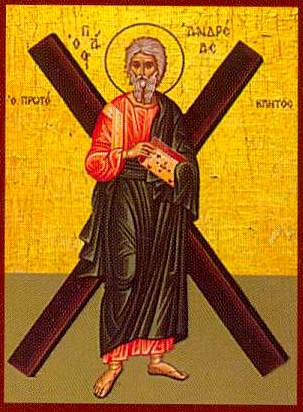
Feast of St. Andrew the First Called.


The Holy Apostle Andrew the First-Called was the first of the Apostles to follow Christ, and he later brought his own brother, the holy Apostle Peter, to Christ (John 1:35-42). The future apostle was from Bethsaida, and from his youth he turned with all his soul to God. He did not enter into marriage, and he worked with his brother as a fisherman. When the holy Prophet, Forerunner and Baptist John began to preach, St Andrew became his closest disciple. St John the Baptist himself sent to Christ his own two disciples, the future Apostles Andrew and John the Theologian, declaring Christ to be the Lamb of God.

After the Descent of the Holy Spirit upon the Apostles, St Andrew went to the Eastern lands preaching the Word of God. He went through Asia Minor, Thrace, Macedonia, he reached the River Danube, went along the coast of the Black Sea, through Crimea, the Black Sea region and along the River Dniepr he climbed to the place where the city of Kiev now stands.

He stopped overnight on the hills of Kiev. Rising in the morning, he said to those disciples that were with him: "See these hills? Upon these hills shall shine forth the beneficence of God, and there will be a great city here, and God shall raise up many churches." The apostle went up around the hills, blessed them and set up a cross. Having prayed, he went up even further along the Dniepr and reached a settlement of the Slavs, where Novgorod was built. From here the apostle went through the land of the Varangians towards Rome for preaching, and again he returned to Thrace, where in the small village of Byzantium, the future Constantinople, he founded the Church of Christ. The name of the holy Apostle Andrew links the mother, the Church of Constantinople, with her daughter, the Russian Church.

On his journeys the First-Called Apostle endured many sufferings and torments from pagans: they cast him out of their cities and they beat him. In Sinope they pelted him with stones, but remaining unharmed, the persistant disciple of Christ continued to preach to people about the Savior. Through the prayers of the Apostle, the Lord worked miracles. By the labors of the holy Apostle Andrew, Christian Churches were established, for which he provided bishops and clergy. The final city to which the Apostle came was the city of Patra, where he was destined to suffer martyrdom.

The Lord worked many miracles through His disciple in Patra. The infirm were made whole, and the blind received their sight. Through the prayers of the Apostle, the illustrious citizen Sosios recovered from serious illness; he healed Maximilla, wife of the governor of Patra, and his brother Stratokles. The miracles accomplished by the Apostle and his fiery speech enlightened almost all the citizens of the city of Patra with the true Faith.

Few pagans remained at Patra, but among them was the prefect of the city, Aegeatos. The Apostle Andrew repeatedly turned to him with the words of the Gospel. But even the miracles of the Apostle did not convince Aegeatos. The holy Apostle with love and humility appealed to his soul, striving to reveal to him the Christian mystery of life eternal, through the wonderworking power of the Holy Cross of the Lord. The angry Aegeatos gave orders to crucify the apostle. The pagan thought he might undo St Andrew's preaching if he were to put him to death on the cross.

St Andrew the First-Called accepted the decision of the prefect with joy and with prayer to the Lord, and went willingly to the place of execution. In order to prolong the suffering of the saint, Aegeatos gave orders not to nail the saint's hands and feet, but to tie them to the cross. For two days the apostle taught the citizens who gathered about. The people, in listening to him, with all their souls pitied him and tried to take St Andrew down from the cross. Fearing a riot of the people, Aegeatos gave orders to stop the execution. But the holy apostle began to pray that the Lord would grant him death on the cross. Just as the soldiers tried to take hold of the Apostle Andrew, they lost control of their hands. The crucified apostle, having given glory to God, said: "Lord Jesus Christ, receive my spirit." Then a blazing ray of divine light illumined the cross and the martyr crucified upon it. When the light faded, the holy Apostle Andrew had already given up his holy soul to the Lord. Maximilla, the wife of the prefect, had the body of the saint taken down from the cross, and buried him with honor.

A few centuries later, under the emperor Constantine the Great, the relics of the holy Apostle Andrew were solemnly transferred to Constantinople and placed in the church of the Holy Apostles beside the relics of the holy Evangelist Luke and St Paul's disciple St Timothy.

Tuesday, November 28, 2006

Broadcast Schedule for Papal Visit to the Ecumenical Patriarchate

EWTN will be broadcasting much of the Pope's visit and then rebroadcasting parts later for those who can't watch the live version. A couple of the highlights are below. Note as far as I can tell the Divine Liturgy is not scheduled to be rebroadcast. This is probably due to its considerable length. Check the EWTN web site for additional events that are scheduled.

MEETING WITH THE ECUMENICAL PATRIARCH BARTHOLOMEW I (90:00)

Wednesday November 29, 2006 12:00 PM Eastern Time
Wednesday November 29, 2006 9:00 AM Pacific Time

MEETING WITH THE ECUMENICAL PATRIARCH BARTHOLOMEW I (90:00)

Wednesday November 29, 2006 11:30 PM Eastern Time
Wednesday November 29, 2006 8:30 PM Pacific Time


ORTHODOX DIVINE LITURGY AT THE PATRIARCHAL CHURCH OF ST. GEORGE (240:00)

Thursday November 30, 2006 2:00 AM Eastern Time
Wednesday November 29, 2006 11:00 PM Pacific Time

Work in Progress

I will be making some changes to Ad Orientem's layout in the next day or so. So if somethings don't work quite right or you see sudden weird changes in appearance please bear with me. Comments suggestions and criticisms are welcome. Also feel free to report bad links or other broken features.

John

Monday, November 27, 2006

Has Rowan Williams swum the Tiber...?


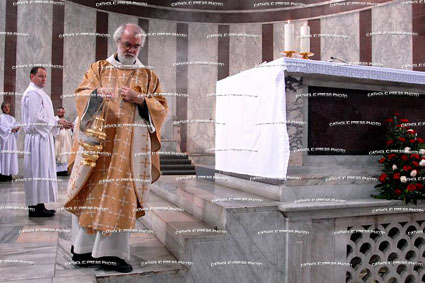
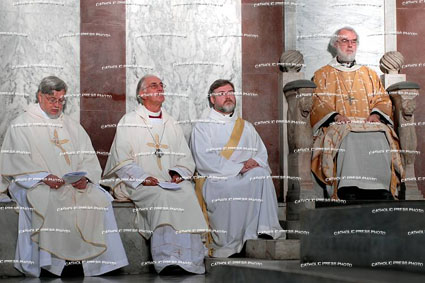
If not, then what was he doing celebrating an Anglican service from the altar of Santa Sabina in Rome? This is one of the main churches of the Dominican religious order. Now I am all in favor of maintaining polite contacts with other Christians (although I think the old Roman dream of reuniting the Anglicans is circling the drain). But there needs to be a line drawn somewhere. The ABC was dressed in the full regalia of an Anglican prelate complete with miter and crosier and was even photographed standing in front of the Bishop�s throne (I don't know if he actually sat in it!).

This Anglican "mass" was assisted by the active participation of several prominent Roman clergy. The last time I checked Rome officially does not recognize Anglican Orders. (On a side note I don't know of any Orthodox who believe that the Anglicans retain the grace of valid sacraments). So again I need to ask... What's going on here? This was not done quietly. It has been widely reported although so far I have only found one Catholic blog that seems to be concerned about the implications of this. I am aware that there have been a few exceptions made for clergy of those churches whose sacraments Rome recognizes. In the case of the Orthodox, Rome holds that we are more or less a part of the same church, but just don't realize it. Yet surely there are limits to ecumenism. During the forthcoming papal visit to Turkey both Pope and Patriarch will be attending liturgical services celebrated by the other. But there are no plans for joint participation in those services beyond attendance. Nor will they be celebrated on the other church's altar. If this happened in an Orthodox Church the bishop who gave permission would probably not be a bishop for more than five minutes beyond the time required to convene the Holy Synod. Since when does the Roman Church allow what it holds (rightly IMO) to be false worship in its churches and on its alters? I hope my Roman brothers and sisters will forgive me for saying that this was a shocking and scandalous affair.


UPDATE: He sat on the throne!


A Patriarchate under siege

Ignore the usual nonsense about "spiritual leader of the Orthodox Church" by someone who as an Orthodox Christian should know better, and you have a pretty good article. Hat tip to Rocco Palmo over at Whispers.

Imagine the Vatican surrounded in a fiercely secular yet very Muslim Italy.

The Christian community there has dwindled to only a few thousand after decades of ethnic cleansing. Much of the church's property has been seized. The government has closed the only seminary and refuses to reopen it.

A law has been passed: Any future Roman Catholic pope must be born on Italian soil, even though there is no seminary to train the young priests, even as the Christian community shrinks to a handful. A cold shadow falls on the Western church.

I asked you to imagine this because it's going on, right now, but not in Rome.

It is happening in Istanbul, where Ecumenical Patriarch Bartholomew I, patriarch of Constantinople and spiritual leader of the world's Orthodox Church, is facing extreme pressure by the Turkish government.

Read the reast here.

Wednesday, November 22, 2006

Down Time

Barring something really significant there will be no major updates on the site over the next few days. Comments are still open for anyone wanting to drop a thought. Wishing each of you a very joyous Thanksgiving…. (Yes, I will be breaking the fast tomorrow).

Ad Orientem

Turks Seize Hagia Sophia to Protest Papal Visit

From the AP:

ISTANBUL, Turkey - About 40 members of a nationalist party occupied one of Istanbul's most famous buildings, the Haghia Sophia, on Wednesday to protest the visit next week of Pope Benedict XVI, police said.

The protesters belong to the Great Unity Party, a far right-wing group that has previously staged demonstrations against the planned visit. Police said they were preparing to enter the former Byzantine church, which was converted into a mosque before becoming a museum, to remove the protesters.

The Haghia Sophia is on the pope's list of stops during his Nov. 28-Dec. 1 trip to Turkey.

Benedict is making his first trip to a Muslim nation at a time of heightened tensions between the West and Islam. It is the pope himself who has recently been at the center of those tensions.

The Muslim world erupted in protest after Benedict delivered a speech in September in which he quoted a Byzantine emperor who characterized some of the teachings of the Prophet Muhammad as "evil and inhuman," particularly "his command to spread by the sword the faith."

Is the Pope giving up on the Anglicans?

The Times of London is reporting that the Vatican is preparing plans to welcome in large numbers of disaffected Anglicans. This would seem to be further evidence that B16 has what I would call a fairly realistic view of the state of the Anglican Communion. Such was summed up in the last paragraph of the article rather succinctly…

Despite the friendly overtures,[to the ABC] the Pope believes the Anglican Church faces a difficult future. Graham Leonard, the former Bishop of London and now a Roman Catholic monsignor, said: “The Pope’s view is that theologically Anglicanism has no guts in it.”

Read the rest of the article here.

Saturday, November 18, 2006

Odds and ends...

Item I
The Evangelical Lutheran Church of America has posted an agreed statement resulting from joint discussions with the Orthodox on the Trinity. In this statement the “filioque” received prominent attention.

(7) Our dialogue has discussed extensively the historical and theological issues surrounding the one point in the Creed on which Lutherans and Orthodox have traditionally disagreed with regard to faith in the Holy Trinity: the procession of the Spirit. Together with other churches rooted in Latin-speaking Christianity, Lutherans have traditionally confessed the creedal faith in the Holy Trinity by saying that the Holy Spirit "proceeds from the Father and the Son [Filioque]," and Lutheran theologians have traditionally defended both the addition of the phrase "and the Son" and the truth of the teaching embodied by this addition. Orthodox have traditionally opposed both the addition of the Filioque clause to the Creed and the teaching that the Spirit proceeds from the Son. Our dialogue has progressed to the point where we can make the following statements regarding this historic dispute.

(8) Lutherans, together with many other Western Christians, now widely recognize that the addition of the Filioque to the Nicene Creed, which took place locally by a unilateral action of the Latin Church and without the action of an Ecumenical Council, was illegitimate and contributed to disunity among Christians. Moreover, many Lutherans are now convinced that the original Creed without the Filioque addition could and should be restored in their worship . This need not contradict the Lutheran Confessions, which commit Lutherans to "the decree of the Council of Nicaea" (CA I). It is especially important to note that this article commits Lutherans not simply to the teaching of "the synod of Nicaea," but to the decree —that is, the text— of Nicaea, and to the specific doctrinal decisions embodied in that text. But the text of "the synod of Nicaea," that is the text of A.D. 325, amplified by the First Council of Constantinople of A.D. 381, as reported in the Acts of the Council of Chalcedon (A.D. 451), does not include the Filioque. It simply says that the Holy Spirit is to ek tou patroH ekporeuomenon ("the one proceeding from the Father"), in line with the Gospel of St. John (John 15:26). On this basis, Lutherans can now acknowledge that the Filioque is not ecumenical dogma, but has the status of a local tradition which is not binding on the universal church.

(9) For this reason the Lutheran members of this dialogue are prepared to recommend to their Church that it publicly recognize that the permanently normative and universally binding form of the Nicene Creed is the Greek text of A.D. 381, and that it undertake steps to reflect this recognition in its worship and teaching. This would be a way of enacting in the Evangelical Lutheran Church in America the Lutheran World Federation resolution of 1990, which found it "appropriate" that member churches "which already use the Nicene Creed in their liturgies may use the version of 381, for example in ecumenical services," and further found it appropriate that Lutherans preparing common vernacular texts of the Nicene Creed together with Orthodox churches "may agree to a version without the ‘western’ filioque."

(10) At the same time, Lutherans are not prepared to regard the teaching that the Holy Spirit proceeds from the Father and the Son as a heresy—a teaching against faith in the Holy Trinity. It is part of their confessional documents, and many of the chief teachers of the Lutheran tradition, including Luther himself, taught it vigorously. Lutheran recognition that the Filioque is not part of the Nicene Creed in its original and ecumenically binding form is not, therefore, to be equated with Lutheran rejection of all theological teaching which ascribes to the Son a role in the procession of the Holy Spirit, still less with an acknowledgment that all such teaching is heretical. Nevertheless, Lutherans are open to further exploration of the relation of the Spirit to the Son in conversation with Orthodox and in careful dialogue with their concerns.

(11) Orthodox very warmly agree with the Lutherans that the Filioque does not belong to the normative Creed as recognized by the Council of Constantinople of A.D. 879/880, which was accepted unanimously by both East and West. At the same time, Orthodox do not regard the teaching that the Holy Spirit proceeds from the Son as well as from the Father to be one which they can accept. This teaching is opposed to the monarchy of the Father and to the equality of the Spirit to the Father and the Son as a hypostasis or person distinct from both, as expressed by the original Creed. On the other hand, Orthodox may accept the teaching of the "double procession" of the Spirit from the Father and the Son in the patristic sense that the Spirit is sent from the Father through/and the Son in the mystery of our salvation in Christ. The relation of the Son to the Spirit in the context of salvation (oikonomia) is not the same with their relation in the eternal Trinity (theologia). Thus for Orthodox the dispute over the Filioque can be narrowed down to accepting or rejecting the distinction between how the Trinity is eternally in themselves and how they appear in Christ. That the Holy Spirit eternally comes forth from the Son, so as to depend for his being and his possession of the one divine nature on the Son as well as on the Father, is a teaching which Orthodox uniformly oppose.

(12) Despite our differences in theological perspective, Lutherans and Orthodox agree on certain basic theological commitments, which constitute criteria of acceptable Trinitarian teaching. In particular they agree that any acceptable Trinitarian teaching: (a) must affirm the monarchy of the Father; (b) must affirm that the divine essence exists only in the three distinct, equal, and undivided persons of the Trinity, without confusion of their personal properties; and (c) must affirm the consistent Christian teaching of the intimate relation of the Son and the Spirit in the economy of salvation.

Sometimes progress comes in little bites…

Item II
St. Vladimir’s Seminary has a new Dean and Provost. Fr. John Behr has been elected as Dean and Fr. Chad Hatfield formerly Dean of St. Herman’s seminary in Alaska will serve as Provost. The following is from the official web site of St. Vlad’s…

Fr Chad Hatfield comes to St Vladimir’s from St. Herman Seminary in Kodiak, Alaska, where he has served with great distinction as Dean since 2002. Fr Hatfield holds a Doctor of Ministry from Pittsburgh Theological Seminary where his thesis was “An Examination of the Pastoral Rites for Ministry to the Sick as Found in the Orthodox Christian Euchologia.” He received his Master of Divinity in 1978 and Master of Sacred Theology in 1988 from Nashotah House Seminary in Wisconsin. Ordained as Priest by Bishop Basil (Essey) of the Antiochian Orthodox Christian Archdiocese of North America in 1994, he is Vice President of the Orthodox Christian Mission Center (OCMC) Board, Co-Chair of the OCA Department of Evangelism, and member of the OCA Board of Theological Education, the Editorial Advisory Board for Christian Bioethics journal and the Kodiak College Advisory Council. Fr Hatfield and his wife, Matushka Thekla, will be moving to St Vladimir’s campus at the completion of the current academic year.

Fr John Behr is the current Professor of Patristics at St Vladimir’s and is widely regarded as one of the eminent theologians of our time. Having studied under Bishop Kallistos (Ware), Fr Behr earned his Doctor of Philosophy in Theology from Oxford University and a Master of Theology from St Vladimir’s Orthodox Theological Seminary. A prolific author, his most recent published books include The Mystery of Christ: Life in Death (Crestwood, NY: SVS Press, 2006) and The Nicene Faith, vol. 2 of The Formation of Christian Theology (Crestwood, NY: SVS Press, 2004). He has also published numerous articles and papers and speaks throughout the world on Orthodox theology. Ordained to the priesthood in 2001, Fr Behr is the current editor of St Vladimir’s Theological Quarterly and the Popular Patristics Series and is the faculty supervisor for the Inter-Seminary Dialogue. He lives with his wife Kate and their two sons and daughter on St Vladimir’s campus.

Many Years to both men and congratulations to the board of trustees on such excellent choices!

Item III
There is a fascinating video in two parts (part 1 & part 2) on youtube which discusses the history of the development and reform of the Roman Liturgy post Trent with an emphasis on the Pauline reforms post Vatican II. This is not your usual one dimensional slam by traditionalists (although certainly the narrator is sympathetic to the traditionalist point of view). The film presents significant historical background (especially so for a video) on some of the origins of the liturgical revolution in the Latin Church. Not wanting to get into the theological differences between Orthodoxy and the Latin Church, I will confine myself to saying I do not agree with the negative emphasis given to communion under both species and the dangers presented by a vernacular liturgy and married clergy. The video completely ignores the fact that the East has all of these and is in much better shape liturgically than the Roman Church. That said it is certainly worth a look for those wanting to know why some are so bent out of shape over the way things have been going for the last four decades. It is not you typical polemic broadside.

Item IV
Al Kimel over at Pontifications has posted an essay on Theopoiesis vs. Theosis. This is not light reading. But for those whose eyes don’t glaze over when the topic gets deep, there are bound to be theological fireworks in the discussion hosted by the redoubtable Michael Liccione at Sacramentum Vitae. Frankly this is probably a bit over my head, but I will enjoy following (as best I can) the discussion.

Item V
On a personal note, we Orthodox on the reformed calendar are now entering the first full week of the Nativity (Advent) Fast. During this period of spiritual preparation for the Feast of the Nativity I will be making a conscious effort to curb and limit the attention I pay to the distractions of the world. This is not to say that I am retiring to a monastery until Christmas. But I do expect (and hope) that it will mean less time spent in front of a computer monitor and more time in front of my prayer corner. Thus I will beg the indulgence of my readers if in the coming weeks my posts are somewhat less frequent and regular. I do hope to post at least weekly or more often if something of importance or great interest pops up. (Look for comments on the Pope’s forthcoming visit to Turkey and the EP.) But frequent updates should not be expected to resume until after the fast is broken.

Under the mercy,
Ad Orientem

ROCOR Western American Diocese on the Act of Canonical Communion

Epistle of the Pastoral Conference of the Clergy of the Western American Diocese

We, the clergy of the Western American Diocese of the Russian Orthodox Church Outside of Russia, having gathered for a Pastoral Conference at the Church of the Holy Ascension in the capital city of California, Sacramento, greet all the parishioners and all the faithful of the wide-spread Western American Diocese with the words: "Peace be unto you."

Over the past four days we have had fellowship, have prayed, have listened to lectures, asked questions, have shared our joys, concerns, sorrows, worries and hopes. On the most important questions, by the grace of God, our clergy has demonstrated remarkable oneness of mind and mutual understanding. For this we give thanks to the Lord God.

Great hierarchs have served in our diocese: the future Patriarch of All Russia and Confessor St Tikhon, the Wonderworker St John of Shanghai and San Francisco, the ever-memorable Archbishop Anthony (Medvedev), and Bishop Nektary of Seattle, who was the spiritual son of the Elder Nectarius of Optina. The Western American Diocese was especially loved by two First Hierarchs of the Church Abroad: His Beatitude Metropolitan Anastassy, who established a summer residence in Burlingame, and the ever-memorable Metropolitan Philaret, who loved to visit California. It was here that he celebrated the 50th Anniversary of his priesthood. All of these hierarchs not only left behind them an indelible mark on the Western American Diocese, but also their directives concerning the organization of Church life, concerning their love for the Russian Church, concerning spiritual unity, concerning sobornost' and trust. The spirit of these great hierarchs is alive in the Western-American Diocese to this day, and we sense their prayers for us.

We are thankful to our Lord God that five years ago it was pleasing to Him that the Most Reverend Metropolitan Laurus be elected First Hierarch of the Russian Church Abroad. The lot of service fell upon Metropolitan Laurus at that moment in the history of the Russian Orthodox Church Outside of Russia when enormous changes occurred in the life of the Church in Russia—changes which permitted the two parts of the Russian Church, in Russia and abroad, to overcome their differences and to step forward onto the path of restoration of ecclesiastical unity.

After the repose of the Right Reverend Bishop Nektary of Seattle in 1983, when there was no auxiliary bishop in the Western American Diocese, the ever-memorable Archbishop Anthony wrote in his will that in the case of his death the Most Reverend Archbishop Laurus of Syracuse should administer the Western American Diocese until the appointment of a Ruling Bishop. Archbishop Anthony felt that Archbishop Laurus not only earned the trust of the clergy and the flock of the Western American Diocese, but also was gifted with love, peace, sobriety and discernment, which are especially necessary at times of change in Church life. Now, not only the Western American Diocese, but the entire Russian Orthodox Church Outside of Russia is poised to enter into canonical communion with the Church in Russia, and it is not by chance that it is Metropolitan Laurus who stands at the head of the part of the Russian Church that is found abroad.

The restoration of canonical unity with the Church in Russia means that the day which the spiritual leaders of the Russian diaspora long awaited has come. The restoration of canonical unity will allow our Russian Orthodox Church Abroad to return to the family of Orthodox Local Churches and to fulfill its mission in the contemporary world not in isolation, but in collaboration with the healthy forces of Orthodoxy in the entire world. We must not be afraid of this and look for enemies where there are none. If we have the truth, if the Lord is with us, if we have a glorious past, then it would be a sin at the present time to lock ourselves away in our own righteousness. It would be a sin to hide our inheritance.

During the past several years we have had the opportunity to experience collaboration of our Western American Diocese with representatives of the Local Churches: we have frequently been visited by guests from Russia, by representatives of the Moscow Patriarchate, among whom were the Rector of the Moscow Theological Schools, the Most Reverend Archbishop Evgeniy and the well-known All-Russian Father-Confessor of Optina Hermitage, Schema-Abbot Iliy; our youth has begun to participate in the activities of other jurisdictions—assisting in the construction of houses for the poor in Mexico, and youth camps in Romania; a representative of our Church participated in the Diocesan Assembly of the Orthodox Church in America; one of the main spiritual treasures of the OCA, the Wonder-working Sitka Icon of the Mother of God visited the San Francisco Cathedral; representatives of the Greek, Antiochian, Jerusalem and OCA jurisdictions support (and teach at) St John's Academy, the only institution of its kind in the Russian Church Abroad; Orthodox families of the Bay Area took in children from an orphanage in Belarus; church choirs and Orthodox ensembles from Russia sang at parishes of the Western American Diocese; one of the main presentations at the Pastoral Conference of the clergy of the Western American Diocese in the Spring of 2006 was given by a representative of the Antiochian Archdiocese; a Christian music group made up of converts from the Bulgarian Church in the USA participated in our diocesan young adult Retreat in September 2006; choir directors and clergy from the Moscow Patriarchate gave lectures at Church Choir Conferences and at the All-Diaspora Youth Conference; the participants of the Diocesan Pastoral Conference in Vancouver prayed with and shared the joy of the "Slava" of the local parish of our fraternal Serbian Church...

We must state and affirm that these joint activities brought nothing but inspiration, joy and mutual benefit to Orthodoxy. We lost nothing, but, to the contrary, were enriched by this experience and fellowship.

How much energy and time have been wasted on confrontation with the Church in Russia? One of the speakers at the IV All-Diaspora Sobor noted that in his diocese, for years, if not decades, at Pastoral Conferences only two topics were discussed: "Sergianism" and ecumenism. About pastoral questions, questions concerning youth, the Orthodox family, missionary work, education, the preparation of the generation to follow—not one word. Before us stand so many challenges, there is so much work, so much not even begun, and even more uncompleted.

We, the clergy of the Western American Diocese feel that it is necessary, as soon as possible, without delay, or without any slowing down, to complete the process of the reestablishment of the unity of the Russian Church. This will allow us to move on to the critical problems of our parish and diocesan life. This will allow us to collaborate and share experiences with our Orthodox neighbors from the Local Orthodox Churches. This will also allow us to travel to Russia, and at Russian holy places, in ancient churches and monasteries, to pray together with those related to us by faith and by blood – our brothers and sisters – to commune of the Holy Mysteries of Christ and to draw spiritual strength for the continuation of our service in the Western American Diocese. This will also permit all who wish to visit the holy places of Mt. Athos, Georgia, Jerusalem and other countries not only as pilgrims, but as fully-accepted Orthodox, who can have Eucharistic communion with the Orthodox faithful of these countries.

The "Act of Canonical Communion," which has been confirmed by the supreme ecclesiastical authority of the Russian Orthodox Church Outside of Russia, will establish a firm canonical foundation for the Russian Church Abroad, as a self-administering part of the Local Russian Church. As a result of this "Act," it, on the one hand, will preserve its internal freedom, its church structures, its own special God-given place in the contemporary world, its spiritual-pastoral-historical heritage; and, on the other hand, it will reestablish its canonical and prayerful communion with the Church in Russia and the status of the Russian Orthodox Church Outside of Russia will fully conform with the ecclesiastical canonical norms of Orthodoxy.

Among the participants of our Pastoral Conference there are seven members of the IV All-Diaspora Sobor. On the fourth working day of the All-Diaspora Sobor, at the opening of which the words "Today the grace of the Holy Spirit has gathered us together" were sung, a Resolution was ratified. The first paragraph of the Resolution, where is expressed "the full trust and love of the clergy and the laity to their First Hierarch, the Most Reverend Metropolitan Laurus, and to the Hierarchical Sobor," and that the members of the Sobor witness that as faithful children of the Holy Church, they will bow down before the will of God and be subject to the decisions of the forthcoming Hierarchical Sobor, was passed unanimously. In other words, every member of the All-Diaspora Sobor witnessed, before the Holy Spirit, that he gives a promise of faithfulness to the Russian Church Abroad, its First Hierarch and the Hierarchical Sobor. At the Hierarchical Sobor it was decided to complete the matter of the unification of the Russian Church "without delay." The members of the IV All-Diaspora Sobor, participating in this Pastoral Conference, reaffirm the promise given by them at the All-Diaspora Sobor and do not plan to betray the grace which they received at that Sobor.

We, the participants of the Pastoral Conference of the Western-American Diocese firmly believe that the Holy New Martyrs of Russia did not shed their blood in vain, and that their prayer before the Throne of God cannot fail to bring fruit. Twenty-five years ago they were glorified and twenty-five years ago in this very month for the first time the Prayer to the New Martyrs was read, in which the call for Church unity so strongly resounds:

"Let all divisions in our Church cease to exist, that all may be one…"

Exactly half a century ago Our Western American luminary St John, archpastor, man of prayer and ascetic clairvoyantly foretold that about which he prayed so fervently and desired with all his heart:

"We beseech the Lord that He will hasten the advent of that longed-for and expected hour, when the First Hierarch of All Russia, having ascended his Patriarchal throne in the Dormition Cathedral of the ancient capital, shall gather around himself all the Russian archpastors having assembled from all the Russian and foreign lands" (from the Epistle of Archbishop John to His Shanghai Flock dated August 2, 1946).

We firmly believe that by the mercy of God and the prayers of the Holy New Martyrs of Russia and the Holy Hierarch St John, Wonderworker of Shanghai and San Francisco, this long-awaited hour has come and that we may proclaim with the words of the Paschal prokimenon:

"This is the day which the Lord has made, let us rejoice and be glad in it!"

† Archbishop KYRILL

Archpriest Alexander Lebedeff (Los Angeles)
Archpriest Stefan Pavlenko (Burlingame)
Archpriest Peter Perekrestov (San Francisco)
Archpriest John Ocana (Sunnyvale)
Archpriest George Kurtow (Monterey)
Archpriest Serge Kotar (San Francisco)
Archpriest Paul Volmensky (Sacramento)
Archpriest Alexis Kotar (Seattle)
Archpriest David Moser (Boise)
Archpriest Yaroslav Belikow (San Francisco)
Archpriest Martin Swanson (St. Louis)
Priest Boris Henderson (Denver)
Hieromonk Raphael (Winnipeg)
Priest Seraphim Bell (Walla Walla)
Hieromonk Tryphon (Vashon Island)
Priest Luke Higgins (Walla Walla)
Priest Anatole Lyovin (Honolulu)
Priest James Steele (Diamond Springs)
Priest John McCuen (Phoenix)
Priest Sergei Kapitan (Reno)
Priest Alexey Chumakov (Los Angeles)
Priest James Baglien (Corvallis)
Hieromonk James (San Francisco)
Priest Martin Person (Los Angeles)
Priest Daniel Reese (Walla Walla)
Deacon Nikolai Lenkoff (Mulino)
Deacon Jan Veselak (Denver)
Deacon Dimitri Jakimowicz (San Francisco)

November 3/16, 2006
Sacramento, California

www.wadiocese.com

Friday, November 17, 2006

Some thoughts on losing a war...

One of the few programs on television I watch religiously is on the Sci Fi channel. It’s called Battlestar Galactica. This is a remake of the campy late 1970’s series of the same name. But while the older series was a cross between space opera and silly comedy the new series is incredibly gritty, well written and blessed with superb acting. It is also dark. When I say dark, I mean midnight black. The motto of this program could be “remember it’s always darkest just before it gets even more hopeless.” Most television programs tend to end on a happy note. If that’s what you’re looking for DO NOT watch this program. Allow me a small example from the pilot miniseries.

(WARNING!!! PLOT SPOILER AHEAD FOR THOSE WHO MAY WANT TO GO OUT AND RENT THE DVD)

The pilot is set in an unknown time and corner of the universe with humans living on twelve planets in a solar system called “The Colonies.” A long time ago we are told in the written prologue, they made a race of machines called Cylons to serve them. But the machines rebelled and there was a war that eventually ended in a draw. The Cylons left and had not been heard from in a generation. Meanwhile The Colonies are seen as an advanced society that is relatively democratic, peaceful and prosperous. Then the Cylons came back.

In the space of roughly 24 hours in their time (about 3 1/2 hrs on DVD) the twelve colonies are annihilated. I mean gone, as in wiped out. Genocide is an often overused term. This program shows what a real genocide might look like. The home worlds are obliterated in a massive surprise attack with nuclear weapons raining down on cities. The Colonial Fleet is also destroyed except for a lone ship called the Galactica, a sort of space age aircraft carrier/battleship.

The Galactica survives the initial massacre by a stroke of luck and retreats to the far corner of the solar system to rearm. While there a handful of civilian space ships arrive lead by the erstwhile Secretary of Education, now President of The Colonies, Laura Roselyn with perhaps 50,000 survivors left from a civilization of probably tens of billions of people.

There she meets the commanding officer of the Galactica, Bill Adama who quickly makes it clear he has only one interest. He wants to get back into the fight as quickly as possible. A stunned President Rosalyn asks him if he is serious. To which Adama replies with his own question. “What do you suggest we do? Run?” And that’s when Rosalyn gives the money quote that is at the heart of my post.

“Yes. We run. I respectfully suggest it’s the only sane thing to do. We leave and we don’t come back. I am not sure if you realize this, but the war is over. And we lost.”

(SPOILER OVER… SAFE TO RESUME READING)

There are today in the Episcopal Church (TEC) 110 dioceses and a significant number of retired bishops. Of those perhaps a dozen are at least somewhat orthodox (small “o”). Five are in open resistance to their own church, with one (San Joaquin) contemplating secession from TEC. The rest are to varying degree heretics or even apostates. The number of orthodox Christians left in TEC is not known but it’s unlikely that they comprise more than 10% of the clergy in most dioceses. There are exceptions to be sure. But in the big picture they are an extreme and dwindling minority in a denomination which has elected an apostate as its presiding bishop. How many times have we all heard of the few clergy and laymen who courageously soldier on against all odds, dreaming of a restoration?

My question is at what point does one step back and say the cause is lost? The few bishops who have not become formal heretics in TEC must at some point retire or die. Do you think the people running the show will tolerate many more Bishop Schofields? They came very close to taking steps to remove him as Bp of San Joaquin, and may yet do so. How long can one remain in communion with heretical or apostate bishops knowing them to be such? Even if your own bishop is one of the few, he (and by extension you) is in communion with heretics. Leaving is painful. But fighting for a cause that is lost can be more painful. It can warp one’s faith and allow bitterness and anger to intrude itself into the soul. Better to accept this defeat and focus on where to go for spiritual nourishment. For the Protestant minded there is no shortage of denominations available. Pick one.

For the catholic minded, that is to say those seeking The Church and not a denomination there are logically two choices, Orthodoxy or Rome. But wherever you go one thing needs to be said plainly though with love and empathy for the pain of this fact. Staying in TEC is no longer a moral option for an orthodox Christian. There is no longer any reasonable hope of reversing the fortunes of this fight. To believe otherwise is to be willfully blind to the truth. “The war is over. And we lost.”

Matthew 10: 14-15
14 And whosoever shall not receive you, nor hear your words, when ye depart out of that house or city, shake off the dust of your feet.
15 Verily I say unto you, It shall be more tolerable for the land of Sodom and Gomorrha in the day of judgment, than for that city.

Monday, November 13, 2006

ROCOR and the OCA (etc.)

I had an interesting conversation after liturgy today with a friend of mine. I started to mention the idea of a parish pilgrimage to the relics of St. John in San Francisco and inserted "since we will soon be in communion with ROCOR" or words to that effect at the beginning of the sentence. I got cut off and a discussion quickly ensued over whether we will in fact be in communion with ROCOR (we being the OCA but it could apply to all of the other canonical jurisdictions).

He seemed to feel that ROCOR would not be in communion with anyone that they were not comfortable with. I replied that ROCOR was not entering communion with Moscow as an autocephalous church. They were restoring the bonds of the once undivided Russian Orthodox Church. And while they will enjoy a fairly broad degree of administrative autonomy they will be part of the Holy Synod of the Russian Orthodox Church, and under the Patriarch of Moscow, not merely in communion with him as a separate church. Thus logically they will be in communion with whoever the MP is in communion with. An email from one of the Orthodox E-Lists I belong to came in tonight and seems to affirm my view of things. The relevant portion is below.

...As it is, under the Act of Canonical Communion, ROCA is quite clearly once more part of the Patriarchate of Moscow and, by definition, in communion with whomsoever the Patriarchate is in communion.

This Act is a resumption of the former unity, in which ROCA is subordinate to its own patriarchate. Our bishops will not have the freedom to choose not to be in communion with those with whom our Patriarchate is in communion. To do so would be uncanonical.

Fr Ambrose (ROCOR)


As an afterthought I should point out that this does not mean that anyone who is Orthodox will automatically be able to commune the Holy Mysteries in a ROCOR parish. The same basic rule applies there as with all Orthodox jurisdictions outside of your own. If you want to commune, you need to check with the priest before hand and be sure you meet whatever disciplines are observed in preparation for taking Holy Communion within the jurisdiction/parish you're visiting.

Whither Anglicanism?

The Rev. John Hunwicke has an extremely interesting essay posted on titusonenine web blog. In it he asks some rather pointed questions, like where is the Anglican Communion going? Not that many years ago it seemed headed to reconciliation with Rome and maybe Orthodoxy. However beginning in the 1970’s it took a sharp left turn and has been driving down that road happily ever since. Rev Hunwicke writes in part…

It is now clear that Benedict XVI is making Christian Unity the great aim of his ‘brief pontificate’. We hear of a visit to the Ecumenical Patriarch; reports of a major and extended visit to Rome by the Patriarch of Moscow; of a major RC– Orthodox document next autumn; of overtures to some of the more orthodox separated fragments of Latin Christianity. There surely can be no doubt that Cardinal Kasper’s visit to England should be seen in this context. Rome is in effect saying ‘Do you want to join the game? After all, we thought you did, back in the Sixties when together we set up ARCIC [the Anglican–Roman Catholic International Commission]. Have you really now abandoned the old Anglican dream of unity with us and with the ancient churches of the East? Does the Lord allow you to do that?’

And there are persistent rumours of a Vatican committee set up to take a careful look at those parts of the fracturing Anglican faith-community which are Catholic-minded and Catholic-converging. After all, Benedict XVI is the Joseph Ratzinger who spoke so sympathetically about us in the early 1990s; who sent a telegram of solidarity to a traditionalist Anglican gathering in America; who encouraged the Anglican Usage of the Roman rite – Anglican parishes in America united with Rome and continuing to use what is in effect an Anglican Book of Common Prayer.

So there is a real prospect of a great outbreak of Christian Unity and of us out in the cold. In the past, some Catholic Anglicans have been keener on unity with Rome, while others have looked further east. This is now a seriously dated disagreement. What we now face is East and West uniting, while we sink into a morass of women bishops, gay marriage, and liberal Methodists; doubtful sacraments and clergy who make light of the doctrines of the Creed. And all Kasper got from his journey to warn us was unreconstructed archiepiscopal abuse of Rome in our Synod, and a silly ‘paper’ by two bishops saying that Junia is the answer to everything.

Setting aside some very speculative rumors about which I have heard absolutely nothing the essay in its entirety is well worth a read.
Hat tip to Bill (AKA The Godfather)

Saturday, November 11, 2006

Armistice Day

One of the World War I military cemetaries at Ypres Belgium

From my grandmother (memory eternal) and my cousin Sarah Jane (herself now in poor health with fading memory) I gleaned the story of my great-uncle Francis Guy (known as Guy in the family). He was one of the older children (14 in all) of my great-grandparents who lived in Endicott New York at the turn of the last century. My great-grandfather was by all accounts a good man, hard working and God fearing as they used to say in those days. But he also had a reputation for being stubborn with a "my way or the highway" mentality. By contrast my uncle Guy was a shy youth in his middle teens who had been born with some minor disfigurement on his face to which no one really paid any notice other than him. But he was very self conscious about it. In late 1914 my great grandfather wanted him to get a job at the local shoe manufacturing plant run by the Endicott Johnson company, then the biggest by far employer in my home town. Guy was perfectly OK with this. But he asked if he could set aside a small amount of his earnings to save for an operation which he felt would remove the offending birth mark. My great-grandfather said no. He was a man who believed that if you were born that way, it’s what God intended and that’s the end of it.

Well he was also not very diplomatic about it and there was an argument. A real barn burner by all accounts and when it was over an ultimatum was given to the boy. Do as you’re told or get out and make your own way in the world. In the heat of anger and hurt Guy left home. Now at this time what would become known as the Great War had just broken out in Europe. Guy like a lot of kids of his generation had rather romantic notions about war. The United States had not fought a really serious one in almost sixty years and memory dulls with time. With the United States still neutral and in need of a job Guy struck out for Canada where he enlisted in the Royal Canadian Army (Canada was part of the British Empire then). I am not sure if he lied about his age. He landed in the Princess Patricia Regiment which would gain great fame in the war. After preliminary training the regiment was shipped to England and then over to the continent where it joined up with the British Expeditionary Force holding the left wing of the Allied line with the Belgian Army in one of the few parts of Belgium not occupied by the Germans.

In September of 1915 during one of the innumerable back and forth battles near Ypres his unit assaulted the German trench works. The attack was repelled with the customary horrific casualties but Guy made it back to his own trench unharmed. When he looked back over the battlefield known as no man’s land between the opposing trench lines he saw amongst the human wreckage of war one of his close friends lying wounded. The odds of surviving in no man’s land were not good since neither side respected stretcher bearers or medics. The wounded were usually left to die. Guy leapt out of the relative safety of his trench and rushed forward to save his buddy. He reached him and under heavy fire dragged him back to the trench. After lowering the wounded soldier down Guy turned to drop down himself when he was shot in the stomach. He died several days later at a military hospital and was buried in one of the vast cemeteries near Ypres created by the carnage of the War to End All Wars.

My great-grandparents received the telegram while watching a silent movie at the local cinema house. The lights were turned on and half the town showed up to express their sympathy. The Canadian Army later (and retroactively) conferred the Military Medal on him posthumously which my great-grandmother was buried with. I am told that in Ottawa there is a book on display with the names of all of the dead of the Princess Patricia Regiment inscribed in it. A page is ceremoniously turned each day. On one of those pages is the name of a kid with a birth mark from a small town in upstate New York, Francis Guy Dwyer. Eternal rest grant unto him O Lord, and let perpetual light shine upon him.

The next worse thing to a battle lost, is a battle won.
-The Duke of Wellington


In Flanders Fields
By: Lieutenant Colonel John McCrae, MD (1872-1918)
Royal Canadian Army

IN FLANDERS FIELDS the poppies blow
Between the crosses row on row,
That mark our place; and in the sky
The larks, still bravely singing, fly
Scarce heard amid the guns below.

We are the Dead. Short days ago
We lived, felt dawn, saw sunset glow,
Loved and were loved, and now we lie
In Flanders fields.

Take up our quarrel with the foe:
To you from failing hands we throw
The torch; be yours to hold it high.
If ye break faith with us who die
We shall not sleep, though poppies grow
In Flanders fields.

Friday, November 10, 2006

The Limits of the Church (part 2)

Read part 1 here.

The 'economic' explanation raises even greater difficulties when we consider its general theological premises. One can scarcely ascribe to the Church the power and the right, as it were, to convert the 'has-not-been' into the 'has-been', to change the meaningless into the valid, as Professor Diovuniotis expresses it (Church Quarterly Review, No.231 [April 1931, p.97), `in the order of economy.' This would give a particular sharpness to the question whether it is possible to receive schismatic clergy 'in their existing orders.' In the Russian Church adherents from Roman Catholicism or from the Nestorians, etc., are received into communion 'through recantation of heresy', that is, through the sacrament of repentance. Clergy are given absolution by a bishop and thereby, the inhibition lying on a schismatic cleric is removed. One asks whether it is conceivable that in this delivery and absolution from sin there is also accomplished silently - and even secretly - baptism, confirmation, ordination as deacon or priest, sometimes even consecration as bishop, without any 'form' or clear and distinctive 'external act' which might enable us to notice and consider precisely what sacraments are being performed.

Here there is a double equivocation, both from the standpoint of motive and from the standpoint of the fact itself. Can one, in short, celebrate a sacrament by virtue of 'intention' alone and without some visible act? Of course not. Not because there belongs to the 'form' some self-sufficient or 'magic' effect, but precisely because in the celebration of a sacrament the 'external act' and the pouring-forth of grace are in substance indivisible and inseparable. Certainly, the Church is the 'steward of grace' and to her is given power to preserve and teach these gifts of grace. But the power of the Church does not extend to the very foundations of Christian existence. It is impossible to conceive that the Church might have the right, 'in the order of economy', to admit to the priestly function without ordination the clergy of schismatic confessions, even of those that have not preserved the 'apostolic succession', while remedying not only all defects but a complete lack of grace while granting power and recognition by means of an unexpressed 'intention'.

In such an interpretation the Church's whole sacramental system becomes too soft and elastic. Khomiakov, too, was not sufficiently careful, when, in defending the new Greek practice of receiving reunited Latins through baptism, he wrote to Palmer that 'all sacraments are completed only in the bosom of the true Church and it matters not whether they be completed in one form or another. Reconciliation (with the Church) renovates the sacraments or completes them, giving a full and Orthodox meaning to the rite that was before either insufficient or heterodox, and the repetition of the preceding sacraments is virtually contained in the rite or fact of reconciliation. Therefore, the visible repetition of baptism or confirmation, though unnecessary, cannot be considered as erroneous, and establishes only a ritual difference without any difference of opinion' (Russia and the English Church, ch. vi, p.62). This is impossible. The 'repetition' of a sacrament is not only superfluous but impermissible. If there was no sacrament and what was previously performed was an imperfect, heretical rite, then the sacrament must be accomplished for the first time - and with complete sincerity and candor. In any case, the Catholic sacraments are not just 'rites' and it is not possible to treat the external aspect of a sacramental celebration with such disciplinary relativism.

The 'economic' interpretation of the canons might be probable and convincing, but only in the presence of direct and perfectly clear proofs, whereas it is generally supported by indirect data and most often by indirect intentions and conclusions. The 'economic' interpretation is not the teaching of the Church. It is only a private 'theological opinion', very late and very controversial, which arose in a period of theological confusion and decadence in a hasty endeavor to dissociate oneself as sharply as possible from Roman theology.

Roman theology admits and acknowledges that there remains in sects a valid hierarchy and even, in a certain sense, the 'apostolic succession', so that under certain conditions sacraments may be accomplished - and actually are accomplished - among schismatics and even among heretics. The basic premises of this sacramental theology have already been established with sufficient definition by St Augustine, and the Orthodox theologian has every reason to take the theology of Augustine into account in his doctrinal synthesis.

The first thing to notice in Augustine is the organic way in which he relates the question of the validity of sacraments to the doctrine of the Church. The reality of the sacraments celebrated by schismatics signifies for Augustine the continuation of their links with the Church. He directly affirms that in the sacraments of sectarians the Church is active: some she engenders of herself, others she engenders outside herself, of her maid-servant, and schismatic baptism is valid for this very reason, that it is performed by the Church (de bapt. i, 15, 23). What is valid in the sects is that which is in them from the Church, that which remains with them as their portion of the sacred inner core of the Church, that through which they are with the Church. In quibusdam rebus nobiscurn sunt.

The unity of the Church is based on a twofold bond - the 'unity of the Spirit' and the 'bond of peace' (cf. Eph. 4.3). In sects and schisms the 'bond of peace' is broken and torn, but the 'unity of the Spirit' in the sacraments is not brought to an end. This is the unique paradox of sectarian existence: the sect remains united with the Church in the grace of the sacraments, and this becomes a condemnation once love and communal mutuality have withered and died.

With this is connected St Augustine's second basic distinction, the distinction between the 'validity' or 'reality' of the sacraments and their 'efficacy'. The sacraments of schismatics are valid; that is, they genuinely are sacraments, but they are not efficacious by virtue of schism and division. For in sects and schisms love withers, and without love salvation is impossible. There are two sides to salvation: the objective action of God's grace, and man's subjective effort or fidelity. The holy and sanctifying Spirit still breathes in the sects, but in the stubbornness and powerlessness of schism healing is not accomplished. It is untrue to say that in schismatic rites nothing is accomplished, for, if they are considered to be only empty acts and words, deprived of grace, by the same token not only are they empty, they are converted into a profanation, a sinister counterfeit. If the rites of schismatics are not sacraments, then they are a blasphemous caricature, and in that case neither 'economic' suppression of facts nor 'economic' glossing over of sin is possible. The sacramental rite cannot be only a rite, empty but innocent. The sacrament is accomplished in reality.

Nevertheless it is impossible, Augustine argues, to say that in the sects the sacraments are of avail, are efficacious. The sacraments are not magic acts. Indeed, the Eucharist itself may also be taken 'unto judgement and condemnation', but this does not refute the reality or 'validity' of the Eucharist. The same may be said of baptism: baptismal grace must be renewed in unceasing effort and service, otherwise it becomes 'inefficacious'. From this point of view St Gregory of Nyssa attacked with great energy the practice of postponing baptism to the hour of death, or at least to advanced years, in order to avoid pollution of the baptismal robe. He transfers the emphasis. Baptism is not just the end of sinful existence, rather it is the beginning of everything. Baptismal grace is not just the remission of sins, but a gift or pledge. His name may be entered in the army list, but the honor of a soldier lies in his service, not in his calling alone. What does baptism mean without spiritual deeds?

Augustine wishes to say the same thing in his distinction between 'character' and 'grace'. In any case, there rests on everyone baptized a 'sign' or 'seal', even if he falls away and departs, and each will be tried concerning this 'sign' or 'pledge' in the Day of Judgement. The baptized are distinguished from the unbaptized even when baptismal grace has not flowered in their works and deeds, even when they have corrupted and wasted their whole life. That is the ineffaceable consequence of the divine touch. This clear distinction between the two inseparable factors of sacramental existence, divine grace and human love, is characteristic of the whole sacramental theology of St Augustine. The sacraments are accomplished by grace and not by love, yet man is saved in freedom and not in compulsion, and for that reason grace somehow does not burn with a life-giving flame outside communality and love.

One thing remains obscure. How does the activity of the Spirit continue beyond the canonical borders of the Church? What is the validity of sacraments without communion, of stolen garments, sacraments in the hands of usurpers? Recent Roman theology answers that question by the doctrine of the validity of the sacraments ex opere operato. In St Augustine this distinction does not exist, but he understood the validity of sacraments performed outside canonical unity in the same sense. In fact ex opere operato points to the independence of the sacrament from the personal action of the minister. The Church performs the sacrament and, in her, Christ the high priest. The sacraments are performed by the prayer and activity of the Church, ex opere orantis et operantis ecclesiae. It is in this sense that the doctrine of validity ex opere operato, must be accepted. For Augustine it was not so important that the sacraments of the schismatics are 'unlawful' or 'illicit' (illicita); much more important is the fact that schism is a dissipation of love. But the love of God can overcome the failure of love in man. In the sects themselves - and even among the heretics - the Church continues to perform her saving and sanctifying work. It may not follow, perhaps, that we should say that schismatics are still in the Church. In any case this would not be precise and sounds equivocal. It would be truer to say that the Church continues to work in the schisms in expectation of that mysterious hour when the stubborn heart will be melted in the warmth of God's prevenient grace, when the will and thirst for communality and unity will finally burst into flame. The 'validity' of sacraments among schismatics is the mysterious guarantee of their return to Catholic plenitude and unity.

The sacramental theology of St Augustine was not received by the Eastern Church in antiquity nor by Byzantine theology, but not because they saw in it something alien or superfluous. Augustine was simply not very well known in the East. In modern times the doctrine of the sacraments has not infrequently been expounded in the Orthodox East, and in Russia, on a Roman model, but there has not yet been a creative appropriation of Augustine's conception.

Contemporary Orthodox theology must express and explain the traditional canonical practice of the Church in relation to heretics and schismatics on the basis of those general premises which have been established by Augustine.

It is necessary to hold firmly in mind that in asserting the 'validity' of the sacraments and of the hierarchy itself in the sects, St Augustine in no way relaxed or removed the boundary dividing sect and communality. This is not so much a canonical as a spiritual boundary: communal love in the Church and separatism and alienation in the schism. For Augustine this was the boundary of salvation, since grace operates outside communality but does not save. (It is appropriate to note that here, too, Augustine closely follows Cyprian, who asserted that except in the Church even martyrdom for Christ does not avail.) For this reason, despite all the 'reality' and 'validity' of a schismatic hierarchy, it is impossible to speak in a strict sense of the retention of the 'apostolic succession' beyond the limits of canonical communality. This question has been investigated exhaustively and with great insight in the remarkable article of the late C.G. Turner, 'The Apostolic Succession', in Essays on the Early History of the Church and the Ministry, edited by H.B. Swete (1918).

From this it follows without a doubt that the so-called 'branch' theory is unacceptable. This theory depicts the cleavages of the Christian world in too complacent and comfortable a manner. The onlooker may not be able immediately to discern the schismatic 'branches' from the Catholic trunk. In its essence, moreover, a schism is not just a branch. It is also the will for schism. It is the mysterious and even enigmatic sphere beyond the canonical limits of the Church, where the sacraments are still celebrated and where hearts often still burn in faith, in love and in works. We must admit this, but we must remember that the limit is real, that unity does not exist. Khomiakov, it seems, was speaking of this when he said: 'Inasmuch as the earthly and visible Church is not the fullness and completeness of the whole Church which the Lord has appointed to appear at the final judgement of all creation, she acts and knows only within her own limits; and (according to the words of Paul the Apostle to the Corinthians, 1 Cor. 5.12) does not judge the rest of mankind, and only looks upon those as excluded, that is to say, not belonging to her, who have excluded themselves. The rest of mankind, whether alien from the Church, or united to her by ties which God has not willed to reveal to her, she leaves to the judgement of the Great Day' (Russia and the English Church, ch. xxiii, p.194).

In the same sense Metropolitan Philaret of Moscow decided to speak of Churches which were 'not purely true': 'Mark you, I do not presume to call false any Church which believes that Jesus is the Christ. The Christian Church can only be either purely true, confessing the true and saving divine teaching without the false admixtures and pernicious opinions of men, or not purely true, mixing with the true and saving teaching of faith in Christ the false and pernicious opinions of men' ( Conversation between a Seeker and a Believer Concerning the Orthodoxy of the Eastern Greco-Russian Church. Moscow 1831, pp.27-29). 'You expect now that I should give judgement concerning the other half of present Christianity,' the Metropolitan said in the concluding conversation, 'but I just simply look upon them; in part I see how the Head and Lord of the Church heals the many deep wounds of the old serpent in all the parts and limbs of his Body, applying now gentle, now strong, remedies, even fire and iron, in order to soften hardness, to draw out poison, to clean wounds, to separate out malignant growths, to restore spirit and life in the numbed and half-dead members. In this way I attest my faith that, in the end, the power of God will triumph openly over human weakness, good over evil, unity over division, life over death' (ibid., p.135).

These statements of Metropolitan Philaret are a beginning only. Not everything in them is clearly and fully expressed. But the question is truly put. There are many bonds, still not broken, whereby the schisms are held together in a certain unity with the Church. The whole of our attention and our will must be concentrated and directed towards removing the stubbornness of dissension. 'We seek not conquest,' says St Gregory of Nazianzen, 'but the return of our brethren, whose separation from us is tearing us apart.'

-Archpriest George Florovsky

The fading ghosts of the war to end all wars...

The number of surviving soldiers who went "over there" to make the world safe for democracy is now believed to be around twelve in this country. We are witnessing the last gasps of a generation that gave so much for their country and got very little back. If I were asked to rank the top five catastrophes of the western world post Roman Empire, World War I would be on that list. The horror of that war is incompressible to the modern world. Pray God it remains so.

A class act signs off...

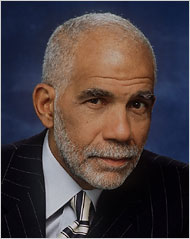
Ed Bradley of 60 Minutes fame has reposed from blood cancer at the tragically early age of 65. Although not a huge fan of CBS as a network I always thought he was one of the best journalists in the business. His stories were human and always interesting. But his style was often what stood out. Bradley had an aura around him that is hard to put in words. The best way I can describe it is to say that he had class the way a bank has money. May his memory be eternal!

Thursday, November 09, 2006

Britains new generation of... terrorists

Hundreds of young British Muslims are being radicalised, groomed and set on a path to mass murder, the head of MI5 said yesterday.

In a stark public warning, Dame Eliza ManninghamBuller, the Director-General of MI5, revealed that the Security Service’s caseload had risen by 80 per cent since January and now involved about 30 “Priority 1” plots.

It has identified 200 terrorist networks involving at least 1,600 people, many under the direct control of al-Qaeda leaders in Pakistan.

“More and more people are moving from passive sympathy towards active terrorism through being radicalised or indoctrinated by friends, families, in organised training events here and overseas,” she said. “Young teenagers are being groomed to be suicide bombers.”

From the Times of London.