Wednesday, March 09, 2011

Hieromonk Gabriel Bunge on his conversion to Orthodoxy

This is a very serious interview/article that touches on a wide range of issues including monasticism and recent activities within the Roman Catholic Church. I strongly encourage reading it carefully and in its entirety.
A Catholic hermit converted to Orthodoxy

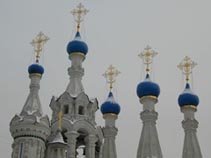
A well-known theologian, hieromonk Gabriel Bunge, rarely gives interviews. He leads a hermit's life in a small skete in Switzerland, never uses the Internet, and the only means of communication with him is the telephone. The latter works as the answering machine in a distant room. If you want to talk with him, you have to leave a message with the time when you are going to phone again, and if Father Gabriel is ready to talk, he will be near the telephone at the time you specified. We were lucky not to go through this complex operation because we met Father Gabriel in Moscow. On August 27, he converted to Orthodoxy from Catholicism.

In our conversation, Father Gabriel told us about the motives for his decision, about the main differences between Valaam and Switzerland, and about many other things.

“We Are Like Weirdos”

Q: If someone comes from one Christian tradition to another, it must mean that they feel they lack something vital in their spiritual life...

A: Yes. And if this person is seventy years old, like me, this step cannot be called a hasty one, can it?

Q: No, it can't. But what did you lack, being a monk with such a great spiritual experience?

A: I have to speak not of one decision, but of the whole life journey with its inner logic: at one point an event happens which was being prepared by one's whole life.

Like all young people, I was searching for my way in life, so to speak. I entered the University in Bonn and started studying philosophy and comparative theology. Not long before that, I had visited Greece and spent two months on the island of Lesbos. It was there that I saw a real Orthodox monastic elder for the first time. At that time, I was already inwardly being drawn to monasticism and had read some Orthodox literature, including Russian sources. That elder amazed me. He became the incarnation of the monastic that I had come across only in books before. Suddenly, in front of me, I saw a monastic life which from the very beginning seemed to be authentic, true, the closest to the first Christian monks' practice. Afterwords, I was in touch with that elder my whole life. So I got an ideal of monastic life.

When I came back to Germany, I joined the Order of Saint Benedict - it seemed to be the closest to my aspirations. The structure of the Order itself resembles one of the early Christian Church. In the Order, there is no vertical system of subordination, each community exists on its own. What guarantees the unity of these communities is the tradition and the Church Typicon. That is, not the juridical order but the spiritual ideal. By the way, in this sense I think that it is the Benedictines, of all Western believers, who are ready to understand the Orthodox believers most keenly. But still my spiritual Father and I saw very soon that with my fancy for Eastern monasticism and the love of Eastern Christianity on the whole, I was not in my proper place in this Order. So the abbot, an elderly and experienced man I still honor, decided to transfer me to a small monastery in Belgium, and not without regret. I spent 18 years there, acquired great experience, and from there, with a blessing, I went to the skete in Switzerland. All those transfers were caused by one reason: the attempt to progress to authentic monastic life, as it was with early Christians. Like the one I saw with Eastern Christians.The most recent step on this way was the conversion to Orthodoxy.

Q: Why did you decide to adopt it? One can love Orthodoxy with all one's heart and stay within the traditional Catholicism. There are many such examples in the West.

A: Yes, many people who are drawn to Orthodoxy stay within the Catholic Church. And this is normal. In the majority of Western cathedrals there are Orthodox icons. In Italy, there are professional schools of icon painting taught by Russian specialists and others. More and more believers in Europe are interested today in Byzantine hymns. Even the traditionalists of the Catholic Church have been discovering Byzantine singing. Of course they do not use them during the divine service in the church, but outside of the church, for example, at concerts. Orthodox literature gets translated into all European languages, and the books are published in the major Catholic publishing houses. In short, in the West they really have not lost the taste for all authentic, Christian, that the Eastern tradition has preserved. But, alas, it changes nothing in real life of people and society on the whole. The interest in Orthodoxy is more cultural. And those wretched people like me who have a spiritual interest in Orthodoxy, are left in the minority. We are like weirdos; we are seldom understood.

“Simply to Know Where Everything Comes From”

Q: As a theologian, you have often spoken on the problem of West and East's separation. Can we say that your conversion to Orthodoxy is the result of your meditation on this topic?

A: When I was in Greece and started turning towards Eastern Christianity, I began to perceive the schism between the East and the West very painfully. It stopped being an abstract theory or a plot in a Church history book, but rather something that was directly affecting my spiritual life. This is why the conversion to Orthodoxy started looking like a very logical step. In youth, I sincerely hoped that the union of the Western and the Eastern Christianity was possible. I was waiting for it to happen with all my heart. And I had some reasons to believe in it. At the Second Vatican Council, there were observers from the Russian Orthodox Church, including the current Metropolitan of Saint Petersburg and Ladoga Vladimir (Kotlyarov). At that time Metropolitan Nikodim (Rotov) was very active in international affairs. And many people thought that the two Churches were moving towards each other and would eventually meet at one point. It was my dream that was becoming more and more real. But as I was growing older and learning some things deeper, I stopped believing in the possibility of the reconciliation of two Churches in terms of the divine services and institutional unity. What was I to do? I could only go on searching for this unity on my own, individually, restoring it in one separate soul, mine. I could not do more. I just followed my conscience, and came to Orthodoxy.

Q: Isn't it too radical an opinion?

A: While still in Greece, being a Catholic, I realized that it was the West that separated from the East, not vice versa. At that moment, it was unthinkable for me. I needed time to understand and accept this. I cannot blame anyone, of course I can’t! We are talking about a whole big historic process, and we cannot say that this or that person is to blame for this. But facts remain facts: what we call Western Christianity today was born as a chain of ruptures with the East. These ruptures were the Gregorian reform, followed by the separation of the churches in the XI century, then the Reformation in the XV century, and finally the Second Vatican Council in the XX century. This is, surely, a very rough scheme, but I think it is correct on the whole.

Q: However, there is an opinion that the chain of these ruptures is a normal historic process because any phenomenon (and Christian Church is no exception) goes through its stages of development. What's the tragedy in that?

A: The tragedy is in the people. In a situation of radical, revolutionary events there always appear people who start to divide life into 'before' and 'after.' They want to start counting only from this new point as if everything that happened before had no meaning. When the future Protestants proclaimed the Reformation, I do not think they knew it would lead to the separation of the Western Church into two big camps. They did not realize it, they just acted. And they began to divide those around them into the healthy ones - those who accepted the Reformation - and the unhealthy, sick ones - the followers of Pope.

Moreover, history repeats itself: the same is happening now around the Second Vatican Council within the Roman Catholic Church. There are people who did not accept its decisions and people who consider it to be some kind of a starting point. And everybody reasons along those lines. A simple example: if in a conversation, someone mentions 'council' without any additional details, everybody automatically assumes that they are talking about the Second Vatican Council.

Q: What's your opinion on the modern liberal moods among Catholics?

A: I am very glad to have the opportunity to address myself to the Russian audience and say that you should not reduce all Catholics to one level. Among them are such who would like to be more secular, more liberal. It does not mean they are criminals, it's just their point of view on life. There are others, those who are fully dedicated to tradition. I would not call them traditionalists, because tradition itself is not so important to them. This is not an ancient folklore that one must nourish artificially and keep aswim. No! Tradition to them is what in every epoch ensured and still ensures live personal contact with Christ, everyday living in God's hands. As John the Theologian said, "That which we have seen and heard we declare to you, that you also may have fellowship with us; and truly our fellowship is with the Father, and with his Son Jesus Christ" (1 John 1:3). I am sure that the position "there is God and there is me" is for heretics. For Christians, it is "God, me and everyone else." Everyone else is other believers, and those who for many centuries have preserved the faith for us. If people had not listened to other people so devotedly, if they had not written it down and had not passed it on, there would have been no New Testament. It means there would have been nothing...

Q: And what, in this case, should our attitude be to those who are not very dedicated to tradition?

A: We should not beat them in the face and of course we should not chase them out of the Church. Any person deserves Christian mercy. If I, being an Orthodox, saw a Catholic in an Orthodox church, I would like to approach him and tell him openly, softly, and confidentially, "Listen, brother, you might be interested to know that in the beginning we all crossed ourselves in this way: from right to left. Now everything has changed. No, I am not calling you to reconsider all your life and rush to the Orthodox Church. I just want you to know where things came from."

Valaam

Q: And why did you choose the Russian Orthodox Church?

A: I think the key factor in such decisions is the people who surround you. When my acquaintances, Russian bishops from Saint Petersburg, learned I was adopting Orthodoxy, they said, "We are not in the least surprised! You've always been with us. But now we are going to have closer communion, a sacred one - at one Chalice." I've known Metropolitan Hilarion, the current head of the Department for external church relations of Moscow Patriarchate, for a long time. We first met in 1994 when he was a hieromonk. I consider him to be my good friend and I cherish this friendship.

Hierarch Hilarion, if you will, is one of the most competent and knowledgeable people I've ever met. He actually became for me the only person I could turn to with my request, who knew me, my beliefs and my situation. And who, as I was sure, was ready to respond. And that’s what happened.

Q: How will it help you in reaching your ideal of spiritual life?

A: You want prophecy from me, but I am no prophet. I do not know specifically what will happen next. We shall simply live. Even now I have already found in Russia many things that keep me interested.

For example, I visited Valaam. You know, in the West if a believer is drawn to a life utmost monastic seclusion, he actually has nowhere to go.

Hermitages such as they are in Russia, do not exist in the West. This form of life seems to be outdate already. As a monk I am constantly in search for the utmost seclusion, even loneliness. In Valaam, I felt all of it was there.

Q: Isn’t there enough loneliness in your skeet in Switzerland? Valaam is also a crowded place, pilgrims come there regularly.

A: Switzerland is a small and densely populated country. The skete is surrounded by a forest, but in a 15 minutes walk there is a village with approximately a hundred people living there. In Valaam it is much more quiet. Yes, of course, there are many people there. But the place itself, as I felt, is isolated from the rest of the world. Maybe it is so because it is an island, or maybe it is due to other, non-geographic reasons.

It seems to me that all this can give rise to this desirable state of seclusion in the heart of everyone who comes there.

Q: Is it more difficult in Europe?

A: To put it roughly, we can say this does not exist in the West altogether. The authentic monastic tradition in the West was practically stamped out in the course of the French bourgeois revolution in 1789. I have a firm belief that the consequences of this revolution for Europe were no less heavy than the consequences of the 1917 revolution and the 70 years of atheist power for Russia. In France after those bloody events monasticism had to be restored almost from scratch. Common priests, not monks, were to perform this. There was no one else. In Russia monasticism survived in-spite of all the shocks and horrors. Yes, it happened at the level of particular individuals, namely, elders. But they existed! And they kept the spiritual tradition and authentic monastic life. It seems to me that in everything that concerns monastic life, Russia did not have to start from scratch. This is why I am sorry to hear Russians say sometimes "we had it all destroyed, the Church was stamped out, etc." I always want to respond, "On my opinion, you have it all, new martyrs and confessors, monastic elders." And they are all near, just stretch out your arm. Only you have to stretch it out, take this wealth and use it in practice, so to speak, in your life. I often get the impression that the majority of people in Russia do not value this. Or they just do not understand that this is valuable.

Q: Why, in your opinion, does it happen so?

A: Speaking of problems, people concentrate on material, at times external difficulties that monasteries and the Church face nowadays. Yes, there is much to reconstruct. But this is only the technical part, so to speak, only the walls and the roofs. It goes without saying, people complain: roofs and walls cost money, and where can one find money... But if we mentally go above the roof - let it be with holes - we shall see that the walls is not the main thing, it's more important with what kind of heart one enters the walls. The Russian saying goes, "The church is not in the logs but in the ribs." And this is the most important thing, this spiritual tradition, that is still within Russians. Monastic elders and new martyrs preserved all of this for us. Sometimes people argue, "But there are so few elders now, most of them died already. There is no one to teach us." I always respond, "If you have no living elder to teach you, turn to the deceased one. You have his hagiography, his texts, his teachings. Read them, and correlate with your life. I don't mean to say that I have never met people in Russia who know, value, and cherish this knowledge. There are many, many people who do and my visit to Valaam proved it.

Jump into the Water

Q: What must change now in your daily life after the conversion?

A: Of course, there are things that cannot but change. Having become a member of the Russian Orthodox Church but still living in Switzerland, I submit to Archbishop Innokenty of Korsun. My relations with the Catholic Church cannot, naturally, remain the same.

Q: What reaction do you expect from your spiritual children? They must be all Catholics...

A: Firstly, I fortunately deal with good understanding people, and I am sure they will respect my decision. And secondly, I have never kept my opinions and beliefs in secret. All my spiritual children have known that my ideal of Christianity is in the East. I do not think they will be that surprised. I had not said anything to them beforehand to avoid unnecessary discussions. But I do not think anything extraordinary will happen. I believe that the tradition of spiritual talks my children used to come for will remain, I have no reason to stop it. Finally, people I communicate with regularly share my spiritual ideal more or less; otherwise, they would not be coming.

Q: What about divine services?

A: Of course, from now on I won't be able to administer communion to Catholics. But even before I used to do it very seldom: the skete is away from the big world, the territory is kept locked, the services are also private, the chapel is small - for ten people at the most. Only at Christmas and Easter we open the doors for everyone who wants to join us.

Q: If you could and wanted to give contemporaries a very short piece of advice about organizing their praying life, what would you say?

A: If you want to learn to swim, jump into the water. Only that way you can learn. Only the one who prays will feel the meaning, the taste and the joy of prayer. You can't learn to pray sitting in a big warm armchair. If you are ready to kneel, to repent sincerely, to raise your eyes and hands to Heaven, then many things will be revealed to you. Of course you can read many books, listen to lectures, talk to people - these are also important and help to understand more. But what is the value of all these things if we don't take any real steps afterwards? If we don't start praying? I think you must understand this, too. Obviously, you are asking this question from the position of one who does not believe...

Q: Exactly. Our magazine is for those who doubt.

A: There is nothing wrong with doubts, they are even useful. One should not search for them, however. But if they do appear, one must simply recall that we all have a chance to hear, "Reach your finger, and behold My hands; and reach your hand, and put it into my side: and do not be unbelieving, but believing" (John 20: 27).
Source.

Hat tip a reader who asked not to be named.

Chief Executive of NPR Resigns

NPR announced on Wednesday that the public radio network’s board had accepted the resignation of its chief executive, Vivian Schiller.

Controversy has swirled around NPR in recent months, as Republicans in Congress have sought to reduce or eliminate money for NPR from the federal budget and as conservatives have accused the network of having a liberal bias. Most recently, a political activist released a video clip showing a fundraising executive giving harsh personal views of the Tea Party movement in a meeting with people posing as prospective donors.

Ms. Schiller was quick to condemn those remarks, made by Glenn Schiller, who is no relation to her, and Mr. Schiller moved up his already planned departure from NPR to leave immediately.

But Ms. Schiller had also drawn criticism for the network’s handling of the dismissal of a political commentator, Juan Williams.

Ms. Schiller joined NPR in January 2009 after serving as a senior vice president at The New York Times Company, where she was general manager of nytimes.com.
Read the rest here.

Washington’s Options on Libya

The Obama administration is throwing out so many conflicting messages on Libya that they are blunting any potential pressure on the Libyan regime and weakening American credibility. It’s dangerous to make threats if you’re not prepared to follow through. All of the public hand-wringing has made it even worse.

President Obama was talking tough again on Monday, warning that the West is considering all options, including military intervention. Just a day before, his chief of staff, William Daley, complained that “lots of people throw around phrases like no-fly zone; they talk about it as though it’s just a video game.” A few days earlier, Defense Secretary Robert Gates said a no-fly zone could require a huge, prolonged operation, an argument challenged by some military planners.

We are not eager to see the United States involved in another conflict in the Muslim world. Sending in American troops would be a disaster. But some way must be found to support Libya’s uprising and stop Col. Muammar el-Qaddafi from slaughtering his people. On Tuesday, his forces appeared to be gaining momentum as they again turned warplanes against the opposition.

Even with overwhelming air superiority, preventing Libyan warplanes from flying would entail some risk for American and NATO pilots. And what happens if Colonel Qaddafi holds on? Will the United States and its allies continue to patrol the skies?

When the United States, Britain and France imposed an air cap over Iraq after the 1991 gulf war, they grounded airplanes and helicopters and stopped the massacres of Kurds in the north and Shiites in the south. It went on for 12 years.
Read the rest here.

See my comment on their op-ed here.

Tuesday, March 08, 2011

The Great Canon of St. Andrew of Crete (in Slavonic)


March 7th in the Cathedral of Christ the Savior Moscow

Anglicans to consider opening communion to unbaptized

Canadian Anglicans will hold discussions this spring about whether baptism is necessary for taking part in communion — questioning a requirement of Christianity that has existed for 2,000 years.

“Official teaching is you have to be baptized first. But a number of clergy across the country feel strongly about this as an issue and many have approached their bishops about allowing for an ‘open table’ in which all could take communion,” said Archdeacon Paul Feheley, who is the principal secretary to Archbishop Fred Hiltz, head of the Anglican Church of Canada.

It will be discussed when the House of Bishops meet in April, but not as an official topic, he said.

The idea — already rejected as a dangerous step by more orthodox Anglicans — was raised in an article this week in the AnglicanJournal.com in which an Ontario church pastor argues that removing the requirement of baptism would help stop the decline in the number of Anglicans attending services.
Read the rest here.

Niall Ferguson on US Debt

See the interview here.

So what's the big deal?

OK. I watch such a minimal amount of television that I am way out of the loop on most of the current cultural issues. But last night I was stuck in the same room with some people who were watching "Two and a Half Men," Charlie Sheen's former series. For those even more out of the loop than me he was sacked by CBS yesterday after several weeks of bad mouthing CBS and the show's creator. Some of his rants frankly have caused me to question if he might not be several fries short of a Happy Meal. But I digress.

The show I saw last night was disgusting. There is no other word for it. It was the kind of thing than in a more civilized society would either not be shown at all or would only be shown late at night. The humor, if you could call it that, was so low brow and guttural it would make a sailor blush (I speak from experience on both points).

Bottom line: Good riddance.

Debit Card Fees Prompt a Push Near Deadline

WASHINGTON — It seemed a good idea last year, when the financial crisis had turned banks into Public Enemy No. 1 and lawmakers were looking for ways to reward consumers still bitter about billion-dollar bailouts and executive bonuses.

Without much warning or debate, the Senate passed an amendment directing the Federal Reserve to reduce the hidden “swipe fees” that banks collect from retailers each time a customer makes a purchase with a debit card.

Merchants, who had complained that the $20.5 billion in annual fees were biting into their profits, were elated. Banks were stunned. Their lobbyists tried to reverse the move, but when the overhaul of the nation’s financial regulation was passed by Congress last July, the debit card cut survived.

Now, as the Fed faces a deadline in April to write the rules for the lower fees, banks and debit card companies are engaged in an all-out assault on Capitol Hill, enlisting a growing cadre of lawmakers and lobbyists to push for changes, delay or outright repeal. Banks contend the proposed cut in fees — to 12 cents per transaction from an average of 44 cents — will leave many of them unable to afford to issue debit cards to customers or will force them to raise other consumer banking charges to cover the costs. They also claim retailers will reap unfair profits.

A coalition of banks and card companies have plastered subway cars and Internet sites with ads warning, “Bureaucrats want to take away your debit card!”
Read the rest here

Never forget; banks are the enemy!

Monday, March 07, 2011

Senators Call for Bipartisan Decisions on Budget

RICHMOND, Va. — As the White House and Congressional Republicans fight in Washington over cutting a small slice of the federal budget, two United States senators held an unusual bipartisan forum here on Monday to argue that the only way to get projected deficits under control is to slow the growth of entitlement benefit programs and to raise revenue.

Mark Warner, Democrat of Virginia, and Saxby Chambliss, Republican of Georgia, the leaders of a deficit-reduction effort in the Senate, said they were trying to start a national conversation.

Polls show that the public likes the idea of addressing the nation’s long-term debt problems in a general sense, but opposes many specific proposals to rein in the costs of Medicare, Medicaid and Social Security.

The two senators told an overflow crowd of more than 200 local business leaders here on Monday that businesses would have to put “skin in the game” as all Americans sacrifice to assure the nation’s long-term solvency.

Each senator also said that both parties would have to give ground.
Read the rest here.

Russia Cashes In on Anxiety Over Supply of Middle East Oil

MOSCOW — Whatever the eventual outcome of the Arab world’s social upheaval, there is a clear economic winner so far: Vladimir V. Putin.

Russia, which pumps more oil than Saudi Arabia, is reaping a windfall from the steep rise in global energy prices resulting from instability in oil regions of the Middle East and North Africa. Riding the high oil prices, the Russian ruble has risen faster against the dollar this year than any other currency, which is helpful because it will curb consumer inflation during an election year.

Russian stocks are buoyant, too: the Micex index closed last week at 1,781, up nearly 6 percent since the beginning of the year. (Monday was a holiday in Russia.)

But the Russians could not step in to offset any potential big drop in global production, because Russia does not have any oil wells standing idle that would allow it to increase production. Right now Russia is pumping oil at its top capacity.

But at last week’s closing of $114, the price of each of those barrels of Ural crude, the country’s main export blend, has risen 24 percent since the beginning of the year.

Last week, the prime minister, Mr. Putin, sat down for a televised meeting with Russia’s finance minister, Aleksei L. Kudrin, which was nationally televised on state news channels for the public’s enlightenment as the two discussed, just short of gloating, the benefits to Russia of a global oil panic.

“Mr. Kudrin, budget revenues have become considerable,” Mr. Putin said matter-of-factly.
Read the rest here.

When it's OK not to tip your cab driver

Early Sunday morning, four men hailed a cab in Manhattan and asked to go to the Bronx. The cabdriver refused, and then ran two of them over with his taxi, sending them to the hospital, according to the New York City Police Department.

Just before 4 a.m., the four men got into the cab in Midtown Manhattan, the police said.

“I told the taxi driver, to the Bronx; he lets us in, and then we go in and he says I’m only taking you two blocks,” Frank Lembo, one of the four passengers, told Eyewitness News.

The cabdriver, Mohammed Azam, 27, suggested they drive to a nearby police precinct station, Precinct 18 Midtown North on West 54th Street, to ask if he did, in fact, have to take the men to the Bronx. The police said they told him that he did, but when the men went back outside, police officials said, the driver hit two of them with his cab at the corner of West 54th Street and Eighth Avenue.

One man, Anthony Loreto, was in critical condition early Monday morning, according to Eyewitness News. The other man was listed in stable condition.

Mr. Azam was arrested and charged with one count of vehicular assault and three counts of leaving the scene of an accident, according to the Police Department.

Another passenger, Joe Hladki, told Eyewitness News that he could not understand why it happened.

“There’s no money,” he said, “nothing.”

The New York City Taxi and Limousine Commission did not immediately return a call seeking comment Sunday night.
Source

The Fading Power of Beck’s Alarms

Almost every time I flipped on television last week, there was a deeply angry guy on a running tirade about the conspiracies afoot, the enemies around all corners, and how he alone seemed to understand what was under way.

While it’s true that Charlie Sheen sucked up a lot of airtime last week, I’d been watching Glenn Beck, the Fox News host who invoked Hezbollah, socialists, the price of gas, Shariah law, George Soros, Planned Parenthood, and, yes, Charlie Sheen, as he predicted a coming apocalypse.

Mr. Beck, a conservative Jeremiah and talk-radio phenomenon, burst into television prominence in 2009 by taking the forsaken 5 p.m. slot on Fox News and turning it into a juggernaut. A conjurer of conspiracies who spotted sedition everywhere he looked, Mr. Beck struck a big chord and ended up on the cover of Time magazine and The New York Times Magazine, and held rallies all over the country that were mobbed with acolytes. He achieved unheard-of ratings, swamped the competition and at times seemed to threaten the dominion of Bill O’Reilly and Sean Hannity at Fox.

But a funny thing happened on the way from the revolution. Since last August, when he summoned more than 100,000 followers to the Washington mall for the “Restoring Honor” rally, Mr. Beck has lost over a third of his audience on Fox — a greater percentage drop than other hosts at Fox. True, he fell from the great heights of the health care debate in January 2010, but there has been worrisome erosion — more than one million viewers — especially in the younger demographic.
Read the rest here.

Glenn Beck is a demagogue. Just another and more caustic version of Limbaugh.

Mexican Church Takes a Closer Look at Donors

PACHUCA, Mexico — The large orange chapel here, with its towering cross, would be just another Roman Catholic church if not for a bronze plaque announcing that it was “donated by Heriberto Lazcano Lazcano” — better known as “the executioner,” commander of the ruthless crime syndicate called the Zetas.

The nameplate goes on to quote Psalm 143: “Lord, hear my prayer, answer my plea.” But Mexican Catholics are the ones struggling with how to respond.

Ever since the chapel’s financing spawned a government investigation four months ago, the Roman Catholic Church in Mexico has been trying to confront its historic ties to drug traffickers. Long dependent on gifts, but often less than discriminating about where they come from, the church is grappling with its role as thousands die in turf wars among rich, and sometimes generous, criminals.

“The chapel put the entire church in Mexico on alert,” said the Rev. Hugo Valdemar, a spokesman for the country’s largest archdiocese, in Mexico City. “As a result, our public posture has changed, and become much tougher.”

The church has indeed gone further than before, with public pledges to reject “narcolimosnas,” or “narco alms,” and priests linked to traffickers. A handful of outspoken bishops have also stepped up condemnations of both the cartels and the government’s militaristic efforts to stop them.
Read the rest here.

Wisconsin Democrats show signs of capitulation

CHICAGO – Talks appear to have broken down between Wisconsin’s Democratic state senators and representatives of Gov. Scott Walker, whose plan to cut collective bargaining rights and benefits for public workers has created a major battle in the state, some of the Senate Democrats said on Sunday.

Senator Fred Risser, one of 14 Democrats who left Wisconsin last month to prevent the Republican-dominated Senate from approving the collective bargaining measure, said it now seemed conceivable that he and his fellow Democrats would return to Wisconsin, at some point in the future, without a negotiated compromise.

“We have always said we would go back eventually,” Mr. Risser said, adding that the Democrats had yet to make any decision about when to go back to Madison, a move that would open the way for a vote on the proposal by Mr. Walker, a Republican elected in November. “We will have accomplished some of our purpose – to slow things up and let people know what was in this bill.”

The Democrats left the state on Feb. 17, the day that a vote was expected on Mr. Walker’s measure in the state Senate. While Republicans control the chamber, they need 20 senators – and, thus, at least one Democrat – to take votes on fiscal matters.
Read the rest here.

The Fast Begins

For those who are new to fasting here are a few tips I have gleaned from sources I trust.

1. If you are new don't try to dive in all at once. Speak with your priest/spiritual father and get his advice.

2. With the exception noted above avoid discussing your fast or other people's. Fasting is (or at least should be) a private matter. Nothing good will come from such talk or gossip. If you find you are keeping the fast more strictly than someone else you may be tempted to the sin of pride. And worse you may cause hurt feelings or discouragement among those who are not able for whatever reason to keep it as strictly. The reverse is also true.

3. Exercise common sense. Health trumps the fasting rules. Don't overdo it. If you need to eat something, then eat. If your health precludes you from abstaining completely from somethings (dairy is tough for some people to abandon for 8 weeks without negative health issues) then do what you need to do. Again talk to your priest.

4. Don't give up. Most people will fail at times. When you fall, pick yourself up and get back on the horse.

Sunday, March 06, 2011

On Fasting by St. Paisy of Neamt

The third virtue is fasting. Fasting I call the eating of a little bit once a day. Getting up from the table when one is still hungry, having his food, bread, and salt, and his drink-water, which the springs themselves bring forth. Behold the royal way of receiving food; that is, many have been saved by this path, so the Holy Fathers have said. To refrain from food for a day, or two days, three, four, five, or a week, a man cannot do always. But, so as every day to eat bread and drink, one can always do this; only, having eaten, one should be a little hungry, so that the body will be submissive to the spirit and capable of labors and sensitive to mental movements, and so the bodily passions will be conquered. Complete fasting cannot mortify the bodily passions as well as poor food mortifies them. Some fast for a time and then give themselves over to delicious foods, for many begin fasting beyond their strength and also other severe labors, and then they grow weak from the lack of measure and unevenness of this labor, and they seek tasty foods and repose for the strengthening of the body. To act in this way means to build and then again destroy, since the body through thinness from fasting is yearning for sweet things and seeks consolation, and the sweet foods ignite the passions. But if someone establishes for himself a definite measure as to how much poor food to eat in a day, he will receive great profit. However, concerning the quantity of food, one must establish a rule that it be as much as is necessary for the strengthening of oneself. Such a one can perform every kind of spiritual work. But if someone fasts beyond this, at another time he will give himself up to repose. Ascetic labor according to measure is priceless. For certain of the Great Fathers also took food in measure, and in everything they used it in its right time, and everything had measure—in ascetic labors, in bodily needs, in cell possessions, and in everything they used it in its right time, and everything according to a definite, moderate rule. Therefore, the Holy Fathers do not command one to begin to fast above one's power and to make oneself weak. Take as your rule to eat every day; thus one may refrain in a more firm way; but if one fasts more than this, how will he refrain later from eating to the full and overeating? In no way will he be able to. Such an immoderate beginning comes either from vainglory or lack of understanding, while continence is one of the virtues which aids in the subjugating of the flesh. Hunger and thirst are given to man for the purification of the body, for the preservation from unclean thoughts and lustful passions. Every day to eat poorly is a means to perfection, as certain ones have said, and one who eats every day at a definite hour in no way is lowered morally nor undergoes any harm of soul. Saint Theodore the Studite praises such ones in his instruction on the Friday of the first week of the Great Fast, where he cites in confirmation of his words the Holy God-bearing Fathers and the Lord Himself. Thus we also should act.

The Lord endured a lengthy fast, as did Moses and Elias, but only once. And certain other ones sometimes when entreating something from the Creator, laid upon themselves a certain time of fasting, but in accordance with natural laws and the teaching of the Divine Scripture. From the activity of the Saints, from the Life of our Savior, and from the rules of those who have lived in good order, it is evident that it is splendid and profitable always to be ready and to be found in ascetic labor, in work, and in endurance; however, not to weaken oneself by immoderate fasting and not to bring the body into a state of inactivity. If the flesh is inflamed because of youth, one must refrain a great deal; but if it is infirm, one must take much or little. Look and judge according to your own infirmity as to how much you can do. To each one there is a measure, and the inward teacher is one's conscience; not everyone can have the same rule and same ascetic labor, because some are strong and others are weak. Some are like iron, others are like copper, while others are like wax. And thus correctly discovering one's own measure, take food once each day, apart from Saturdays, Sundays, and Great Feasts of the Lord. A moderate and sensible fast is the foundation and chief of all virtues. One should fight evil as one fights a lion and a fierce serpent—in the infirmity of the body and spiritual poverty. He who wishes his mind to be firm against defiled thoughts should make his body refined through fasting.

It is not possible, without fasting, to serve as a Priest. As it is indispensible to breathe, so also is it to fast. Fasting once having entered into the soul, kills to the depths the sin which lies therein.
Source.

The Rule of Fasting in the Orthodox Church

In answer to numerous requests from readers, the rule of fasting is given for each day of the year. Where no indication of fast is given, and during "fast-free weeks," all foods may be eaten (except during Cheese-fare Week, when meat alone is forbidden every day). Where "fast day" is indicated alone, the fast is a strict one, with no meat, eggs, dairy products, fish, wine or oil to be eaten. Where, underneath "fast day," is indicated "wine and oil allowed," the fast is relaxed for the sake of a feast day or vigil, to allow eating of these foods. Where "fish, wine and oil allowed" is indicated, then all three of these foods may be eaten.

The rule of fasting, which is dependent on the Church's cycle of feasts and fasts, is contained in the Church's Typicon, chiefly in chapters 32 and 33, and is repeated in the appropriate places of the Divine service books, the Menaia and Triodion. In general, fast days for Orthodox Christians are all Wednesdays and Fridays throughout the year (except for fast-free periods), the four canonical fast periods of Great Lent, Nativity Fast, Apostles' Fast, and Dormition Fast, and a few special days: the Exaltation of the Cross (September 14th) and the Beheading of the Forerunner (August 29th)—which, even though they are feast days, are also fast days (with wine and oil allowed) for the sake of the events commemorated thereon.

There are some local variations in the allowances of wine and oil, and sometimes of fish, and so the indications in the present Calendar cannot be uniformly applied everywhere. In particular, on the celebrations of the patronal feast of a parish or monastery, fish is generally allowed, and when a saint is honored with a service of Sung Doxology or Polyeleos rank, wine and oil are allowed. In the Russian Church, on the feast days of the more renowned Russian saints, such as St. Sergius of Radonezh and St. Seraphim of Sarov, and of wonderworking Icons of the Mother of God such as the Kazan and Vladimir Icons, of course, wine and oil are allowed (except during Great Lent), although this is not mentioned in the present Calendar because the Typicon leaves this to local practice, indicating only the fasts and allowances that are of general application. The meaning of the Typicon in its allowances is simple: the more one labors for the glorification of a saint or feast day, the more consolation one is allowed in food. For one who has become accustomed to the Orthodox fast, the allowance of oil on food, or fried foods, together with a little wine, is indeed a consolation, as well as a source of physical strength. Where the Typicon itself indicates two variant practices (as for a few of the weekdays of Great Lent), the present Calendar follows the Typicon's preferred practice.

While most Orthodox Christians are perhaps aware of the general rule of fasting for Great Lent and the Dormition Fast (wine and oil allowed only on Saturdays and Sundays, except for a few feast days and vigils), many are probably not familiar with the precise rule governing the less severe fast of the Nativity and Apostles' Fast. Therefore, we shall quote this rule, from Chapter 33 of the Typicon:

"It should be noted that in the Fast of the Holy Apostles and of the Nativity of Christ, on Tuesday and Thursday we do not eat fish, but only oil and wine. On Monday, Wednesday, and Friday we eat neither oil nor wine... On Saturday and Sunday we eat fish. If there occurs on Tuesday or Thursday a saint who has a Doxology, we eat fish; if on Monday, the same; but if on Wednesday or Friday, we allow only oil and wine. If it be a saint who has a Vigil on Wednesday or Friday, or the saint whose temple it is, we allow oil and wine and fish... But from the 20th of December until the 25th, even if it be Saturday or Sunday, we do not allow fish."

In these two fasts, the fast for laymen is the same as that of many Orthodox monasteries, where Monday throughout the year is kept as a fast day in honor of the fleshless ones, the Angels.

This rule of fasting, to be sure, is not intended to be a "straight-jacket" for Orthodox believers, nor a source of pharisaical pride for anyone who keeps the letter of the Church's law. It is rather the rule, the standard, against which each is to measure his own practice, and towards which one must always strive, according to one's strength and circumstances. Whenever, for sickness or any other reason, one falls short of the rule, he applies to himself the spiritual medicine of self-reproach and strives to enter more fully into the spirit and discipline of fasting, which is indeed of great spiritual benefit to those who sincerely strive to follow it.

Hieromonk Seraphim Rose
Source.

THE MEANING OF THE GREAT FAST: The True Nature of Fasting

-Mother Mary and Bishop Kallistos Ware

THE TRUE NATURE OF FASTING
'We waited, and at last our expectations were fulfilled', writes the Serbian Bishop Nikolai of Ochrid, describing the Easter service at Jerusalem. 'When the Patriarch sang "Christ is risen", a heavy burden fell from our souls. We felt as if we also had been raised from the dead. All at once, from all around, the same cry resounded like the noise of many waters. "Christ is risen" sang the Greeks, the Russians, the Arabs, the Serbs, the Copts, the Armenians, the Ethiopians one after another, each in his own tongue, in his own melody. . . . Coming out from the service at dawn, we began to regard everything in the light of the glory of Christ's Resurrection, and all appeared different from what it had yesterday; everything seemed better, more expressive, more glorious. Only in the light of the Resurrection does life receive meaning.' 1

This sense of resurrection joy, so vividly described by Bishop Nikolai, forms the foundation of all the worship of the Orthodox Church; it is the one and only basis for our Christian life and hope. Yet, in order for us to experience the full power of this Paschal rejoicing, each of us needs to pass through a time of preparation. 'We waited,' says Bishop Nikolai, 'and at last our expectations were fulfilled.' Without this waiting, without this expectant preparation, the deeper meaning of the Easter celebration will be lost.

So it is that before the festival of Easter there has developed a long preparatory season of repentance and fasting, extending in present Orthodox usage over ten weeks. First come twenty-two days (four successive Sundays) of preliminary observance; then the six weeks or forty days of the Great Fast of Lent; and finally Holy Week, Balancing the seven weeks of Lent and Holy Week, there follows after Easter a corresponding season of fifty days of thanksgiving, concluding with Pentecost.
Read the rest here.

On the Eve of the Great Fast

I humbly beg forgiveness from anyone whom I have offended by any word, action or inaction, and most especially through anything I have posted on this blog. Please forgive me.

Saturday, March 05, 2011

You do what?

Being in Florida where I am helping mom with my step-father who is in the advanced stages of dementia is going to require some adjustments this Lent. So I was explaining to her the nuts and bolts of Orthodox Lent... and I could tell from her facial expression that she was wondering just how many people in the family were losing it. Hopefully she has not booked reservations for me in a nice padded room with a complimentary "I love me" suit.

As health costs soar, GOP and insurers differ on cause

MANCHESTER, N.H. — Workers at a circuit-board factory here just saw their health insurance premiums rise 20 percent. At Buddy Zaremba’s print shop nearby, the increase was 37 percent. And for engineers at the Woodland Design Group, they rose 43 percent.

The new federal health care law may eventually “bend the cost curve” downward, as proponents argue. But for now, at many workplaces here, the rising cost of health care is prompting insurance premiums to skyrocket while coverage is shrinking.

As Congress continues to debate the new health care law, health insurance costs are still rising, particularly for small businesses. Republicans are seizing on the trend as evidence that the new law includes expensive features that are driving up premiums. But the insurance industry says premiums are rising primarily because of the underlying cost of care and a growing demand for it.

Across the country, premiums have more than doubled in the last decade, with smaller companies particularly hard hit in recent years, federal officials say.
Read the rest here.

Friday, March 04, 2011

Some Good News: Yes, the economy is (slowly) getting better

Lest I be accused of being a perma-bear, I take note of some undeniably good news. There are growing signs that hiring is picking up. The official (as opposed to real) unemployment figures dropped below 9% today. Also there is strong evidence that economic growth is picking up steam. However rising inflation and the threat of a potentially severe oil shock coupled with a staggering level of debt could derail it all. We shall see. I am shifting into the cautiously optimistic column. But I would definitely hedge any bets on a sustained recovery. The real test will come when we see if/how Congress deals with the debt and if/when the FED decides to stop printing money like it's going out of style (which it might be).

Loughner Faces 49 Counts in Tucson Shootings

PHOENIX – Prosecutors filed 49 federal charges Friday against Jared L. Loughner, the suspect in the Tucson shooting spree, accusing him of murdering and attempting to murder five federal officials but also of killing four constituents of Representative Gabrielle Giffords who were attending a public event she sponsored, and injuring 10 others waiting in line to talk to her.

“You have a right to meet with your member of Congress openly and freely and peacefully,” said U.S. Attorney Dennis K. Burke, indicating he was confident that the novel legal theory the prosecutors were using – including charges involving victims who were not federal officials but merely attending a “federally provided activity” – would be upheld in court. Outside legal experts, however, said the charges would give an opening for Mr. Loughner’s defense team, led by Judy Clarke, to challenge their validity.

The raft of new charges, some of which could carry the death penalty, go far beyond the previous indictment against Mr. Loughner, a troubled 22-year-old man who is accused of opening fire outside a Tucson-area supermarket on Jan. 8 with a Glock semiautomatic pistol in an effort to kill Ms. Giffords.
Read the rest here.

150 Years Ago: Abraham Lincoln is sworn is as President

“Everybody longing for the Inaugural,” George Templeton Strong confided to his diary. It had been four long months since Lincoln was elected, nearly a year since he was nominated. Today, at last, was March 4, the perfect day in the calendar for parades and pageantry (march forth!). And also, more darkly, for the armies already assembling. Lincoln rose at 5 a.m., restless. How long had he been getting ready for this day?

Beyond the pageantry, there would also be substance, in the form of his Inaugural Address, the most highly anticipated speech in American history. There are more beautiful speeches in the Lincoln canon (Second Inaugural, Gettysburg), and more impressive displays of research (Cooper Union). But no Lincoln speech was ever delivered with more preparation, under more scrutiny, for higher stakes than this one.

There was no room for misstep. Every syllable had to be just right, not only to keep the border states in the Union, but also to assure his core audience in the North that he was not another doughface, like his predecessor. He had been writing the speech for months, in his peculiar way, putting thoughts down on scraps of paper, which he then glued to an early printed master copy — a crude version of cut and paste.

After his arrival in Washington, he turned to William Seward, the man he had defeated for the nomination, for help with the final edits. Seward responded with 49 editorial suggestions; Lincoln accepted 27. The most valuable was a request that he conclude the speech with a plea for moderation. So a remarkable final paragraph was born, completely unlike the rest of the speech, written out by hand.

At noon, Lincoln was escorted by President Buchanan in an open barouche to the unfinished Capitol, where they found a throng of 30,000 gathered. The moment had arrived. Lincoln quietly reached into his pocket and put on his steel-rimmed spectacles, at which point a wag in the audience yelled, “Look at old goggles!” and was promptly arrested.
Read the rest here.

Queen Elizabeth II to make first state visit to Ireland

LONDON — Queen Elizabeth II will make her first-ever visit to the Republic of Ireland — the first ruling British monarch to go there in a century marked by Ireland's brutal war of independence from Britain and the grueling conflict in Northern Ireland.

The long-anticipated visit by the 84-year-old queen will highlight Ireland's reconciliation with its former colonial master and the slow blooming of peace in neighboring Northern Ireland.

Buckingham Palace and the Irish government confirmed the queen would visit this year, accompanied by her husband, the Duke of Edinburgh. British and Irish officials, speaking on condition of anonymity because they were not authorized to speak on the record, said they were planning a three-day visit in May.

Most Irish politicians cheered the news, but the IRA-linked Sinn Fein party warned it was premature.

King George V spent six days in Dublin in 1911, when Britain and Ireland were united under a single crown. Ireland won its independence in 1922 following a two-year guerrilla war, but relations between Ireland and Britain remained poisoned by the disputed fate of Northern Ireland, still part of the United Kingdom.
Read the rest here.

Thursday, March 03, 2011

150 Years Ago: Czar Alexander II signs the other Emancipation Proclamation

H.I.M. Alexander II Czar Emperor and Autocrat of All the Russias
The Emancipation Reform of 1861 in Russia (Russian: Крестьянская реформа 1861 года, lit. "The Peasant Reform of 1861") was the first and most important of liberal reforms effected during the reign of Alexander II of Russia. The reform, together with a related reform in 1861, amounted to the liquidation of serf dependence previously suffered by Russian peasants.

The 1861 Emancipation Manifesto proclaimed the emancipation of the serfs on private estates and of the domestic (household) serfs. By this edict more than twenty-three million people received their liberty.[1] Serfs were granted the full rights of free citizens, gaining the rights to marry without having to gain consent, to own property and to own a business. The Manifesto prescribed that peasants would be able to buy the land from the landlords. Household serfs were the worst affected as they gained only their freedom and no land.

In Georgia the emancipation was postponed till 1864 and on much better terms for the nobles than in Russia. State owned serfs - the serfs on the imperial properties - were emancipated in 1866[1] and were given better and larger plots of land.
Read the rest here.

Stephen King's next novel is about JFK assassination

Stephen King's next novel will look at the assassination of President Kennedy.

The 1000-page book, which will come out in November, will be called 11/22/63 - the title named for the day of Kennedy's murder in Dallas, Texas.

King, who has been sdescribed by Lee Child as "America's greatest living novelist", has written a fictional account of a high school teacher's desperate effort to prevent the tragedy. The book will be published on 8 November 2011 and UK rights have been bought by Hodder.

The book will focus on Jake Epping, a 35-year-old high school English teacher in Lisbon Falls, Maine. His friend Al reveals that his storeroom is a portal to 1958, and enlists Jake on a mission to try to prevent the Kennedy assassination. Jake becomes George Amberson, and enters a world of Elvis and JFK, of a troubled loner named Lee Harvey Oswald and high school librarian Sadie Dunhill, who becomes the love of Jake's life, "a life that transgresses all the normal rules of time".
Read the rest here.

Libya seizes NATO troops

Three Dutch marines were being held by authorities in Libya after they were captured by forces loyal to Moammar Gadhafi while trying to rescue stranded workers, officials said Thursday.

The trio were surrounded by armed men and captured Sunday after landing near Sirte in a Lynx helicopter that was on board the navy ship HMS Tromp, which is anchored off the Libyan coast to help evacuations from the conflict-torn country, Dutch Defense Ministry spokesman Otte Beeksma told The Associated Press.

News of the marines' detention by Gadhafi came a day after the Libyan Human Rights League estimated the death toll in the conflict stood at 6,000, the Egyptian newspaper Al-Masry Al-Youm reported.

On Wednesday, anti-government rebels fought off forces loyal to Gadhafi — who were supported by airstrikes — in a fierce battle for Brega, a strategic oil facility 460 miles east of Gadhafi's stronghold in Tripoli.

On Thursday, witnesses told Reuters that a warplane had again bombed Brega while about 50 miles to the east rebels shored up the defenses of the town of Ajdabiya with rocket launchers, anti-tank aircraft guns and tanks.
Read the rest here.

Roman Catholic bishops veto married Eastern Rite priests in Italy

Italian news sources are reporting that the Italian Episcopal Conference (CEI) has vetoed the idea of allowing married priests of the Romanian Catholic Church (one of the Eastern Catholic Churches in union with the pope of Rome) to exercise their priestly ministry in Italy.

In an article entitled “Priests of a Lesser God: CEI — New Veto to the Presence of Married Catholic Clergy in Italy,” Italian news service Adista reported obtaining a copy of a confidential letter written last September 13 by Cardinal Angelo Bagnasco, president of the Italian Episcopal Conference to Lucian Muresan, Major Archbishop of the Romanian Catholic Church. In it, Cardinal Bugnasco explained the position of the Italian Episcopal Conference regarding not allowing the presence of married Romanian Catholic priests in Italy. (The Romanian Catholic Church follows the Byzantine liturgical rite and retains many customs — such as a married priesthood — similar to Eastern Orthodoxy, from which it broke away in 1698 when it entered union with Rome. It is estimated there are 800,000 Romanian Catholics in Italy.) Cardinal Bagnasco, appointed by Pope Benedict XVI in 2007 to be President of the CEI, said that the Bishops’ Conference

“after having carefully examined the issue in light of the figures relating to the consistency of the ethnic communities from Eastern European countries and the situation of clergy in the Italian dioceses, believes that, at present and in general, there is not ‘just and reasonable cause’ to justify the granting of the dispensation.”
Read the rest here.

HT: Dave Brown

Wednesday, March 02, 2011

Ron Paul rips Ben Bernanke and the FED

NY Times: A Conspiracy With a Silver Lining (illegal price manpulation)

As Americans know all too well by this point, commodity prices — for corn, wheat, soybeans, crude oil, gold and even farmland — have been going through the roof for what seems like forever. There are many causes, primarily supply and demand pressures driven by fears about the unrest in the Middle East, the rise of consumerism in China and India, and the Fed’s $600 billion campaign to increase the money supply.

Nonetheless, how to explain the price of silver? In the past six months, the value of the precious metal has increased nearly 80 percent, to more than $34 an ounce from around $19 an ounce. In the last month alone, its price has increased nearly 23 percent. This kind of price action in the silver market is reminiscent of the fortune-busting, roller-coaster ride enjoyed by the Hunt Brothers, Nelson Bunker and William Herbert, back in 1970s and early 1980s when they tried unsuccessfully to corner the market. When the Hunts started buying silver in 1973, the price of the metal was $1.95 an ounce. By early 1980, the brothers had driven the price up to $54 an ounce before the Federal Reserve intervened, changed the rules on speculative silver investments and the price plunged. The brothers later declared bankruptcy.

The Hunts may be gone from the market, but there are still plenty of people suspicious about the trading in silver, and now they have the Web to explore and to expand their conspiracy narratives. This time around — according to bloggers and commenters on sites with names like Silverseek, 321Gold and Seeking Alpha — silver shot up in price after a whistleblower exposed an alleged conspiracy to keep the price artificially low despite the inflationary pressure of the Fed’s cheap money policy. (Some even suspect that the Fed itself was behind the effort to keep silver prices low, as a way to keep the dollar’s value artificially high.) Trying to unravel the mysterious rise in silver’s price is a conspiracy theorist’s dream, replete with powerful bankers, informants, suspicious car accidents and a now a squeeze on short sellers. Most intriguingly, however, much of the speculation seems highly plausible.
Read the rest here.

Yet again I observe that banks are the enemy.

At BYU Honor Code is Taken Seriously

When the sophomore center Brandon Davies was dismissed from Brigham Young’s third-ranked basketball team on Tuesday for violating the university’s honor code, it dealt a hard blow to the championship aspirations of the Cougars. But it also highlighted one of the big differences between B.Y.U. and other universities involved in major college sports.

Many colleges have honor codes, but they typically focus on protecting academic integrity and discouraging behavior that harms others. The United States Military Academy’s Cadet Honor Code states that “a cadet will not lie, cheat, steal, or tolerate those who do.” Many universities follow that example.

At B.Y.U., owned and operated privately by the Church of Jesus Christ of Latter-day Saints, the honor code is separate from the academic honesty policy, and is more closely linked to the personal-behavior tenets of the Mormon church.

There are precise guidelines regarding grooming, clothing, chastity and language. There are restrictions against the use of tobacco, alcohol, tea and coffee. There are precise visitation rules for resident halls and off-campus housing. (“The use of the bathroom areas by members of the opposite sex is not appropriate unless emergency or civility dictates otherwise, and then only if the safety, privacy, and sensitivity of other residents are not jeopardized,” reads the off-campus housing policy.) Gambling and “involvement with pornographic, erotic, indecent, or offensive material” are forbidden. So is “homosexual behavior.”

The B.Y.U. Honor Code “aligns with the core principles and mission of the university, and certainly the sponsoring church,” Carri Jenkins, a university spokeswoman, said. It applies to all of the roughly 34,000 students, whether they are Mormon or not. More than 98 percent of them are.

In college sports, B.Y.U. has always played by some different rules. It declines to play games on Sundays, which forces schedulers of the coming N.C.A.A. basketball tournament, for example, to place the Cougars in specific brackets. Most B.Y.U. students are Mormon and interrupt their studies and athletic careers with two-year missions, which detractors say can give them an edge in maturity and size.
Read the rest here.

Postal Service on path to be broke by October

WASHINGTON — The Republican-controlled House opened the envelope of postal finances on Wednesday and what it pulled out wasn't pretty.

Unless things change, the post office will run out of money by the end of the fiscal year in October, Postmaster General Patrick R. Donahoe told the House Oversight subcommittee on the postal service.

Donahoe said that as of Sept. 30 his agency will owe the federal government a payment of $5.5 billion to fund medical costs, in advance, for future retirees, and in November it will need to make a $1.3 billion payment for worker's compensation.

"The Postal Service will not have the cash available to make both of these payments. We need legislation this year to address that fact," he said.

If it does come down to crunch time, said Donahoe: "We will deliver the mail." Employees will be paid, as will suppliers, he said. "The thing we will not do is pay the federal government."

Without some important changes to the law the post office "cannot survive as a self-financing entity," Donahoe said.

While the post office has been battered by the recession and the movement of mail to the Internet, it has also cut costs sharply by reducing its workforce by 240,000 people in recent years. Last year it cut costs by $3 billion and expects to reduce spending by another $2 billion this year, Donahoe said.

But, alone among federal agencies, the post office is required to pay about $5.5 billion annually into an account to fund future retiree medical benefits.
Read the rest here.

Manning faces new charges, possible death penalty

WASHINGTON — Following an intensive seven-month investigation, the Army on Wednesday filed 22 additional charges against Pfc. Bradley Manning, accused of illegally downloading tens of thousands of classified U.S. military and State Department documents that were then publicly released by WikiLeaks, military officials tell NBC News.

The most serious of the new charges is "aiding the enemy," a capital offense which carries a potential death sentence.

Pentagon and military officials say some of the classified information released by WikiLeaks contained the names of informants and others who had cooperated with U.S. military forces in Afghanistan, endangering their lives.

According to the officials, the U.S. military rounded up many of those named and brought them into their bases for protection. But, according to one military official, "We didn't get them all." Military officials tell NBC News a small number of them still have not been found.

Manning's lawyer, David Coombs, did not immediately return a call from msnbc.com for comment.

But Coombs wrote on his blog Wednesday that it was uncertain whether any additional charges filed against his client would stick.
Read the rest here.

Justices Rule for Protesters at Military Funerals

WASHINGTON — The First Amendment protects hateful protests at military funerals, the Supreme Court ruled on Wednesday in an 8-to-1 decision.

“Speech is powerful,” Chief Justice John G. Roberts Jr. wrote for the majority. “It can stir people to action, move them to tears of both joy and sorrow, and — as it did here — inflict great pain.”

But under the First Amendment, he went on, “we cannot react to that pain by punishing the speaker.” Instead, the national commitment to free speech, he said, requires protection of “even hurtful speech on public issues to ensure that we do not stifle public debate.”

The decision was the latest in a series of muscular First Amendment rulings from the Roberts court. Last year, the court struck down laws limiting speech about politics and making it a crime to distribute depictions of cruelty to animals. In the current term’s other major First Amendment case, the court seems likely, based on the justices’ questioning, to strike down a law banning the sale of violent video games to minors. Only the interest in national security has in the recent run of decisions been ruled substantial enough to overcome free speech interests.

Chief Justice Roberts used sweeping language culled from the First Amendment canon of foundational decisions in setting out the central place free speech plays in the constitutional structure. “Debate on public issues should be robust, uninhibited and wide-open,” he wrote, because “speech on public issues occupies the highest rung of the hierarchy of First Amendment values.” The case decided Wednesday arose from a protest at the funeral of a Marine who had died in Iraq, Lance Cpl. Matthew A. Snyder. As they had at hundreds of other funerals, members of the Westboro Baptist Church of Topeka, Kan., appeared with signs bearing messages like “America is Doomed” and “God Hates Fags.”
Read the rest here.

Purely on the basis of the law I disagree. The court's ruling has effectively eliminated the so called "fighting words" exception to the First Amendment. I think this is a bridge too far and an unnecessary expansion of an already well established right.

Assange complains of Jewish smear campaign

LONDON — A report published by a British magazine on Tuesday said the WikiLeaks founder, Julian Assange, suggested that British journalists, including the editor of The Guardian, were engaged in a Jewish-led conspiracy to smear his organization.

His remarks appeared in the magazine Private Eye, in an article by its editor, Ian Hislop, who outlined a rambling phone call that Mr. Assange made on Feb. 16 to complain about the coverage of WikiLeaks.

He was especially angry about a Private Eye report that Israel Shamir, an Assange associate in Russia, was a Holocaust denier. Mr. Assange complained that the article was part of a campaign by Jewish reporters in London to smear WikiLeaks.
Read the rest here.

NFL Owners Bank on Players' Profligacy

When NFL owners read the opposing defense, they see an obvious soft spot in the line: the free-spending, high-living ways of more than 20 percent of the league’s players.

Though a lockout has been threatened for years — and despite an apparent rise in the number of football stars safeguarding their millions — roughly 380 of the NFL's near 1,700 players still live paycheck to paycheck, according to financial experts familiar with the league.

“Therein lies the leverage these owners have to potentially use as an excuse to force the Players Association … to sneeze first,” said Reggie Wilkes, a 10-year NFL linebacker and now a financial adviser who preaches “lifestyle management” to more than 20 NFL clients. “If (union chief) DeMaurice Smith doesn’t have guys saving their money, it’s going to be difficult for them to withstand a potential lockout.”

Many players are "going to be hurting," agreed New York Jets linebacker Bart Scott, 30, a Wilkes client. Scott, who stands to earn, or lose, $6 million next season, is frugal by NFL standards, driving his 2002 Lincoln Navigator “into the ground” and purchasing a $700,000 home — relatively modest by football star standards. Scott said some “young guys” in his locker room “see what the older guys have, and they’re not there yet. They’re trying to catch up and keep up with the Joneses” by buying $2 million mansions.
Read the rest here.

Traditionalist Anglicans urged not to cling to 'illusion'

Traditionalist Anglicans who remain in the Anglican Church, against Pope Benedict XVI's offer of an Anglican ordinariate, are wasting "time and spiritual energy" clinging to a "dangerous illusion", said the Vatican's delegate for the Australian ordinariate, reports the Catholic News Service.

Melbourne Auxiliary Bishop Peter Elliott urged Anglicans at festival in Perth to take up the Pope's offer of "peace."

"I would caution people who still claim to be Anglo-Catholics and yet are holding back," he told The Record, Catholic newspaper of the Archdiocese of Perth this week. "I'd say 'When are you going to face realities?' because there's no place for a classical Anglo-Catholic in the Anglican Communion anymore."

Those coming into the ordinariates are the "last fruits" of the Anglicans' Oxford Movement started in 1833 by Blessed John Henry Newman to restore Catholic identity in the Anglican Church, Bishop Elliott said. But he warned that times have changed and events have taken a "new and confronting turn."

"These realities seem to be lost on some Anglo-Catholics who are tempted to make a desperate last stand by just staying where they are," he told the festival, which drew more than 100 people.
Read the rest here.

Gunmen kill Christian Pakistan government minister

ISLAMABAD – Assailants purportedly sent by al-Qaida and the Taliban killed the only Christian member of Pakistan's federal Cabinet Wednesday, spraying his car with bullets outside his mother's home. It was the second assassination in two months of a high-profile opponent of blasphemy laws that impose the death penalty for insulting Islam.

Shahbaz Bhatti, a 42-year-old Roman Catholic, had been aware of the danger, saying in a video-taped message meant for broadcast in the event of his death that he was being threatened by the Taliban and al-Qaida. The threats would not deter him from speaking for persecuted Christians and other minorities, he said. "I will die to defend their rights," he said on the tape released Wednesday.

His assassination further undermines Pakistan's shaky image as a moderate Islamic state and could deepen the political turmoil in this nuclear-armed, U.S.-allied state where militants frequently stage suicide attacks. The Vatican said the slaying shows that the pope's warnings about the danger to Christians in the region are fully justified.

Despite the threats, Bhatti, who had been assigned bodyguards, was without protection when he visited his mother in the capital of Islamabad on Wednesday afternoon, police said. The politician had just pulled out of the driveway of the house, where he frequently stayed, when three men standing nearby opened fire, said Gulam Rahim, a witness.
Read the rest here.

Benedict XVI: 'Jews not guilty of Deicide'

VATICAN CITY -- Pope Benedict XVI has made a sweeping exoneration of the Jewish people for the death of Jesus Christ in a new book, tackling one of the most controversial issues in Christianity.

In "Jesus of Nazareth" excerpts released Wednesday, Benedict uses a biblical and theological analysis to explain why it is not true that the Jewish people as a whole were responsible for Jesus' death.

Interpretations to the contrary have been used for centuries to justify the persecution of Jews.

While the Vatican has for five decades taught that Jews weren't collectively responsible, Jewish scholars said Wednesday the argument laid out by the German-born pontiff, who has had his share of mishaps with Jews, was significant and would help fight anti-Semitism today.
Read the rest here.

Tuesday, March 01, 2011

Christianity isn’t dying, it’s being eradicated

It’s official: Britain is no longer a Christian nation. In banning Eunice and Owen Johns, a devout Christian couple, from fostering children, Lord Justice Munby and Mr Justice Beatson declared that we live in a secular state, and that the Johns’ religious convictions disqualified them from raising citizens of that state. We’ve outgrown Christianity, the judges professed. Instead, we have graduated to the status of a multicultural nation, blessed by a plurality of faiths.

Ironically, the justices who have pronounced that Britain is no longer Christian did so in a court where witnesses swear on the Bible and invoke God’s help in telling the truth. I do not imagine that these judges leave out the first word in “God Save the Queen” – nor would they shun an invitation to the Royal wedding, which is happening not at a registry office but the centrepiece of official Christendom, Westminster Abbey.

In taking part in these traditions, the judges – and the rest of us – are no different from past generations. For Christianity is not merely a part of life here, a provider of schools, hospitals and orphanages. It is the backbone of our laws, the impetus for the charity, justice and tolerance that have long been characteristic of this country. Its grand principles have inspired citizens to extraordinary actions, such as William Wilberforce’s campaign against slavery, and to ordinary kindnesses, such as reading to hospital patients or delivering meals on wheels. When David Cameron speaks of our moral duty to our Arab brothers, or shares his vision for the Big Society, he taps not into narrow party allegiance, but into our common Christian heritage.
Read the rest here.

Bernanke Speaks: Stocks tank; oil gold and silver spike

Mr. Bernanke testified before the US Senate Banking Committee today. He warned of dire consequences if the debt is not brought under control soon referring to it as a near and present danger to the US economy. He warned in particular of the dangers that might attend should the world start to question Congress' ability/willingness to make the tough decisions required to deal with our fiscal situation. The financial markets took note.

DOW -168.32 12,058.02
S&P 500 -20.89 1,306.33
NASDAQ -44.86 2,737.41
Oil +.68 $100.31
Gold +22.00 $1,434.20
Silver +.71 $34.71

Pirate: Danish family will be killed if rescue attempted

NAIROBI, Kenya — A Somali pirate is warning that his peers will kill their seven Danish hostages if any rescue attempt is made.

Abdullahi Mohamed told The Associated Press that he has ties with the gang holding the four adults and three children. Mohamed has provided reliable information to AP in the past.

Mohamed said Tuesday that any attack against the pirates would result in the deaths of the hostages, and he referred to the killings last week of four American hostages taken captive by pirates on their yacht.

Most hostages captured in the pirate-infested waters off East Africa are professional sailors, not families. Pirates are not known to have captured children before.

Just days before the hijacking, the family wrote on a travel blog that it was in daily contact with anti-piracy forces and had prepared a "piracy plan" in case of an attack.

Blog postings chronicling the family's round-the-world journey showed it entered the area well aware that the American yacht had been hijacked by pirates but comforted by the presence of counter-piracy forces.
Read the rest here.

Not exactly the likable fool played by Johnny Depp and other Hollywood romantic pirate characters.

Feast of St. David of Wales

Many years to all those who look to St. David of Wales as their patron or the patron of their homeland!

Following Our Lady to Russia

Interview With Father Erich Fink

ROME, FEB. 28, 2011 (Zenit.org).- For Father Erich Fink, bringing about the conversion of Russia is a lifelong dream -- one that began when he was working in the fields of Germany at only age 10.

Now the priest does pastoral work in Berezniki, in west central Russia. He says that the call made by Our Lady of Fatima -- to pray for Russia's conversion -- is still pertinent today.

Father Fink spoke with the television program "Where God Weeps" of the Catholic Radio and Television Network (CRTN) in cooperation with Aid to the Church in Need.

Q: Father, Russia was a childhood dream of yours. Why?

Father Fink: I think it was a call of Mary of Fatima. I knew about Russia through my father. He was in Russia for seven years as a young man during the war; three years as a soldier and four years as a prisoner of war. He always talked very fondly about the Russian people. He spoke of the Russian women who would throw bread over the prison wall to them, knowing that it was illegal and punishable by death. He later returned to Germany and married my mother.

We suffered greatly during those early years. As children we looked for how we could help our family in these difficulties and we discovered the Fatima prayer. Our Lady of Fatima promised to alleviate especially family problems so we started praying the rosary. It was during this time that the message became clear to me: World peace was dependent on the conversion of Russia. I then decided that I wanted to work there.

Q: How old were you?

Father Fink: I was 10 years old. Within five years I knew clearly that I wanted to become a priest. And already at that time, I wanted to go to Russia and assist in this conversion.

Q: Was there a particular person that inspired you?

Father Fink: No person inspired me. I remember I was in the fields; we were farmers, and I had this inspiration and I knew then that at some point in time I was going to become a priest and the desire to go to Russia was very strong. I used all possibilities for this to happen. I heard that Tatiana Goracheva was coming to Germany. I looked for and met her…

Q: Tatiana Goricheva was a Lithuanian dissident who was imprisoned for many years and told her conversion story …

Father Fink: Yes, she was an atheistic philosopher and she converted. She then started to preach and give testimony of her newfound faith and as a result she was arrested and exiled. I met her and told her that I wanted to work as a priest in Russia. She said: "It is unrealistic and in your lifetime Russia will not change."

Q: What was the greatest challenge that you encountered when you first went to Berezniki?

Father Fink: My greatest problem at that time was the language. I only knew the alphabet and I could not speak even a sentence.

Q: What are the challenges you face while working in Russia?

Father Fink: From the morning to the evening people come to me and ask for spiritual and material help. At every moment, I have to decide, however, how to provide help and ask myself this: "Is it a sincere desire for spiritual help? What is the right way for us to provide social assistance?" I also have to help the people, to lead the people to be independent in making decisions and finding their own solutions in improving their lives. These are the great challenges.

Q: What would you say is the biggest challenge facing the Catholic Church in Russia?

Father Fink: We must give a testimony of the divine dignity of every human person. This is the greatest need in Russia. We have so many problems: alcoholism, drug addiction and children on the streets. Every person has a divine dignity. This dignity can be nourished with a holistic approach that not only involves social works but also has to involve spiritual nourishment. The Catholic Church has the possibilities to do this. The Orthodox Church has less experience in these social works and we -- Catholics -- can help. We, however, have to understand the Russian mentality in order to be able to provide the right help and at the same time we must understand and love the Orthodox Church. We have to understand that we are guests and the conversion and renewal of the faith can come only through and in the Orthodox Church. In order to help the Orthodox Church we must understand the Church.

Q: Father, if you were to make an appeal now to Catholics, what would your appeal be?

Father Fink: My appeal is to have an understanding for Russia. I see, especially in Europe and the West, that there are so many doubts: It’s not a democratic system and so on. This doesn’t help. Russia must be a strong country in order to solve all her problems, and it’s on the right track. Russia needs moral support from all the faithful and that they be joyful at the developments. But we need not only understanding, we need prayers. In Fatima when Our Lady asked that all Catholics pray for the conversion of Russia we knew that Communism was finished. Many now are thinking that it is not necessary to continue praying for Russia. We need prayers and spiritual support now more than ever because Russia is, only now, starting her conversion; she has not been converted yet.
Source

Hat Tip: A reader who asked not to be named.

Monday, February 28, 2011

Bernie Madoff: 'Whole government is a Ponzi scheme'

NEW YORK — Wall Street swindler Bernard Madoff said in a magazine interview published Sunday that new regulatory reform enacted after the recent national financial crisis is laughable and that the federal government is a Ponzi scheme.

"The whole new regulatory reform is a joke," Madoff said during a telephone interview with New York magazine in which he discussed his disdain for the financial industry and for its regulators.

The interview was published on the magazine's website Sunday night.

Madoff did an earlier New York Times interview in which he accused banks and hedge funds of being "complicit" in his Ponzi scheme to fleece people out of billions of dollars. He said they failed to scrutinize the discrepancies between his regulatory filings and other information.

He said in the New York magazine interview the Securities and Exchange Commission "looks terrible in this thing," and he said the "whole government is a Ponzi scheme."

A Ponzi, or pyramid, scheme is a scam in which people are persuaded to invest through promises of unusually high returns, with early investors paid their returns out of money put in by later investors.
Read the rest here.

Sorry

I forgot to check my spam catcher over the last couple days and discovered that several non-spam comments got caught. I have cleared them and they are now posted.

Memory Eternal

Frank Buckles America's last living veteran of World War I has reposed at 110

Unions Debate What to Give to Save Bargaining

As Wisconsin’s governor and public employees square off in the biggest public sector labor showdown since Ronald Reagan fired striking air traffic controllers in 1981, government employees’ unions in a range of states are weighing whether to give ground on wages, benefits and work rules to preserve basic bargaining rights.

It is not yet clear whether Gov. Scott Walker of Wisconsin will succeed in his quest to strip public employee unions of most of their bargaining rights. But by simply pressing the issue, he has already won major concessions that would have been unthinkable just a month ago.

Some of Wisconsin’s major public sector unions, faced with what they see as a threat to their existence, have decided to accept concessions that they had been vigorously fighting: they said they would agree to have more money deducted from workers’ paychecks to go toward their pensions and health benefits, translating into a pay cut of around 7 percent.

But Mr. Walker is not settling for that. He said that those concessions were “an interesting development, because a week ago they said that’s not acceptable.”
Read the rest here.

The King's Speech is crowned

LOS ANGELES — “The King’s Speech,” the period drama about King George VI of Britain and his vocal coach, won best picture and three other trophies at the 83rd Academy Awards ceremony on Sunday night. But in many ways the Oscars played out like the more populist and less prestigious Golden Globes: veering in multiple directions as voters sprinkled their attention among a half-dozen pictures, with no film walking away with a commanding sweep.

“The King’s Speech” did not make its presence felt until late in the night, with an unexpected victory for Tom Hooper as best director. David Seidler won for his original screenplay for this film, while Colin Firth took the best-actor prize.
Read the rest here.

Saturday, February 26, 2011

Suddenly, a Rise in Piracy’s Price

At some point, Thomas Jefferson realized, you just can’t do business with pirates any more.

For years, the infant American government, along with many others, had accepted the humiliating practice of paying tribute — essentially mob-style protection fees — to a handful of rulers in the Barbary states so that American ships crossing the Mediterranean would not get hijacked. But in 1801, Tripoli’s pasha, Yusuf Karamanli, tried to jack up his prices. Jefferson said no. And when the strongman turned his pirates loose on American ships, Jefferson sent in the Navy to bombard Tripoli, starting a war that eventually brought the Barbary states to their knees. Rampant piracy went to sleep for nearly 200 years.

The question now is: Are we nearing another enough-is-enough moment with pirates?
Read the rest here.

Ireland: Governing party suffers severe defeat at the polls

DUBLIN — If there were people walking around during the national election on Friday who were passionate supporters of the ruling party, Fianna Fail, they were doing an excellent job of keeping it secret.

“I think Brian Cowen was probably the worst taoiseach we’ve ever had,” said David Ryan, 76, a retired businessman, using the Irish word for prime minister and speaking of Fianna Fail’s former leader. “I am totally angry,” Mr. Ryan went on — not just at Mr. Cowen, who resigned last month, but at the Irish banks whose spectacular debts his government promised to guarantee on a fateful day in 2008. “They were totally corrupt.”

The results of the election will not be announced until late Saturday. But an early exit poll predicted a crushing defeat for Fianna Fail, one of modern history’s most successful political parties, which has been in power for almost 60 of the last 80 years, most recently from 1997 until the present.
Read the rest here.

Friday, February 25, 2011

Question to GOP Rep.: 'Who is going to shoot Obama?'

A Republican lawmaker in Athens, Ga., fielded a startling question by an audience member at a town hall Tuesday, prompting national headlines as well as a Secret Service inquiry.

According to the Athens Banner-Herald, which first reported the incident, an unidentified person in the audience at a town hall hosted by GOP Rep. Paul Broun of Georgia asked “Who is going to shoot Obama?” The question — which was difficult for some to hear — was greeted with laughter.

Broun did not respond directly to the question, instead changing the subject to the issue of the Obama-backed health care bill that passed last year.

“The thing is, I know there’s a lot of frustration with this president,” Broun said, per the Banner-Herald. “We’re going to have an election next year. Hopefully, we’ll elect somebody that’s going to be a conservative, limited-government president that will take a smaller, who will sign a bill to repeal and replace Obamacare.”

In a statement issued Friday, Broun said he "was stunned by the question and chose not to dignify it with a response."

"After the event, my office took action with the appropriate authorities," he said. "I deeply regret that this incident happened at all. Furthermore, I condemn all statements-made in sincerity or jest-that threaten or suggest the use of violence against the President of the United States or any other public official. Such rhetoric cannot and will not be tolerated."

The Washington Post reports that the Secret Service has interviewed the constituent and determined that he or she is not a threat and was merely acting “in poor taste.”

“At this point it's a closed matter,” a Secret Service spokesman told the Post.
Source

Jury Nullification Advocate Is Indicted

Julian P. Heicklen sat silent and unresponsive as his bail hearing began one day recently in federal court in Manhattan; his eyes were closed, his head slumped forward.

“Mr. Heicklen?” the magistrate judge, Ronald L. Ellis, asked. “Mr. Heicklen? Is Mr. Heicklen awake?”

“I believe he is, your honor,” a prosecutor, Rebecca Mermelstein, said. “I think he’s choosing not to respond but is certainly capable of doing so.”

There was, in fact, nothing wrong with Mr. Heicklen, 78, who eventually opened his eyes and told the judge, “I’m exercising my Fifth Amendment right to remain silent.”

Indeed, it was not his silence that landed Mr. Heicklen, a retired Pennsylvania State University chemistry professor, in court; it was what he had been doing outside the federal courthouse at 500 Pearl Street.

Since 2009, Mr. Heicklen has stood there and at courthouse entrances elsewhere and handed out pamphlets encouraging jurors to ignore the law if they disagree with it, and to render verdicts based on conscience.

That concept, called jury nullification, is highly controversial, and courts are hostile to it. But federal prosecutors have now taken the unusual step of having Mr. Heicklen indicted on a charge that his distributing of such pamphlets at the courthouse entrance violates the law against jury tampering. He was arraigned on Friday in a somewhat contentious hearing before Judge Kimba M. Wood, who entered a not guilty plea on his behalf when he refused to say how he would plead. During the proceeding, he railed at the judge and the government, and called the indictment “a tissue of lies.”
Read the rest here.

U.S. Plans Sanctions as Pressure Mounts on Libya

WASHINGTON — The United States moved to increase diplomatic pressure on the embattled Libyan government of Col. Muammar el-Qaddafi on Friday, suspending relations and preparing to impose unilateral sanctions because of the deadly violence the Libyan government has directed at protesters in the country.

Jay Carney, the White House press secretary, told reporters that the sanctions would be announced soon, but gave no specifics. Mr. Carney said the American embassy in Tripoli “has been shuttered” and that diplomatic and military-to-military relations were suspended.

American allies and the United Nations also moved to isolate Libya diplomatically on Friday. A senior U.N. official said the world should intervene to stop the killings and bloodshed in Libya, and France and Britain called on the international organization to approve an arms embargo and sanctions. NATO said it was ready to help to evacuate refugees.
Read the rest here.

OCA: Metropolitan Jonah is placed on leave by the Holy Synod

According to a report from Geneva on the Greek website Romofea.org late last evening, citing “exclusive information” from unamed sources, Metropolitan Jonah has been removed as the Primate, and Archbishop Nathaniel has been named Temporary Administrator by the OCA Synod of Bishops. Earlier in the day the retired Bishop of Los Angeles, Tikhon posted a short note on the web saying “Metropolitan Jonah.... has been given the “Bishop Nikolai’ treatment------mandatory leave of absence. Archbishop Nathaniel Popp has been named to temporarily fill the spot of First Hierarch.Bishop Melchizedek has been named as Chancellor, replacing the Archpriest, Alexander Garklavs.” Neither story has been confirmed or denied by OCA.org.

OCANews.org has, however, confirmed with mulitple sources that Metropolitan Jonah has indeed been placed on a leave of absence, and that indeed +Nathaniel has been named as a temporary replacement. However, the fate of Fr. Garklavs is as yet unclear. According to sources close to Syosset, Bishop Michael (Dahulich) was to travel to Syosset this morning to discuss the Synod’s decisions with Fr. Garklavs. (Fr. Garklavs returned from Santa Fe yesterday before the Synodal retreat was concluded.) Bishop Melchizedek, named by +Tikhon as Garklav’s replacement, was unavailable for comment as he is currently on a train travelling back to Pittsburgh from Santa Fe.
Read the rest here.

Update: Via Byzantine Texas the Holy Synod has issued a statement which can be read here.

Wisconsin labor bill advances

MADISON, Wis. (AP) — Republicans in the Wisconsin Assembly took the first significant action on their plan to strip collective bargaining rights from most public workers, abruptly passing the measure early Friday morning before sleep-deprived Democrats realized what was happening.

The vote ended three straight days of punishing debate in the Assembly. But the political standoff over the bill — and the monumental protests at the state Capitol against it — appear far from over.

The Assembly's vote sent the bill on to the Senate, but minority Democrats in that house have fled to Illinois to prevent a vote. No one knows when they will return from hiding. Republicans who control the chamber sent state troopers out looking for them at their homes on Thursday, but they turned up nothing.

"I applaud the Democrats in the Assembly for earnestly debating this bill and urge their counterparts in the state Senate to return to work and do the same," Assembly Speaker Jeff Fitzgerald, R-Horicon, said in a statement issued moments after the vote.

The plan from Republican Gov. Scott Walker contains a number of provisions he says are designed to fill the state's $137 million deficit and lay the groundwork for fixing a projected $3.6 billion shortfall in the upcoming 2011-13 budget.

The flashpoint is language that would require public workers to contribute more to their pensions and health insurance and strip them of their right to collectively bargain benefits and work conditions.
Read the rest here.

Thursday, February 24, 2011

Student accused of plotting to assassinate George Bush

A college student from Saudi Arabia who studied chemical engineering in Texas bought explosive chemicals online as part of a plan to hide bomb materials inside dolls and baby carriages to blow up dams, nuclear plants or the Dallas home of former President George W. Bush, the Justice Department said Thursday.

"After mastering the English language, learning how to build explosives and continuous planning to target the infidel Americans, it is time for jihad," or holy war, Khalid Ali-M Aldawsari wrote in his private journal, according to court documents.

FBI agents arrested Aldawsari, who was admitted into the United States in 2008 on a student visa, in Texas on Wednesday. The Justice Department has charged him with attempted use of a weapon of mass destruction.

Aldawsari, a chemical engineering student at South Plains College near Lubbock, allegedly referred to Bush's Dallas home as a "tyrant's house," the Justice Department said.

Aldawsari entered the U.S. in October 2008 from Riyadh, Saudi Arabia, to study chemical engineering at Texas Tech University, then transferred earlier this year to nearby South Plains College.

The terrorism case against Aldawsari was significant because it demonstrated that radicalized foreigners can live quietly in the U.S. heartland without raising suspicions from neighbors, classmates, teachers or others. But it also showed how quickly U.S. law enforcement can move when tipped that a terrorist plot may be unfolding.

One of the chemical companies, Carolina Biological Supply of Burlington, N.C., reported $435 in suspicious order by Aldawsari to the FBI on Feb. 1.
Read the rest here.

Oil could hit $220 a barrel on Libya and Algeria fears, warns Nomura

Libya's descent into civil war has led to drastic cuts in oil shipments and prompted warnings that an escalation of the crisis could see Brent crude prices double to $220 a barrel.

Nomura's commodity team said oil prices risk vaulting to uncharted highs over coming weeks if chaos hits Algeria as well, reducing global spare capacity to the wafer-thin margins seen just before the first Gulf War.

On Wednesday, Brent crude rose more than 5pc to almost $112 a barrel, threatening levels that could derail the global economy. It closed at $111.25.

"We could see $220 a barrel should both Libya and Algeria halt oil production. We could be underestimating this as speculative activiites were largely not present in 1990-1991," said Michael Lo, the bank's oil strategist.
Read the rest here.