Saturday, September 02, 2006

The passing of a witness to history...

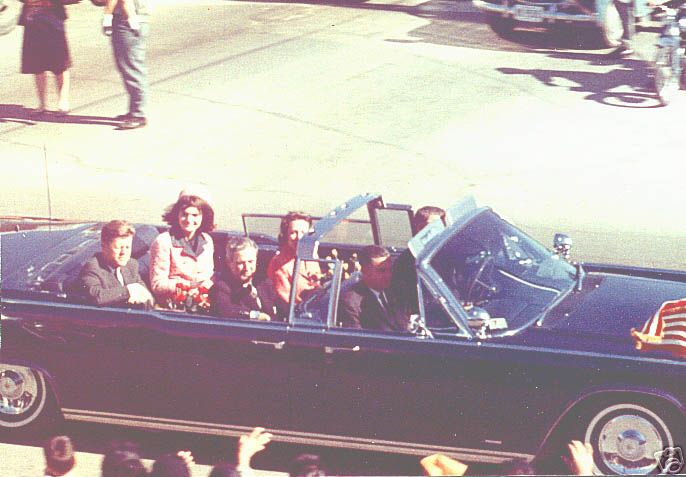
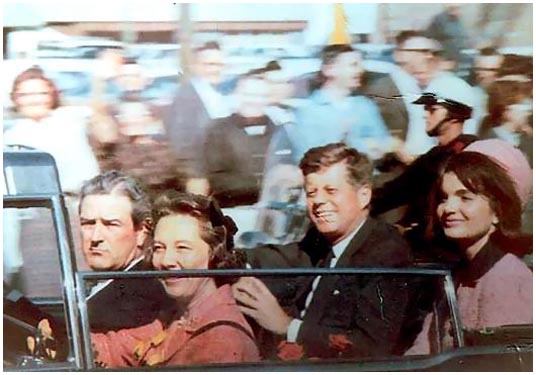
Speaking of assassinations, Nellie Connally, the wife of the then Gov. John B. Connally of Texas has died. She was the last living witness to the murder of President John Kennedy who was actually in the car when it happened. When the attack occurred she cradled her gravely wounded husband in her lap during the high speed drive to the hospital. The Governor survived his wounds. In the photographs above Mrs. Connally can be seen sitting next to her husband in the driver side jump seat of the president’s open limousine as it leaves the airport for and later in the fateful parade through Dallas on Nov 22 1963. Mrs. Kennedy in her famous pink suit and pillbox hat is sitting behind her.

Europe -- Thy Name Is Cowardice

An interesting op-ed from the German DIE WELT (Translated into English):
Europe -- Thy Name Is Cowardice
By Matthias Dopfner
David's Medeinkritik | January 7, 2005

[This article was originally posted in German in DIE WELT.de and was translated from German by Hartmut Lau.]

A few days ago Henryk M. Broder wrote in Welt am Sonntag, "Europe -- your family name is appeasement." It's a phrase you can't get out of your head because it's so terribly true.

Appeasement cost millions of Jews and non-Jews their lives as England and France, allies at the time, negotiated and hesitated too long before they noticed that Hitler had to be fought, not bound to agreements. Appeasement stabilized communism in the Soviet Union and East Germany in that part of Europe where inhuman, suppressive governments were glorified as the ideologically correct alternative to all other possibilities. Appeasement crippled Europe when genocide ran rampant in Kosovo and we Europeans debated and debated until the Americans came in and did our work for us.

Rather than protecting democracy in the Middle East, European appeasement, camouflaged behind the fuzzy word "equidistance," now countenances suicide bombings in Israel by fundamentalist Palestinians. Appeasement generates a mentality that allows Europe to ignore 300,000 victims of Saddam's torture and murder machinery and, motivated by the self-righteousness of the peace-movement, to issue bad grades to George Bush. A particularly grotesque form of appeasement is reacting to the escalating violence by Islamic fundamentalists in Holland and elsewhere by suggesting that we should really have a Muslim holiday in Germany.

Read the rest here.

The latest in liberal protest: Assassinating G. W. Bush

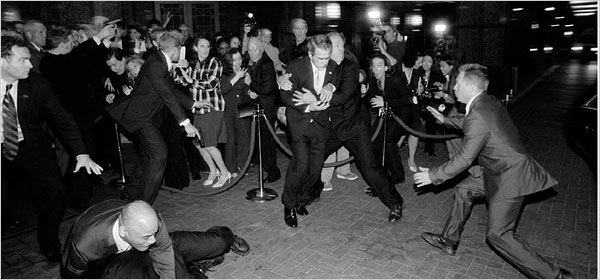
Dateline Chicago Oct 2007: The President of the United States is walking out of a hotel when suddenly there is gunfire and pandemonium. The president falls as security people draw weapons. Of course it’s all captured on live television. Fortunately this is a scene from a movie. Unfortunately the movie is a politically motivated assault on the United States. And just in case anyone misses the point the President who is assassinated is… you probably guessed it… George W. Bush.

Now I have become increasingly disenchanted with this administration’s policies. And I am a staunch defender of the right to freedom of expression. But I am also a strong defender of the right to criticize the irresponsible exercise of that freedom. This is so over the top it is a no brainer. It needs to be roundly condemned by descent people of every political and religious persuasion.

You can read what sounds like a disturbingly sympathetic report on the film by clicking here.

Feast of Saint Simeon the Stylite

Saint Simeon the Stylite was born in the Cappadocian village of Sisan of Christian parents, Sisotian and Martha. At thirteen years of age he began to tend his father's flock of sheep. He devoted himself attentively and with love to this, his first obedience.

Once, after he heard the Beatitudes in church, he was struck by their profundity. Not trusting to his own immature judgment, he turned therefore with his questions to an experienced Elder. The Elder readily explained to the boy the meaning of what he had heard. The seed fell on good soil, and it strengthened his resolve to serve God.

When Simeon was eighteen, he received monastic tonsure and devoted himself to feats of the strictest abstinence and unceasing prayer. His zeal, beyond the strength of the other monastic brethren, so alarmed the igumen that he told Simeon that to either moderate his ascetic deeds or leave the monastery.

St Simeon then withdrew from the monastery and lived in an empty well in the nearby mountains, where he was able to carry out his austere struggles unhindered. After some time, angels appeared in a dream to the igumen, who commanded him to bring back Simeon to the monastery.

The monk, however, did not long remain at the monastery. After a short while he settled into a stony cave, situated not far from the village of Galanissa, and he dwelt there for three years, all the while perfecting himself in monastic feats. Once, he decided to spent the entire forty days of Great Lent without food or drink. With the help of God, the monk endured this strict fast. From that time he abstained from food completely during the entire period of the Great Lent, even from bread and water. For twenty days he prayed while standing, and for twenty days while sitting, so as not to permit the corporeal powers to relax.

A whole crowd of people began to throng to the place of his efforts, wanting to receive healing from sickness and to hear a word of Christian edification. Shunning worldly glory and striving again to find his lost solitude, the monk chose a previously unknown mode of asceticism. He went up a pillar six to eight feet high, and settled upon it in a little cell, devoting himself to intense prayer and fasting.

Reports of St Simeon reached the highest church hierarchy and the imperial court. Patriarch Domninos II (441-448) of Antioch visited the monk, celebrated Divine Liturgy on the pillar and communed the ascetic with the Holy Mysteries.

Elders living in the desert heard about St Simeon, who had chosen a new and strange form of ascetic striving. Wanting to test the new ascetic and determine whether his extreme ascetic feats were pleasing to God, they sent messengers to him, who in the name of these desert fathers were to bid St Simeon to come down from the pillar.

In the case of disobedience they were to forcibly drag him to the ground. But if he was willing to submit, they were to leave him on his pillar. St Simeon displayed complete obedience and deep Christian humility. The monks told him to stay where he was, asking God to be his helper.

St Simeon endured many temptations, and he invariably gained the victory over them. He relied not on his own weak powers, but on the Lord Himself, Who always came to help him. The monk gradually increased the height of the pillar on which he stood. His final pillar was 80 feet in height. Around him a double wall was raised, which hindered the unruly crowd of people from coming too close and disturbing his prayerful concentration.

Women, in general, were not permitted beyond the wall. The saint did not make an exception even for his own mother, who after long and unsuccessful searches finally succeeded in finding her lost son. He would not see her, saying, "If we are worthy, we shall see one another in the life to come." St Martha submitted to this, remaining at the foot of the pillar in silence and prayer, where she finally died. St Simeon asked that her coffin be brought to him. He reverently bid farewell to his dead mother, and a joyful smile appeared on her face.

St Simeon spent 80 years in arduous monastic feats, 47 years of which he stood upon the pillar. God granted him to accomplish in such unusual conditions an indeed apostolic service. Many pagans accepted Baptism, struck by the moral staunchness and bodily strength which the Lord bestowed upon His servant.

The first one to learn of the death of the saint was his close disciple Anthony. Concerned that his teacher had not appeared to the people for three days, he went up on the pillar and found the dead body stooped over at prayer. Patriarch Martyrius of Antioch performed the funeral before a huge throng of clergy and people. They buried him near his pillar. At the place of his ascetic deeds, Anthony established a monastery, upon which rested the special blessing of St Simeon.

We pray to St Simeon for the return to the Church of those who have forsaken Her, or have been separated from Her.
Friday, September 01, 2006

Homily on the Word the Son of God

From The Prologue from Ohrid:

In the beginning was the Word (John 1:1).
The Logos-the rational, intelligent Word-existed in the beginning. This pertains to the Divine Nature of our Lord Jesus Christ. Brethren, by saying, In the beginning, do we think that the Word of God has a beginning? Or that there was a certain date in time when the Son of God was born of God the Father? In no way! For the birth of the Son of God can have neither a date nor a beginning, since time is a condition of this transient world, and it does not affect the eternal God, and therefore does not affect anything at all that is of God. Can the sun remain the sun, if the sunlight is separated from it? Will a man remain a man, if his mind is taken away? Would honey still be honey, if its sweetness is separated from it? It cannot. Even less can one conceive of God as separate from His Logos, from His rational Word, from His Intelligence, from His Wisdom-the eternal Father separate from His co-eternal Son.
No, brethren, the words are not about the beginning of the Son of God from God the Father, but rather about the beginning of the history of the created world and the salvation of mankind. This beginning is in the Word of God, in the Son of God. He began both the creation of the world and the salvation of the world. Whoever would speak of the creation of the visible or invisible worlds, or of the salvation of mankind, must begin with the Beginning. And that Beginning is the Word of God, the Wisdom of God, the Son of God. For example, if someone were telling a story about boating on a lake, he might begin it like this: ``In the beginning there was a lake, and on it sailed a white boat….'' No reasonable person would interpret the words, ``In the beginning there was a lake…'' to mean that the lake came into existence on the same day that the boat sailed on it. Thus, no rational man could take the words of the Evangelist, In the beginning was the Word…, as though the Word of God came forth from God at the same moment that the world was created! Just as the lake existed for thousands of years before the boat sailed on it, so the Word of God existed for a whole eternity before the beginning of creation.
O Son of God, co-eternal with the Father and the Spirit, enlighten us and save us.
To Thee be glory and praise forever. Amen.

The Music of the Russian Orthodox Church


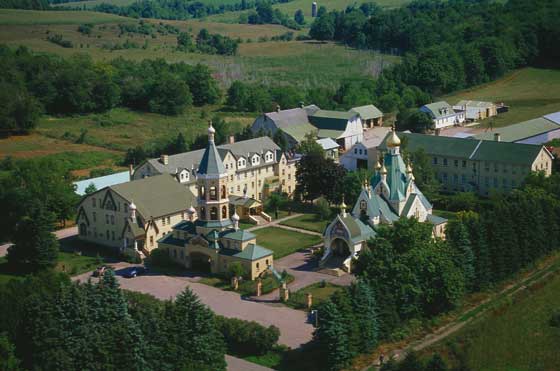
The BBC recently did a news report on the summer school for liturgical music held at Holy Trinity Monastery (Russian Orthodox Church Outside of Russia). You can listen to this wonderful program here.

Hat tip to Fr. John Whiteford.

Thursday, August 31, 2006

Quote of the Day

"Because modern minds are very sick, as minds, and Benedict XVI has a modern mind, like millions and millions of modern people, including churchmen, around him."

-Richard Williamson (schismatic Roman Catholic & bishop vegante) explaining in part why he believes Pope +Benedict XVI is a heretic.

Read the rest here.

Caution & disclaimer: This above link is to a traditionalist Roman Catholic web site that is sympathetic to the schismatic SSPX and is known for controversial and sometimes extremist posts. The reader is advised to approach with care.

Wednesday, August 30, 2006

Ad Orientem

"Praying toward the East is handed down by the holy apostles, as is everything else. This is because the comprehensible sun of righteousness, Christ our God, appeared on earth in those regions of the East where the perceptible sun rises, as the prophet says: 'Orient is his name' (Zech. 6:12); and 'Bow before the Lord, all the earth, who ascended to the heaven of heavens in the East' (Cf. Ps. 67:34); and 'Let us prostrate ourselves in the place where His feet stood' (Cf. Ps. 67:34); and again, 'The feet of the Lord shall stand upon the Mount of Olives in the East' (Zech. 14:4). The prophets also speak thus because of our fervent hope of receiving again the paradise in Eden, as well as the dawn of the brightness of the second coming of Christ our God, from the East."

St. Germanus of Constantinople.

Questions about money? Ask the OCA...

From the web site of the Orthodox Church in America:
SYOSSET, NY [OCA Communications] — On Tuesday, August 22, 2006, His Beatitude, Metropolitan Herman, announced the debut of a new section on the Orthodox Church in America web site [www.oca.org] that will enable interested individuals to submit questions and obtain answers regarding the financial situation of the Church.

"The objective of this new feature will be to initiate and continue a dialogue between the faithful of the Church and the central Church administration," Metropolitan Herman said. "All questions are welcome, and we will attempt to the best of our ability to provide answers in an open and timely manner.
Read the rest here.

Rome Orthodoxy and the big "D": Are we closer than we think?


While I am on the topic of the Roman Catholic Church (RCC), I am thinking that perhaps its time to briefly discuss one of the more common complaints I hear from my former co-religionists. That is the dreaded “D” word. Divorce. Even among the many Catholics who are friendly to Orthodoxy this is a sticking point. They complain about how we permit divorce. This is not a subject I am very comfortable with, but its one worth talking about. Let’s start by briefly stating where the two churches are on this.

The RCC’s position on divorce is pretty clear (as is their official position on most subjects). They don’t allow it. They don’t recognize it. It does not exist as far as they are concerned. They affirm that marriage is a sacramental contract being permanent and therefore is indissoluble. Those who are divorced may still commune provided they do not attempt to remarry. The RCC bars remarried Catholics from the sacraments.

By contrast the Orthodox position on divorce is less rigid or legalistic. In Orthodoxy, Holy Matrimony is not a contract; it is the mysterious or mystical union of a man and woman - in imitation of Christ and the Church - in the presence of "the whole People of God" through her bishop or his presbyter. In Orthodoxy marriage is also considered permanent and divorce is seen at the least as a manifestation of sin and in many cases as a sin in and of itself. (It’s worth noting here that our understanding of sin is different from the Western Church’s, but that’s a topic for another day.) A major point of difference is the approach to the reality of divorce.

Orthodox Christians condemn it but acknowledge that it exists. In some rare cases most Orthodox will even tell you it may be the lesser of evils. Typically these can be reduced to what I once heard described as the three “A”s, abandonment, abuse and adultery (if it’s persistent). I think I might even add another “A” and suggest apostasy on the part of a spouse as a possible justification. I am not talking about an Orthodox Christian who becomes Roman Catholic or Baptist. I am thinking more along the lines of the husband who comes home and says “Honey guess what. I have converted to Islam and next week we are moving to Saudi Arabia where I just know you will love meeting my three new wives.”

While condemning the reality of divorce Orthodoxy is more concerned with the causes of this tragedy and healing the soul wounded by it. Pastorally the divorced Orthodox Christian is treated as someone who has fallen on the road to God and is in need of help as opposed to blanket condemnation. This help typically consists of confession coupled with spiritual counseling which might last a while and possibly a period of being excluded from Holy Communion. This doesn’t mean we condone divorce. We don’t. But it does mean we live in the real world as did the apostles (1 Cor 7:12-16). Jesus himself seems to have affirmed at least the possibility of divorce in cases of adultery and grave immorality (Matt 5:32 & Matt 19: 9). Even the RCC now permits in grave cases civil divorce without being barred from the sacraments. This was not true until fairly recently (of which more in a bit).The crux of the difference between Rome and Orthodoxy is less our attitude towards divorce than towards remarriage.

The Second Marriage:

Many RCs (and way too many Orthodox) are under the impression that in Orthodoxy you have a right to be married three times. That’s a serious error. Presuming compliance with the canons of the Church the Orthodox Christian can claim the right to one marriage blessed in the Church. Second marriages are NOT a right. Indeed the Orthodox Church severely frowns on them. This is true even in cases where the second marriage is the result of the original spouse dying. That’s because in Orthodoxy a valid marriage is not presumed to end with death. However in some cases a second marriage (and in rare cases a third) are tolerated through oikonomia and a condescension to human weakness. This is the decision of the local bishop under the guidance of the particular synod of bishops.

The rules for this will vary somewhat from jurisdiction to jurisdiction and even between bishops in the same jurisdiction. However, generally second marriages are allowed out of pastoral concern for the divorcee/widow who might otherwise have great difficulty in life. Also the concept of annulment is not really known in Orthodoxy. Most Orthodox jurisdictions don’t have juridical courts which weigh the background of a marriage and pronounce it valid or not. In many cases there is a presumption that a failed marriage was spiritually defective from the word go. By contrast the RCC has a peculiar position. It unconditionally forbids second marriages on the part of the divorced but permits with no reservation a fourth or more marriages on the part of the widowed. In Orthodoxy fourth marriages are forbidden.

A legitimate question might be asked about the history of this issue. Without going into the kind of detail that would turn this essay into a short book, it is generally acknowledged that remarriage after divorce was known in the East as early the fifth century. Tolerance for the practice was confirmed at the council of Trulla (692) and various lesser synods. What is not as widely known is that divorce and remarriage also existed in the West. In fairness it must be admitted that it was less common than in the East and had largely been suppressed by the late eighth century. As is often the case, the Fathers can be quoted effectively by both sides though again in fairness some of them were very severe in their criticism of second marriages.

Today:

Until fairly recently the RCC excommunicated anyone who had a divorce. Thus the sacraments were not only withheld from those who remarried but from those who were divorced for any reason. Since the Second Vatican Council this position has evolved into the present policy of excluding only remarried divorcees from communion. But is this a fair description of the RCC’s policy? Or is it closer in practice if not perhaps theory to Orthodoxy than some would like to admit?

Since the late 1960’s the number of so called annulments issued by the RCC world wide but especially here in North America has increased exponentially. There were just 400 granted in the US in 1968 but by 1978, the church handed out 45,000 (an increase of 11,250 percent). By 1983 67,000 annulments were granted in the United States. The number has leveled off since then, but still exceeds 60,000 annually! Theory aside; I would respectfully argue that the Catholic Church does in fact grant divorces. They just call them annulments. That’s not intended as a shot at the RCC but a simple statement of belief backed by statistics. It is well known and has been widely reported in Catholic publications that annulments are easily available to those with money or the right connections. From an historical point of view this has always been true, though it has become far more pronounced in recent decades.

Is this immoral? Strict conservative Catholics have been bent over this for a long time. But I would suggest that in some ways the Roman bishops are being better pastors by acknowledging human sin while striving to reinforce the weak soul. This fairly blatant nod and wink at divorce and remarriage probably keeps people in the Church who might otherwise be lost. Even the most liberal RC bishop is unlikely to give someone more than one marriage annulment. So the “annulled” Catholic knows when he presents himself for marriage number two that he better get it right this time. This is not really that far removed from the practice in Orthodoxy, even if there are a lot of legalistic hoops to jump through.

All this is not to say that we Orthodox do not have our own problems. I mentioned that there is a widespread belief that any Orthodox has a right to be married up to three times in the Church. In far too many cases clergy do little to disabuse the faithful of that false belief. In some places second marriages are indeed permitted too liberally in my opinion. The jurisdictional soup that we deal with outside of traditionally Orthodox countries also makes things harder. If your Greek bishop will not allow you to remarry or wants you to wait a year before doing so why just slide on over to the Antiochians or the OCA (example only not to be taken literally) and one of them might marry you with less hassle. One blessing is that from what I have been able to glean from various sources it seems that some Orthodox bishops are becoming increasingly reluctant to allow third marriages in all but the most unusual cases. Some even prohibit them altogether unless both previous marriages ended with the death of the spouse.

In closing it should be emphasized that even when second marriages are permitted they are not occasions of joy for Orthodox Christians. They are in fact quite penitential in their form. This applies even to widows. There are no crowns and the entire service is subdued with a heavy emphasis on our human failings and imploring the mercy of God, without which we can not hope to be saved.

Tuesday, August 29, 2006

Whatever happened to the Inquisition?


OK. I, no longer being a member, am a bit reluctant to criticize the Roman Catholic Church. And I have to admit that since my conversion my interest in what’s going on in the Latin Church has been steadily waning. It’s not that I have no sympathy for the people suffering though all of the silliness that now reigns in the American Catholic Church. Rather I have just reached a point where it does not affect me and I am not loosing sleep over it. But this is just over the top! I mean really. If I had read this bulletin without knowing the source I would have wagered my next paycheck it was from an Episcopal Church in San Francisco. A quick quote from this week’s bulletin of St. Joan of Arc (SJA) parish in Minnesota…
Call to Action Minnesota: Womenpriests Celebrate the Eucharist. On Saturday, September 23, 4-8 pm. Call to Action invites you to a Eucharistic Celebration with Regina Nicolosi presiding. Rev. Nicolosi was ordained as a womanpriest this summer. Following the Eucharist is a presentation by SJA parishioner Dr. Dorothy Irvin on "Ancient and Contemporary Models of Womenpriests and Deacons". Supper is included. FFI contact Judy McGuire at 612.927.6825.
Hello! Is anyone home? Is this not the same group of heretics recently excommunicated by the Roman Church for playing dress up as priests? Some quick investigating has revealed that apparently SJA has a reputation even in the very liberal diocese that it’s in for being so far out in left field that if the Earth were flat they would be in serious danger of falling off the leftward edge. Most of the rest of the bulletin is wacky liberal socio-political stuff. But if you have a strong stomach you can try reading the parish priest's comments column. I refuse to quote it on this blog

For the record the bishop of this diocese also recently created quite a stir when he silenced a well known and highly regarded priest whose orthodoxy (lower case "o") is unimpeachable. The priest was reasigned as the full time chaplain to a nursing home! This in a diocese that has many parishes with no priest.

Sancte Joannes Baptista ora pro nobis...

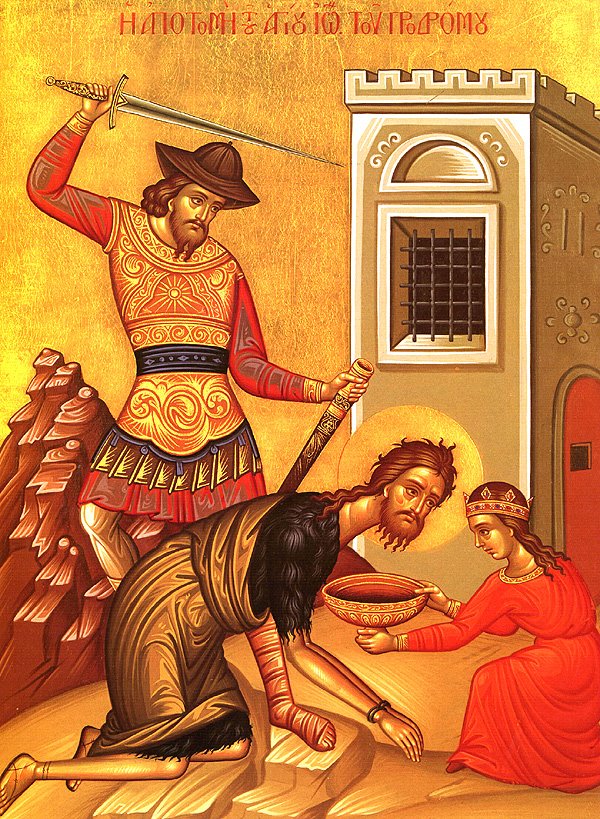
The Beheading of John the Baptist


Today is the commemoration of the martyrdom of the holy St. John the Baptist. It is a fasting day and one with a number of customs peculiar to Orthodox Christians. Food is not served on any form of platter or plate and the use of knives is discouraged. You can read more about this here.

Saturday, August 26, 2006

More Photos of the Fire


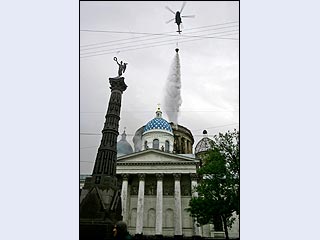
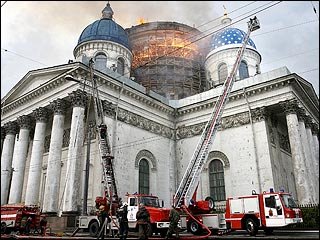
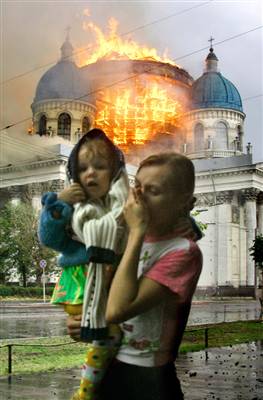
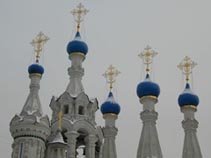
Trinity Cathedral in St. Petersburg (Russia) is badly damaged by fire


From the AP:

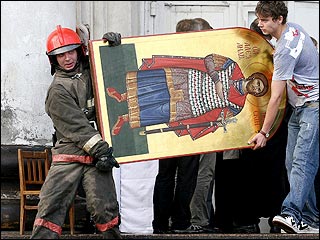
ST. PETERSBURG, Russia - A fire raged through a 19th century cathedral in this former imperial capital Friday, collapsing the main rooftop dome and sending clerics scurrying to save treasured icons.

The fire erupted in the early evening and burned through scaffolding outside the soaring blue central dome of Trinity Cathedral, a duty officer at the Russian Emergency Situations Ministry said.

The central dome collapsed and one of four smaller cupolas surrounding it — painted a striking light blue and in some cases spangled with gold stars — was also destroyed, St. Petersburg emergency department spokeswoman Lyudmila Rubasova said. There were no reports of injuries, she said.

Firefighters battled to save the other three cupolas as emergency workers and church employees removed icons and other religious articles. A helicopter brought in to fight the blaze dumped water on the historic structure.

About four hours after the blaze broke out, Rubasova said one of the three remaining cupolas had been damaged but that the fire was contained. A department spokesman later said the fire had been extinguished.

The cause of the fire was not immediately known, but acting St. Petersburg emergency department chief Leonid Belyayev said the blaze apparently started on scaffolding on the outside of the church, which was undergoing restoration.

He said the most valuable icons and other items had been saved, and that structural damage beneath the roof area was minor.

The cathedral was consecrated in 1835. State-run Rossiya television said the main dome was the second-largest wooden cupola in Europe, and Channel One said that writer Fyodor Dostoyevsky was married there.

It was used as a storehouse during the Soviet era and was returned to the Russian Orthodox Church in 1990.

Thursday, August 24, 2006

Islamic Persecution of Christian Converts in Malaysia

KUALA LUMPUR, Malaysia, Aug. 19 — From the scant personal details that can be pieced together about Lina Joy, she converted from Islam to Christianity eight years ago and since then has endured extraordinary hurdles in her desire to marry the man in her life.

Her name is a household word in this majority Muslim country. But she is now in hiding after death threats from Islamic extremists, who accuse her of being an apostate.

Read the rest here.

Wednesday, August 23, 2006

Russian Church Supports Conservative Episcopalians

The Russian news service Interfax has an article reporting that the Russian Orthodox Church has sent a letter expressing strong support for the conservative bishops of the Episcopal Church (TEC) in their stand against the newly elected presiding bishop Catherine Jefferts-Shori. She is widely seen as an ultra liberal and a theological revisionist. My own reading of some of her statements and some of the public prayers she has uttered suggest that she is not far removed from Unitarianism. The letter expresses a willingness to restore contacts with those Episcopalians who “remain faithful to the gospel’s moral teachings.” The Russian Church severed all ties (purely of an ecumenical nature since the Orthodox do not hold communion with non-Orthodox) in 2003 following the consecration of V. Gene Robinson as bishop of New Hampshire. Robinson is a divorced man openly living in a homosexual relationship. Just what all this portends is something we will have to wait and see. But it might prove interesting to watch. Perhaps there might be some effort to bring some of these disaffected conservatives back into Orthodoxy. The Antiochian Archdiocese has an active Western Rite Vicarate. Let us pray!

Big hat tip to Fr. Huneycutt over at Orthodixie.

Monday, August 21, 2006

Yet another Quote...

This is turning into a good day for quotables....
“They’re the meanest things in creation,” he said delightedly. “I was so excited to get it. It’s the worst pet on earth.”
-Dr. William Leo Smith (ichthyologist) disucussing his stargazer, a highly venomous fish that also produces an electric shock.

Read the story here.

Quote of the Day (runner up)

The Episcopalian Community is not a Church. They have no Apostolic Succession or Eucharist. However, some of their ministers are excellent golfers. That can not be denied.
Freeper Bornacatholic

Quote of the Day

You only know God to the extent you love your enemies.
Fr. Stephen Freeman (OCA) over at Pontifications

Experts hope to get derailed Catholic-Orthodox dialogue back on track

VATICAN CITY (CNS) -- Theological dialogue between the Catholic and Orthodox churches has been derailed for six years. In mid-September, 60 ecumenical experts will try to get it back on track.

The Catholic-Orthodox international dialogue commission is meeting in the Serbian capital of Belgrade Sept. 18-25, in what Pope Benedict XVI has optimistically described as a "new phase in dialogue."

That the encounter is taking place at all has been described as a big step forward by Vatican officials. Representatives from 10 Orthodox churches, including the Russian Orthodox Church, will attend.

But church officials also recognize that it wouldn't take much to send the whole enterprise off the rails again.

For one thing, the two main topics of the meeting are papal primacy and the role of Eastern Catholic churches -- two of the sorest points in Catholic-Orthodox relations.

Read the rest here